
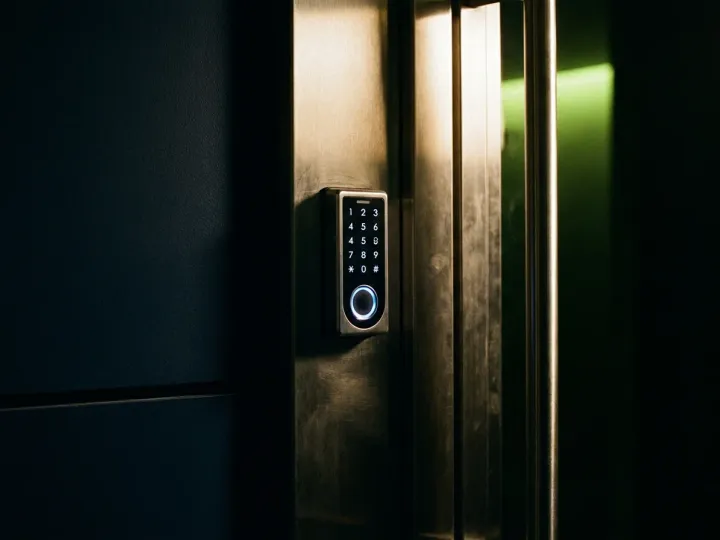
- Texas License #B19847
- Family Owned Since 2010
- Texas Markets 36
- Response · Central TX approx 14 min
- Dispatch 24 / 7
- Google Rating 4.9 / 5
WHAT WE INSTALL
Fingerprint Readers
Optical, capacitive, and ultrasonic sensors. False Accept Rate below 0.001%. Sub-1-second authentication. Capacitive sensors work with wet or calloused hands.
Iris Recognition
Highest accuracy of any biometric modality. Near-infrared capture. Works with glasses and contacts. Iris patterns stable for life, unaffected by aging or injury.
Facial Recognition
3D structured-light mapping with liveness detection. Contactless entry. Recognizes faces with masks. 1-2 second authentication without breaking stride.
Palm-Vein Readers
Near-infrared subcutaneous vein mapping. Contactless, hygienic. Works when hands are dirty, wet, or gloved. Anti-spoofing is inherent: only living tissue registers.
HOW A BIOMETRIC INSTALLATION WORKS
-
Site Assessment
We review your floor plan, door hardware, network topology, and compliance requirements. High-security and regulated facilities receive a written threat-model summary.
-
System Design
We specify the biometric modality, reader model, access control platform, and locking hardware matched to your environment and budget.
-
Installation and Integration
Readers mounted, panels wired, power supplies sized, and management software configured. Integration with your existing card system or HR database as needed.
-
Enrollment
Each authorized user enrolled in 30 to 60 seconds. Bulk enrollment for large organizations runs over one to three days with dedicated enrollment stations.
-
Testing and Documentation
Every reader tested at acceptance criteria. You receive audit log configuration records and compliance documentation ready for your next security audit.
HIPAA - PCI DSS - SOC 2
Built for Facilities Where Access Failures Have Real Consequences
Cards can be handed off. PINs can be observed. A fingerprint or iris scan confirms that the person requesting access is physically present and matches the enrolled record. For Texas facilities operating under regulatory frameworks, that distinction is the difference between a passing audit and a reportable breach.
We work with data center operators in Austin's tech corridor, hospital systems running controlled-substance rooms from El Paso to Beaumont, cannabis dispensaries navigating DPS and DSHS access requirements, and financial institutions protecting trading floors and cash-counting areas. The biometric modality changes. The requirement for a verifiable, time-stamped identity record at each access event does not.
- HIPAA physical safeguard requirements for electronic PHI and controlled substances
- PCI DSS Requirement 9 - cardholder data environment access control
- SOC 2 Type II physical access control evidence for auditors
- Texas DPS and DSHS dispensary physical access documentation
COMPARE BIOMETRIC MODALITIES
| Feature | Fingerprint | Iris Scan | Facial Recognition | Palm-Vein |
|---|---|---|---|---|
| Installed cost per reader | $400-$1,800 | $2,000-$5,000 | $1,200-$3,500 | $1,200-$3,000 |
| False Accept Rate | < 0.001% | < 0.0001% | < 0.001% | < 0.0001% |
| Authentication speed | Under 1 sec | 1-3 sec | 1-2 sec | 1-3 sec |
| Touchless (hygienic) | No | Yes | Yes | Yes |
| Best application | General commercial | Classified / pharma | High-volume entry | Industrial / clinical |
Customers, on the work
Texas reviews.
Five-star work, in the customers' own words. No edits, no filters.
-
I had “Pros On Call” change the locks on my home that I recently purchased. It was easy to get a hold of them, they made an appointment quickly and did a great job for a fair price. I had them come out about two weeks later and put a deadbolt lock on my front door as well and again - easy to get a hold of, they had to order an aged bronze deadbolt lock 🔐 but once it arrived they came out quickly, did a great job, were neat and it was a fair price. I highly recommend “Pros On Call” for all of your Locksmith needs! 5 Stars ⭐️ ⭐️ ⭐️ ⭐️ ⭐️ for sure!!
Read more on Google -
This guy come and help me at the last moment and be very professional and fair price
Read more on Google -
Josh was amazing! I called him when I was locked out of my car, and he arrived within 20 minutes. He was professional, fast, and had my car unlocked in no time. The whole process was stress free, and his pricing was fair. I really appreciate how quickly he came to help. Highly recommend Josh if you ever need a reliable locksmith!
Read more on Google -
Josh was awesome, he came to the rescue and I didn’t have to wait longer than 30 minutes in total. He also was incredibly kind and understanding of my situation. Dropped off my kids, and somehow my key fab went missing! Also gave me a discount!!
Read more on Google -
It sucks they charge an inconvenience fee of 49.00. Which I wish you would have mentioned this on our intial call. Transparency would have been to say hey we charge an inconvenience fee. Never once was this mentioned. When we spoke with the representative all she said was the locksmith will call you with a price. Never once did she say we take your payment info so we can charge you an inconvenience fee. If that was mentioned then this would have been handled differently. She made it seem like we need a card on file to help. Then they attempted to debit my card twice for two separate transactions for 49.00. I understand you run a business. But transparency is key. I specifically asked her what I would be charged for never once did she mention this. Lesson learned. Update***she reached out in regards to my Google review. Although I attempted to resolve per phone call. Shameless.
Read more on Google -
Great service Ermi took less than 2 minutes. Thank you so much!
Read more on Google -
Excellent service and high quality items! Roland was able to get me this key fob AND program it for a great price. Rechargeable fob is a lot more convenient than having to replace the battery every time it dies. Thank you !
Read more on Google -
I have been a customer of pros on call for like over 2 years about and have had to call on them about 6 times. I had used several other locksmith in the prior 15 years but once Roland , one of many these pros came over I never use sny other locksmith service. I am very happy with this company I usually asks for Roland because I know him best and I have developed a kinda professional friendship with him but you can't lose no matter who it is that helps you. All top notch pros. I have called days and night. I am elderley snd lost my keys and I had some stolen. I would tell anyone that ask to call this company. You won't find any better. Here are a few keys Roland msde for me. I have 3 cars an a home. I have to locate my home keys do I didn't have the opputunity to take a picture of them but these here are greal examples.
Read more on Google -
Super great experience! Roland was very fast at getting to where I was. Overall he did an amazing job! Plus super affordable prices, you can't beat that! 10/10
Read more on Google -
Locksmith Roland provided exceptional service at a affordable price point, and I highly recommend both the individual and the company. 💯
Read more on Google -
I had Zach come out to the property that I purchased out in Luling, Texas. It’s about 10 acres, and it has a garage with a corroded lock. Out of all the companies I have called, which is roughly 5 to 6. He was able to take my call, head out the next day, and take care of the corroded lock I need fixed on my property. He was extremely professional and helped me by giving me instructions on how to operate the lock as well! I’m in the military and not able to be in the area, so he was very understanding and professional. Highly recommend!
Read more on Google -
Josh was amazing!!! Got us back up and running with two new key fobs in less than 30 mins. He definitely knows his business and has the experience. Got a great deal and I will definitely be calling him the next time we are in need of assistance again. Thank you, Josh!
Read more on Google -
Josh was a really good technician fast and prompt.... If this ever happens again (hopefully it doesn't )I'll be calling him.
Read more on Google -
Zach got to me asap and even called to make sure we were communicating the right location of my truck! Within 10 minutes it was open and running! He’s the man! Thank you so much for the quick turnaround!
Read more on Google -
Their response time was great. Orlando did a great job. No replacement parts were needed and repairs took an hour. I was badly disappointed at the high bill, even with a military discount. Maybe that is why I couldn’t get an approximate estimate before Orlando came. Bottom line : good work, too expensive
Read more on Google -
Very helpful and super friendly. They were able to unlock my door in minutes at an affordable price! Even offered spare key services!
Read more on Google -
Miguel was very professional and efficient in his work he was very easy to work with and quick in doing his job
Read more on Google -
The locksmith was quick and very efficient, got me back on the road on no time!
Read more on Google -
He was very fast, was able to make me a key and a spare when I was stranded
Read more on Google
Transparent Pricing
Prices below are estimates. Final cost is confirmed on-site after inspection.
- Biometric Access System From $1,000
Install fingerprint or facial recognition access control.
Estimate
Cancellation: $49 fee if a technician is dispatched and arrives on-site. Out-of-area: $50 surcharge for job sites 30+ miles from our shop. Sales tax: 8.25% applies to most services (excludes vehicle lockouts).
Prices effective 2026. Final pricing confirmed on-site after inspection.
BIOMETRIC ACCESS CONTROL FAQ
How accurate are fingerprint readers compared to iris scanners?
Modern fingerprint readers achieve a False Accept Rate below 0.001%, meaning fewer than one unauthorized access per 100,000 attempts. Iris scanners push that further to 0.0001% or lower, making them the highest-accuracy biometric modality currently available at commercial price points. Facial recognition with 3D depth mapping lands between the two at roughly 0.001% FAR. For most Texas data centers and healthcare environments, fingerprint or 3D facial recognition meets the accuracy threshold. Government-classified and pharmaceutical facilities typically specify iris or palm-vein for the additional decimal place of assurance.
Do biometric systems store my actual fingerprint image?
No. Systems create an encrypted mathematical template derived from your biometric - the image itself is never retained. The template is a one-way conversion that cannot be reverse-engineered to recreate the original fingerprint or face. AES-256 encryption protects templates at rest and in transit. Many high-security installations use match-on-card architecture, where the template lives on the employee's smart card rather than a centralized server, eliminating the database breach risk entirely.
Can biometric readers be defeated with a photo or silicone cast?
Current commercial-grade systems include liveness detection that rejects spoofing attempts. Fingerprint readers verify blood flow, skin conductivity, and sub-surface tissue response. 3D facial recognition uses structured light or time-of-flight depth mapping that a flat photo cannot replicate. Iris scanners detect involuntary pupil response and eye movement. That said, not every reader at every price point includes liveness detection: specifying the correct hardware for your threat model is part of our design process.
What happens to biometric access during a power outage?
Access control panels maintain local credential storage and continue operating on battery backup, typically 8 to 24 hours. The biometric reader itself requires low-voltage DC power, so a UPS on the access control circuit keeps the system running through most outages. For fail-safe door hardware (maglocks that release on power loss), we design battery-backed power supplies to maintain the secure state. Fail-secure strikes, which lock on power loss, are specified for vaults and server cages where security outweighs emergency egress considerations.
How long does biometric enrollment take for a large workforce?
Fingerprint enrollment takes 30 to 60 seconds per person. Facial recognition runs 10 to 30 seconds. Iris scanning requires 20 to 40 seconds for both eyes. For organizations with 100 or more employees, we schedule dedicated enrollment stations over one to three days and can integrate with your HR system to pre-populate user records. For organizations with 500 or more employees, mobile enrollment kits let us enroll in conference rooms or on the floor rather than routing everyone through a fixed station.
Does biometric access control meet HIPAA and PCI DSS requirements?
Biometric access control supports HIPAA physical safeguard requirements for protecting areas containing electronic protected health information and controlled medications. PCI DSS Requirement 9 mandates restricting physical access to cardholder data environments: biometric authentication with complete audit logs meets the intent of that requirement. Our installations include written documentation of the access control architecture, log retention configuration, and user consent procedures that auditors and compliance officers expect to see.
Can biometric systems integrate with our existing card access infrastructure?
Yes. Multi-modal readers accept both a proximity or smart card and a biometric, enabling card-plus-biometric two-factor authentication at doors where a card alone is insufficient. We can upgrade specific high-security doors to biometric while maintaining card-only access for general areas, preserving your existing management software and credential database. Most major platforms including Genetec, Lenel OnGuard, and Software House C-CURE support biometric reader integration through Wiegand or OSDP protocol.
Are there Texas-specific legal requirements for collecting biometric data?
Texas follows BIPA-adjacent principles through its biometric privacy statute. Organizations must inform individuals before collecting biometric identifiers, state the purpose and duration of collection, and obtain written consent. We provide compliant enrollment procedures including consent forms, data retention policies, and right-to-deletion protocols. Healthcare organizations additionally fall under HIPAA biometric data provisions. We configure systems and provide documentation so your legal and compliance teams have what they need for both state and federal requirements.
ACCESS CONTROL PLATFORMS
Access control platforms we install + service

Bosch Security
We install + service Bosch Security
Additional platforms we service:
- HID Global access control systems
- Avigilon Alta cloud access control
- Lenel OnGuard enterprise access
- Alarm.com smart access
Pros On Call installs and services access control systems from the leading platforms in commercial security. Contact us to discuss compatibility with your building's existing infrastructure.
Request an access control quote
Card readers, keypads, biometrics, cloud-managed and multi-site systems. We scope it and follow up with a quote.
(888) 601-6005Schedule a Biometric Security Assessment
Texas-licensed integrators, License #B19847. We design and install for data centers, healthcare, dispensaries, and regulated commercial facilities across 36 Texas markets.
Call Now: (888) 601-6005Licensed & Insured · License #B19847 · Average 30-min arrival