
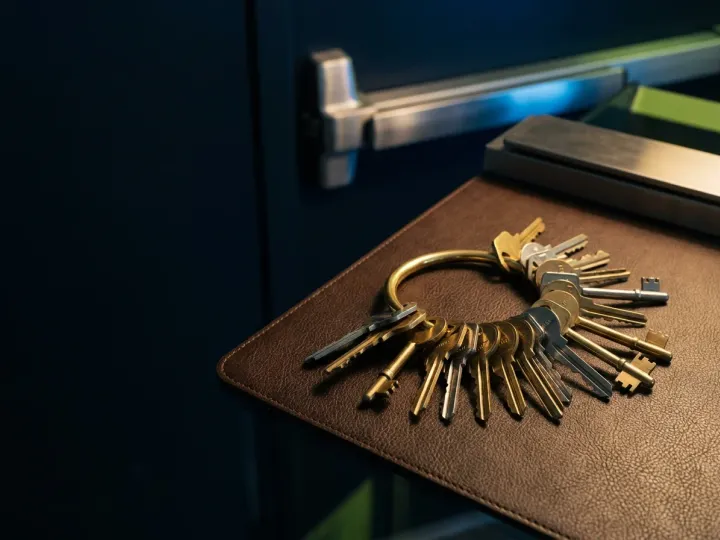
- Texas License #B19847
- Family Owned Since 2010
- Texas Markets 36
- Response · Central TX approx 14 min
- Dispatch 24 / 7
- Google Rating 4.9 / 5
EXIT DEVICE SERVICES WE HANDLE
-
New Installation
Rim, mortise, and vertical rod devices on new construction or tenant improvement projects. Permitted and inspected.
-
Retrofit and Upgrade
Replacing non-compliant or worn exit devices on existing doors. We assess door construction before ordering hardware.
-
Fire-Rated Assemblies
UL-listed panic hardware for 20-minute, 90-minute, and 3-hour fire door assemblies. Certification documentation included.
-
Repair and Maintenance
Broken latches, bent touchbars, misaligned strikes, worn springs. Annual force testing to maintain ADA compliance.
HOW COMMERCIAL PANIC HARDWARE INSTALLATION WORKS
-
Call or Request a Site Assessment
Describe the occupancy type, door count, and any known fire ratings. We confirm whether a permit is required before scheduling.
-
Code Compliance Assessment
On site, we verify IBC occupancy classification, door fire rating labels, ADA path of travel, and existing hardware conditions.
-
Hardware Selection and Quote
We specify the correct device type (rim, mortise, or vertical rod), fire rating, finish, and any dogging or alarm features. Written quote provided before work begins.
-
Installation to Manufacturer Specifications
Device mounted per manufacturer template and UL listing requirements. Strike plate set and reinforced. Force adjusted to ADA limits.
-
Inspection and Documentation
We test operating force, latch engagement, and alarm function. Supply UL listing certificate and permit closeout documentation for your building file.
THE CODE REQUIREMENTS YOUR INSURER CARES ABOUT
IBC, NFPA 101, and ADA Requirements for Texas Exit Devices
IBC Section 1010.1.10 requires panic hardware on exit doors serving assembly occupancies with 50 or more occupants - theaters, churches, restaurants with banquet capacity, event venues - and on doors serving high-hazard (H) occupancies regardless of load. Texas adopted the IBC with minor local amendments; the occupancy thresholds are the same. Stairwell doors on fire egress paths in multi-story Austin office buildings typically require panic hardware at every level.
NFPA 101 Life Safety Code Chapter 7 adds a complementary requirement: egress doors in assembly, educational, and healthcare occupancies must have hardware that releases with a single motion and no more than 15 pounds of force. ADA Section 404.2.9 and Texas Accessibility Standards (TAS) 404 set 5 pounds maximum on interior accessible routes. The panic bar touchpad satisfies the one-hand, no-twist rule. The force specification is what separates a compliant installation from a failed inspection.
- IBC Section 1010.1.10 occupancy threshold verified on every job
- NFPA 101 Chapter 7 single-motion egress requirement met
- ADA 5-lb force limit and TAS 404 compliance on accessible routes
- UL listing certificate provided for every fire-rated assembly
50+
Occupant threshold triggering IBC panic hardware requirement
5 lbs
ADA maximum operating force on accessible interior exit routes
Since 2010
Texas-licensed commercial locksmith
Texas DPS License #B19847 · Bonded · Insured
PANIC DEVICE TYPES: COMPARE YOUR OPTIONS
| Device Type | Application | Code Trigger | Typical Hardware Cost | Retrofit Feasibility |
|---|---|---|---|---|
| Rim Exit Device | Metal doors, single-door exits, back-of-house | IBC 1010.1.10, assembly 50+, high-hazard | $300 to $800 | High - no door mortising required |
| Mortise Exit Device | New construction, wood doors, double doors | IBC 1010.1.10, NFPA 101 Ch. 7 | $500 to $1,200 | Medium - requires 1-3/4 in. door and mortise pocket |
| Concealed Vertical Rod (CVR) | Glass doors, narrow stile aluminum, storefront | IBC 1010.1.10, ADA 404.2.9 | $600 to $1,500 | Medium - rods run inside door, no surface hardware |
| Surface Vertical Rod (SVR) | Narrow stile aluminum, double glass doors | IBC 1010.1.10, NFPA 101 Ch. 7 | $500 to $1,200 | High - mounts on door surface, visible rods |
| Fire-Rated Exit Device | Fire-rated stairwell doors, corridor doors | Texas Fire Code, IBC Table 716.1 | +$100 to $400 over base device | Medium - door must carry matching UL fire rating |
| Alarmed Delayed-Egress | Retail loss prevention, hospital elopement | IBC 1010.1.10.2, fire alarm integration required | $1,000 to $2,500 | Low - requires fire alarm tie-in and occupancy approval |
Customers, on the work
Texas reviews.
Five-star work, in the customers' own words. No edits, no filters.
-
I had “Pros On Call” change the locks on my home that I recently purchased. It was easy to get a hold of them, they made an appointment quickly and did a great job for a fair price. I had them come out about two weeks later and put a deadbolt lock on my front door as well and again - easy to get a hold of, they had to order an aged bronze deadbolt lock 🔐 but once it arrived they came out quickly, did a great job, were neat and it was a fair price. I highly recommend “Pros On Call” for all of your Locksmith needs! 5 Stars ⭐️ ⭐️ ⭐️ ⭐️ ⭐️ for sure!!
Read more on Google -
This guy come and help me at the last moment and be very professional and fair price
Read more on Google -
Josh was amazing! I called him when I was locked out of my car, and he arrived within 20 minutes. He was professional, fast, and had my car unlocked in no time. The whole process was stress free, and his pricing was fair. I really appreciate how quickly he came to help. Highly recommend Josh if you ever need a reliable locksmith!
Read more on Google -
Josh was awesome, he came to the rescue and I didn’t have to wait longer than 30 minutes in total. He also was incredibly kind and understanding of my situation. Dropped off my kids, and somehow my key fab went missing! Also gave me a discount!!
Read more on Google -
It sucks they charge an inconvenience fee of 49.00. Which I wish you would have mentioned this on our intial call. Transparency would have been to say hey we charge an inconvenience fee. Never once was this mentioned. When we spoke with the representative all she said was the locksmith will call you with a price. Never once did she say we take your payment info so we can charge you an inconvenience fee. If that was mentioned then this would have been handled differently. She made it seem like we need a card on file to help. Then they attempted to debit my card twice for two separate transactions for 49.00. I understand you run a business. But transparency is key. I specifically asked her what I would be charged for never once did she mention this. Lesson learned. Update***she reached out in regards to my Google review. Although I attempted to resolve per phone call. Shameless.
Read more on Google -
Great service Ermi took less than 2 minutes. Thank you so much!
Read more on Google -
Excellent service and high quality items! Roland was able to get me this key fob AND program it for a great price. Rechargeable fob is a lot more convenient than having to replace the battery every time it dies. Thank you !
Read more on Google -
I have been a customer of pros on call for like over 2 years about and have had to call on them about 6 times. I had used several other locksmith in the prior 15 years but once Roland , one of many these pros came over I never use sny other locksmith service. I am very happy with this company I usually asks for Roland because I know him best and I have developed a kinda professional friendship with him but you can't lose no matter who it is that helps you. All top notch pros. I have called days and night. I am elderley snd lost my keys and I had some stolen. I would tell anyone that ask to call this company. You won't find any better. Here are a few keys Roland msde for me. I have 3 cars an a home. I have to locate my home keys do I didn't have the opputunity to take a picture of them but these here are greal examples.
Read more on Google -
Super great experience! Roland was very fast at getting to where I was. Overall he did an amazing job! Plus super affordable prices, you can't beat that! 10/10
Read more on Google -
Locksmith Roland provided exceptional service at a affordable price point, and I highly recommend both the individual and the company. 💯
Read more on Google -
I had Zach come out to the property that I purchased out in Luling, Texas. It’s about 10 acres, and it has a garage with a corroded lock. Out of all the companies I have called, which is roughly 5 to 6. He was able to take my call, head out the next day, and take care of the corroded lock I need fixed on my property. He was extremely professional and helped me by giving me instructions on how to operate the lock as well! I’m in the military and not able to be in the area, so he was very understanding and professional. Highly recommend!
Read more on Google -
Josh was amazing!!! Got us back up and running with two new key fobs in less than 30 mins. He definitely knows his business and has the experience. Got a great deal and I will definitely be calling him the next time we are in need of assistance again. Thank you, Josh!
Read more on Google -
Josh was a really good technician fast and prompt.... If this ever happens again (hopefully it doesn't )I'll be calling him.
Read more on Google -
Zach got to me asap and even called to make sure we were communicating the right location of my truck! Within 10 minutes it was open and running! He’s the man! Thank you so much for the quick turnaround!
Read more on Google -
Their response time was great. Orlando did a great job. No replacement parts were needed and repairs took an hour. I was badly disappointed at the high bill, even with a military discount. Maybe that is why I couldn’t get an approximate estimate before Orlando came. Bottom line : good work, too expensive
Read more on Google -
Very helpful and super friendly. They were able to unlock my door in minutes at an affordable price! Even offered spare key services!
Read more on Google -
Miguel was very professional and efficient in his work he was very easy to work with and quick in doing his job
Read more on Google -
The locksmith was quick and very efficient, got me back on the road on no time!
Read more on Google -
He was very fast, was able to make me a key and a spare when I was stranded
Read more on Google
Pricing for this service is custom-quoted
Specialty work like this depends on parts, building type, and scope. Call for a precise price or send the details and we will quote within the hour.
Licensed #B19847. Free phone quotes.
PANIC HARDWARE QUESTIONS
When does Texas law require panic hardware on commercial exit doors?
IBC Section 1010.1.10, adopted in Texas, requires panic hardware on exit doors serving assembly occupancies with 50 or more occupants, high-hazard occupancies (H), and educational occupancies with 50 or more. The Texas Fire Code (adopted IFC) mirrors this threshold. NFPA 101 Chapter 7 uses similar occupancy and load criteria. If your space hosts public gatherings, classroom instruction, or hazardous materials, budget for panic devices on all egress doors.
What is the difference between a rim exit device and a mortise exit device?
A rim device mounts on the door surface - the latch mechanism sits on the face of the door and retracts from a surface-mounted strike. Installation is faster and suits retrofit applications. A mortise device recesses a lock body into a pocket cut in the door edge, the same pocket used by standard mortise locks. Mortise devices are cleaner looking, stronger, and standard on new construction with 1-3/4 inch or thicker doors. Labor cost is higher because of the mortise preparation.
Do fire-rated doors require special panic hardware?
Yes. Any exit device installed on a UL fire-rated door assembly must itself be UL-listed for the door's fire rating (20-minute, 90-minute, or 3-hour). Non-rated hardware on a fire door voids the door's rating, fails fire marshal inspection, and creates liability. We verify the door label before ordering hardware and supply the UL installation certificate your building file requires.
What ADA requirements apply to panic hardware in Texas?
ADAAG 404.2.9 and Texas Accessibility Standards (TAS) 404 require that hardware on accessible routes operate with one hand and no tight grasping, pinching, or twisting. Maximum operating force is 5 pounds for interior doors, 15 pounds for exterior doors (IBC 1010.1.3). The panic bar itself satisfies the one-hand, no-twist requirement. Force adjustment is part of every installation we complete.
Can panic hardware be dogged (held open) during business hours?
Hex-key dogging allows the latch to retract and remain retracted so the door swings freely - useful during deliveries or high-traffic hours. Texas Fire Code prohibits dogging on fire-rated exit doors. On non-rated doors, dogging is permissible when the building is occupied and an employee monitors the exit. Electronic dogging integrated with the fire alarm is available for fire-rated assemblies: the device releases and latches automatically when the fire alarm activates.
How much does commercial panic hardware installation cost?
Rim exit devices typically run $300 to $800 for hardware plus $150 to $300 labor. Mortise devices run $500 to $1,200 hardware plus $200 to $400 labor. Concealed vertical rod devices are $600 to $1,500 hardware plus $250 to $500 labor. Fire-rated units add $100 to $400 to the hardware cost. Alarmed delayed-egress devices (15-second delay, audible alarm) run $1,000 to $2,500 plus installation. Exact quotes require on-site assessment of door construction, fire rating, and code requirements.
Do you pull permits and coordinate with the fire marshal?
Yes. Commercial panic hardware on fire-rated assemblies typically requires a permit and fire marshal inspection in Austin and surrounding jurisdictions. We handle the permit application, coordinate the inspection, and provide the UL listing documentation your building file requires. Our Texas DPS license number appears on all permit applications.
Can you retrofit panic hardware on existing glass storefront doors?
Narrow stile aluminum frames require surface vertical rod (SVR) or concealed vertical rod (CVR) devices designed for that profile. Standard rim devices will not fit. We assess the stile width, frame construction, and existing hardware before ordering. Von Duprin, Corbin Russwin, and Falcon all manufacture narrow-stile compatible exit devices. Retrofit on a glass door typically takes two to four hours per door.
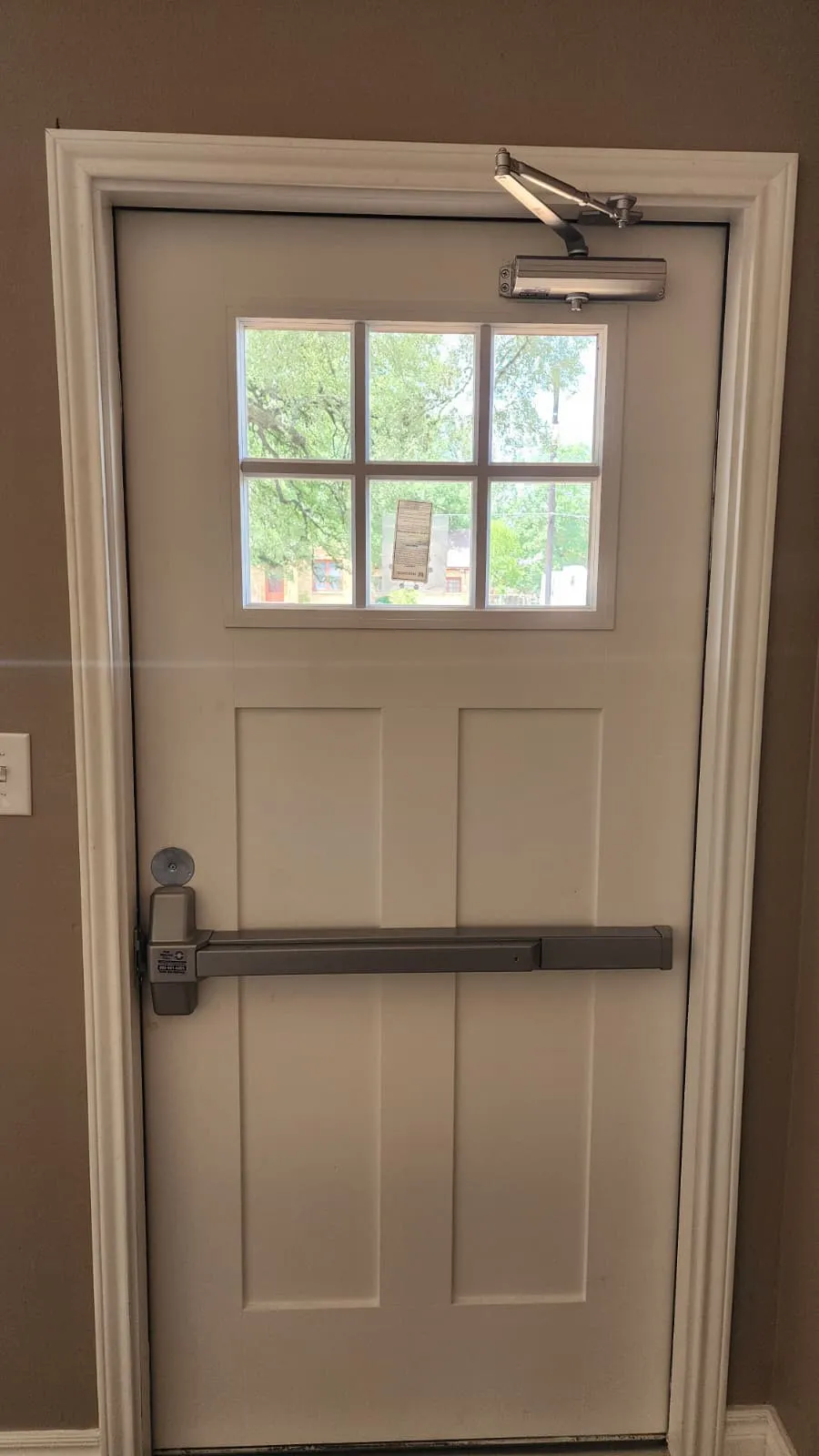
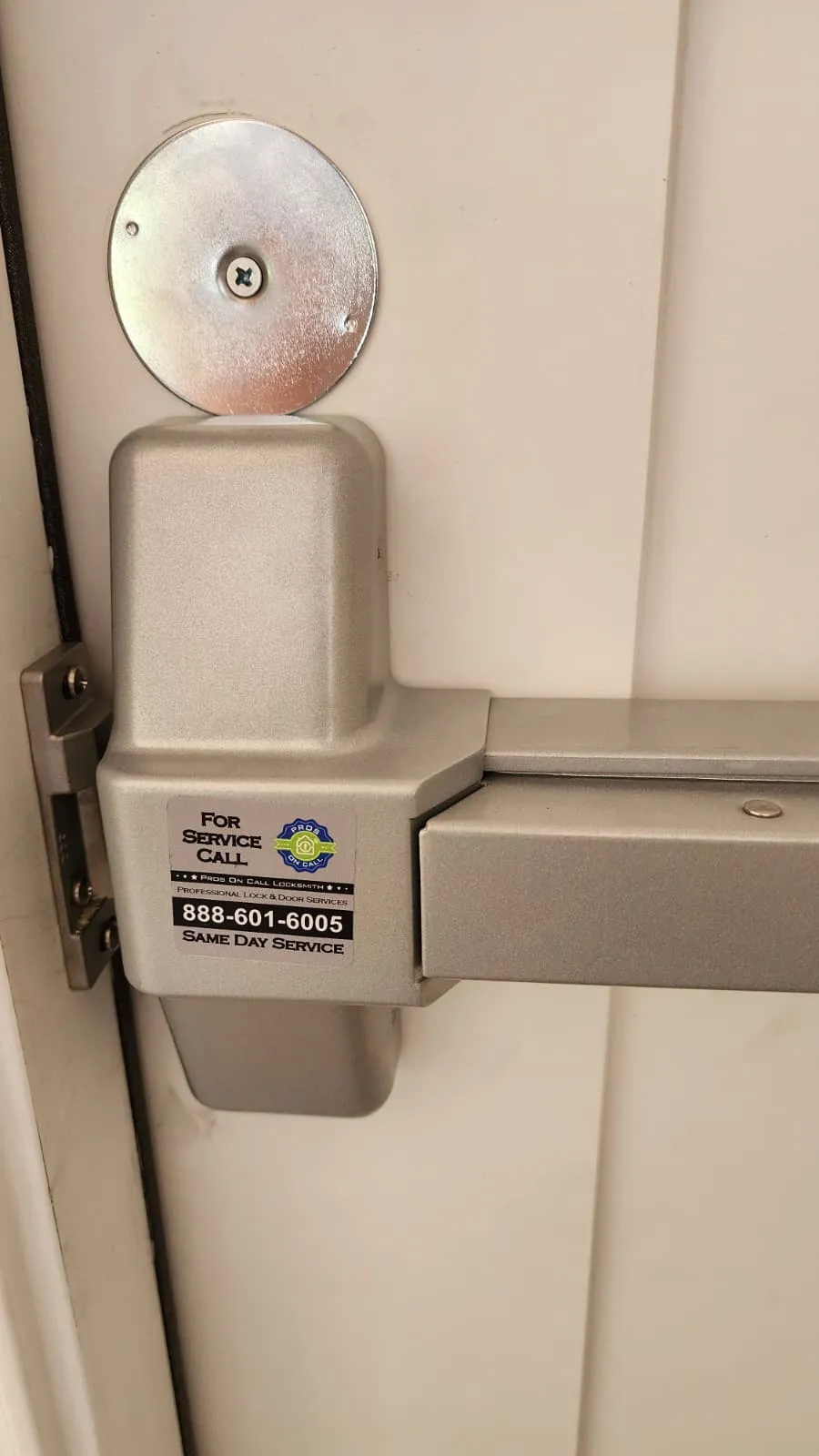
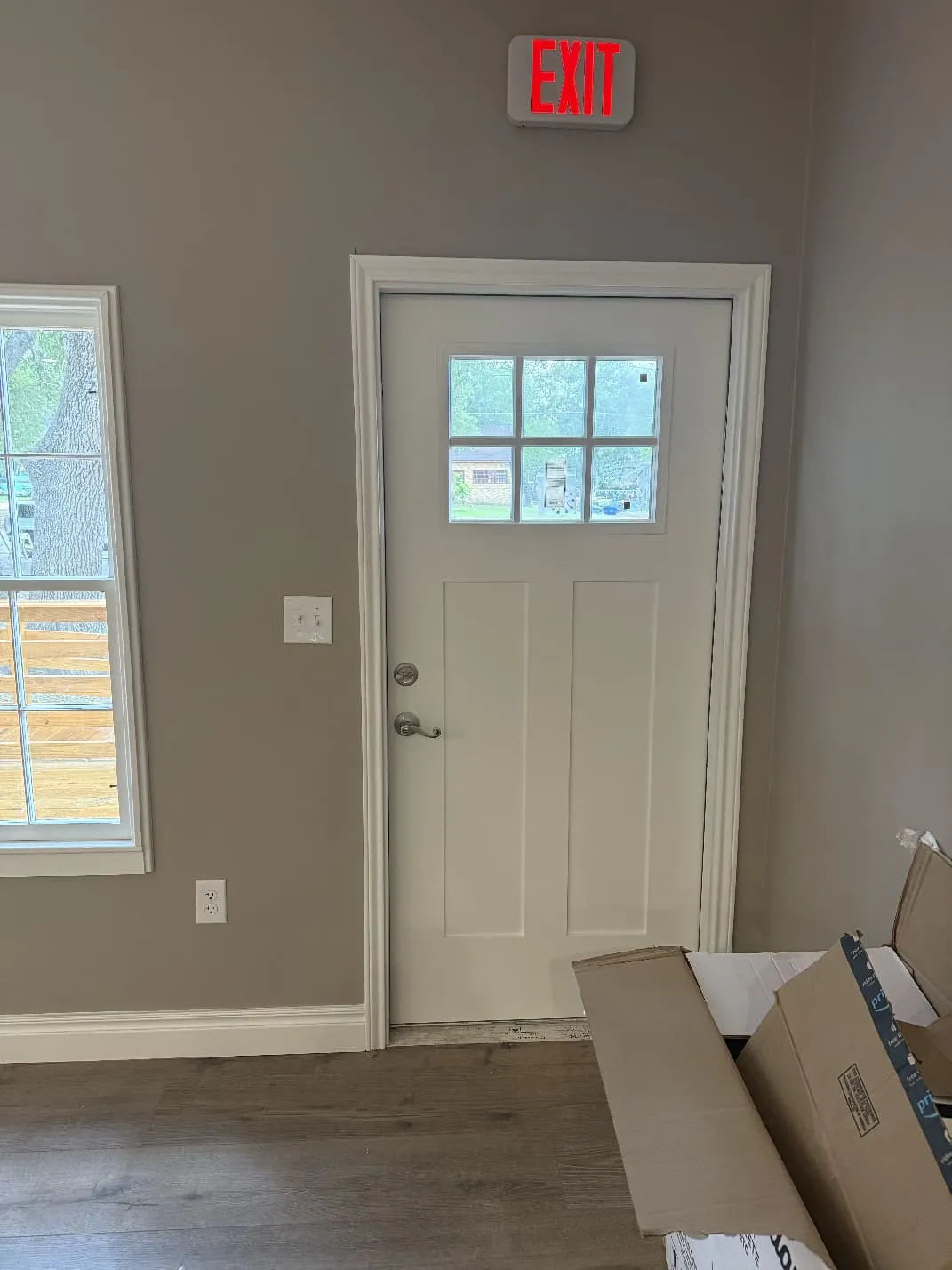
PUSH-BAR AND PANIC HARDWARE
Push-bar and panic hardware we install + service
- We install + service Von Duprin

- We install + service dormakaba

- We install + service LCN

- We install + service Adams Rite

All brand names and logos are trademarks of their respective owners. Pros On Call is an independent locksmith and security service provider. Brand references indicate products we install and service and do not imply affiliation, endorsement, or authorized dealer status unless explicitly stated.
Request commercial locksmith service
Master key systems, panic hardware, electric strikes, high-security locks, and rekeys. We scope it and follow up.
(888) 601-6005Failed Inspection? Upcoming Occupancy Review? We Handle the Whole Job.
Texas-licensed commercial locksmiths, License #B19847. We assess, specify, install, and document. Call for a site assessment.
Call Now: (888) 601-6005Licensed & Insured · License #B19847 · Average 30-min arrival
RELATED COMMERCIAL SERVICES
-
Commercial Lock Installation
ANSI Grade 1 commercial deadbolts, cylindrical, and mortise locks for Austin offices and retail.
Learn More About Commercial Lock Installation -
Master Key Systems
Key hierarchy for multi-tenant buildings, property managers, and facilities with tiered access needs.
Learn More About Master Key Systems -
Commercial Access Control
Card reader, keypad, and credential-based access for commercial entry points across Austin.
Learn More About Commercial Access Control -
High-Security Locks
Restricted-keyway, pick-resistant cylinders for sensitive commercial areas requiring audit trail control.
Learn More About High-Security Locks