
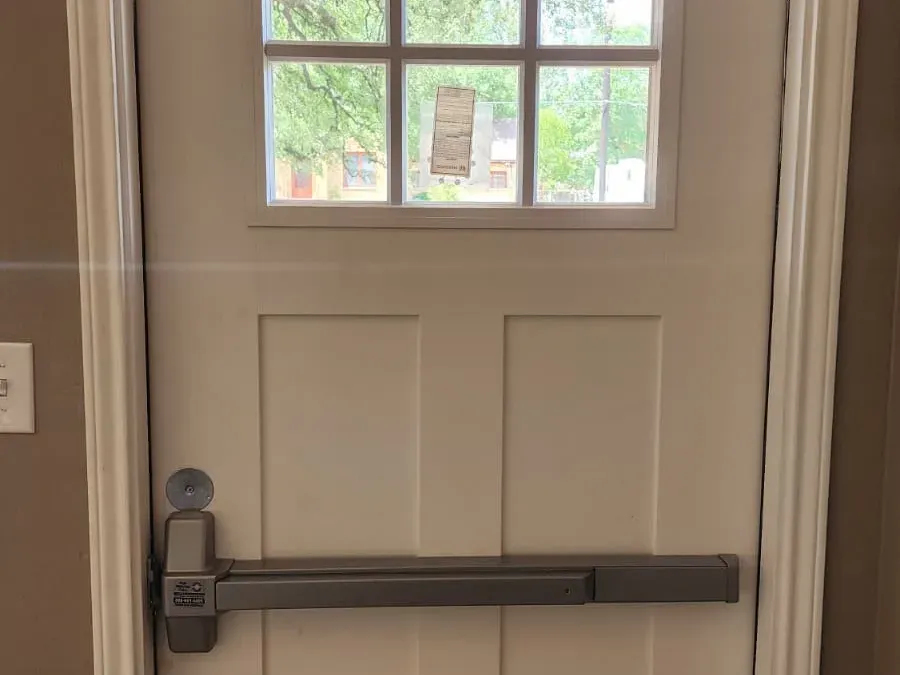
Commercial door hardware isn't just about security. It's about life safety, accessibility, and legal compliance. In Texas, where businesses must meet ADA requirements, fire codes, and insurance standards, choosing the wrong hardware can result in failed inspections, liability issues, and $10,000+ fines.
Whether you're opening a new business, renovating an office, or replacing worn hardware, you need to understand Grade 1 locks, panic bars, door closers, ADA-compliant levers, and Texas-specific building codes.
Why Commercial Hardware Differs from Residential
Commercial buildings face risks that a home doesn't: higher foot traffic, greater liability exposure, mandatory code inspections, and the possibility that employees or customers will need to evacuate fast. The table below captures the four dimensions where commercial requirements go well beyond a residential lockset.
| Dimension | Residential | Commercial |
|---|---|---|
| Security standard | Grade 2-3 locks acceptable | Grade 1 required for high-traffic, liability protection |
| Durability (cycles) | 10,000-400,000 cycles | 1,000,000+ cycles (Grade 1 standard) |
| Code compliance | Minimal requirements | Must meet ADA, fire code, OSHA, local ordinances |
| Liability / insurance | Homeowner's insurance | General liability requires proper hardware (failed inspection = denied claims) |
Choosing the wrong hardware can result in failed inspections, liability issues, and $10,000+ fines.
Types of Commercial Door Hardware
1. Commercial Locks (Grade 1 Required)
Grade 1 is the ANSI/BHMA top rating, required by Texas fire marshals and most commercial insurance carriers on exterior doors. A Grade 1 lock handles 1,000,000+ lock/unlock cycles, withstands 10 full-force kicks, and resists common picking attacks. That durability matters far more than the upfront price difference over a Grade 2 product.
Types of commercial locks:
A. Cylindrical Locks (Most Common)
Cylindrical locks are the workhorse of commercial entry doors. The integrated cylinder sits in a round bore, making them easy to install and swap out when rekeying a suite or changing tenants. They hit Grade 1 at a price that works for most small and mid-size Texas businesses. Top brands: Schlage ND Series ($200-$350), Corbin Russwin CL3300 ($250-$400), Yale 5400LN ($175-$300).
- Cost: $150-$400
B. Mortise Locks (Highest Security)
Mortise locks sit inside a deep pocket cut into the door edge, spreading force across more material than a cylindrical bore. That makes them far more resistant to kick-in and pry attacks, which is why you see them on bank branches, medical offices, and government buildings across Texas. Top brands: Schlage L Series ($350-$600), Mul-T-Lock Hercular ($500-$900), Sargent 8200 ($400-$700).
- Cost: $300-$800
C. Interconnected Locks (Stairwell/Exit Doors)
Stairwell and fire exit doors need to unlock in a single motion under panic conditions. An interconnected lock couples the deadbolt and lever so turning the lever retracts both simultaneously. Texas fire code requires single-motion exit operation.
- Cost: $400-$800
D. Access Control Integration
Electrified hardware lets you log entries, restrict access by time of day, and revoke credentials instantly without changing physical keys, all while still meeting fire and ADA codes.
- Electric strikes ($200-$500)
- Magnetic locks ($300-$600)
- Electric mortise locks ($600-$1,200)
Texas requirement: All exterior commercial doors must have Grade 1 locks per most insurance policies and recommended by fire marshal.
TYPES OF COMMERCIAL LOCKS
Cylindrical Locks
Cylindrical locks are the workhorse of commercial entry doors.
Mortise Locks
Mortise locks sit inside a deep pocket cut into the door edge, spreading force across more material than a cylindrical bore.
Interconnected Locks
Stairwell and fire exit doors need to unlock in a single motion under panic conditions.
Access Control Integration
Electrified hardware lets you log entries, restrict access by time of day, and revoke credentials instantly without changing physical keys.
2. Panic Hardware (Exit Devices)
Panic hardware is a horizontal bar mounted across the door that releases the latch with a single push. No key, no turning handle. Texas follows the International Fire Code, which mandates panic devices on high-occupancy doors because human instinct under stress is to push, not twist.
When panic hardware is required in Texas: Texas follows IFC thresholds that cover a broad range of occupancy types.
- Buildings with 50+ occupants
- Educational facilities (schools, daycares)
- Assembly occupancies (theaters, churches, restaurants)
- High-hazard occupancies (factories with chemicals)
- Any latched door along the egress path serving those 50+ occupant spaces
Types of panic hardware:
A. Rim Exit Device (Surface-Mounted)
Rim devices mount directly to the door face, the fastest retrofit option for existing metal doors. The push bar sits flush and visible, so anyone approaching can see immediately how to open it. Top brands: Von Duprin 99 Series ($400-$600), Dorma ED 3000 ($350-$550), Precision Apex ($300-$500).
- Cost: $300-$700
- Best for: Metal doors, retrofits
B. Mortise Exit Device (Recessed)
Mortise exit devices hide the lock body inside the door, combining mortise-lock strength with one-touch panic exit. The cleaner look suits professional offices and new construction where exposed hardware would read as industrial.
- Cost: $500-$1,000
- Best for: New construction, wood doors
C. Vertical Rod Exit Device
Vertical rod devices extend steel rods to the top and bottom of the door, latching at two points instead of one. That makes them the right choice for wide glass doors and double doors where a single-point latch can't hold the panel flat against wind pressure or crowd force.
- Cost: $600-$1,200
- Best for: Glass doors, double doors
Features to consider (fire rating, weather exposure, and hold-open needs all affect which device fits):
- Fire-rated: Required for fire exit doors (3-hour or 90-minute rating)
- Weatherproof: Exterior doors need rated components
- Dogging feature: Can hold latch retracted (useful for propped-open doors during events)
- Alarms: Optional alarm when door is opened (anti-theft, emergency exit monitoring)
- Electric trim: Remote unlock capability
3. Door Closers (Required for Fire Doors)
A door closer is a hydraulic device that pulls the door shut at a controlled speed. Texas fire code requires self-closing hardware on every fire-rated door, because a door propped open or slow to latch is effectively useless. Closers also support ADA compliance by letting you dial in both closing speed and the force needed to open the door.
When door closers are required in Texas: Four door types trigger a mandatory closer requirement, and all four are common in Texas commercial buildings.
- All fire-rated doors (required to close automatically)
- Exterior doors (security + climate control)
- Doors between conditioned/unconditioned spaces
- ADA-compliant doors (must close slowly enough for wheelchair users)
Types of door closers:
A. Surface-Mounted Closers (Most Common)
Surface-mounted closers bolt to the face of the door or frame, so a technician can adjust them without disassembly. That ease of service matters in a busy office or restaurant where a speed tweak is a quick fix rather than a half-day job. Top brands: LCN 4040XP ($200-$350, most popular), Norton 7500 ($150-$300), Corbin Russwin DC6000 ($175-$325, fire-rated).
- Cost: $100-$400
B. Concealed Closers
Hidden in the door or frame, concealed closers suit storefronts and lobbies where a visible arm would undercut the design. Installation is more complex and costly, so they make most sense in new construction where the rough opening can be sized to fit.
- Cost: $300-$800
Texas fire code requires self-closing hardware on every fire-rated door, because a door propped open or slow to latch is effectively useless.
C. Floor Closers (Glass Doors)
Floor closers sit in a housing set into the concrete beneath the door, the only practical option for frameless all-glass entries common in modern Austin offices and retail fronts. Overhead concealed closers mount in the header above the door, the default spec for courthouses, hospitals, and schools where vandal resistance matters.
- Floor closer cost: $500-$1,500 (best for all-glass doors)
- Overhead concealed cost: $400-$1,000
Key specifications: Texas summers mean exterior doors see extreme heat cycling, so a closer rated for outdoor exposure is worth the added cost on any door that faces the elements.
- Size rating: 1-6 (1 = lightest door, 6 = heaviest)
- Size 3: Standard commercial door (most common)
- Size 4-5: Heavy doors, high-wind areas
- Size 6: Extra-heavy doors, institutional
- Hold-open feature: Holds door open at 90 degrees (fusible link releases in fire)
- Backcheck: Prevents door from opening too fast (protects wall, prevents injury)
- Delayed action: Slows opening speed (ADA requirement)
4. ADA-Compliant Hardware
The Americans with Disabilities Act sets clear, enforceable standards for door hardware in commercial spaces, and Texas Accessibility Standards (TAS) mirror and in some cases add to those federal requirements. The goal is simple: anyone, including someone in a wheelchair or carrying something in both hands, must be able to operate every door without grasping, pinching, or twisting.
A. Lever Handles (Required)
Round knobs are the most common ADA violation Pros On Call finds during audit walkthroughs at Texas businesses. Any hardware requiring a twisting wrist motion is not compliant. Lever handles, push/pull plates, and panic bars all pass. Round knobs and thumb-turn deadbolts (without a lever) do not.
Exception: Residential dwelling units, storage rooms not for public use
B. Operating Force Requirements
Maximum force to open is 5 lbs on interior doors and 8.5 lbs on exterior doors. The only reliable way to confirm compliance is a push-pull gauge, not an estimate by feel.
C. Dimensions. Minimum 32" clear opening at 90 degrees. Thresholds: max 1/2" (sliding doors) or 3/4" (other types), beveled above 1/4". Hardware height: 34" to 48" above floor, measured to the centerline. Many older Texas commercial buildings fall short on secondary doors never updated after original construction. Maneuvering clearances on both sides vary by approach direction and swing, so a site measurement before specifying hardware saves rework.
Cost for ADA compliance (typical per door):
- Replace knobs with levers: $100-$300 per door
- Adjust door closers: $50-$150 per door
- Install panic hardware: $300-$700 per door
- Full ADA door retrofit: $500-$2,000 per opening
5. Electrified Hardware (Access Control)
Electrified door hardware lets you control access remotely, log entry events, and revoke credentials without touching a physical lock, a meaningful upgrade over a mechanical key system for businesses managing multiple locations or rotating contractors.
Types of electric locks:
A. Electric Strikes ($200-$500)
An electric strike replaces the standard strike plate with a pivoting piece that releases on signal. The door still closes and latches mechanically, so it defaults to secure if power is lost.
- Best for: Office entry, apartment buildings, small businesses
B. Magnetic Locks (Maglocks) ($300-$600)
Maglocks use an electromagnet to hold the door closed with 600 to 1,200 lbs of force. Because they have no mechanical latch, they must be wired to fail-safe and release when power is cut, as required by Texas fire code for exit paths.
- Best for: Interior doors, glass doors
C. Electric Mortise Locks ($600-$1,200)
Electric mortise locks combine remote credential control with a mechanical key override in one hardened unit, making them the standard choice for server rooms, pharmacies, and executive suites.
- Best for: High-security areas, offices
D. Electrified Panic Hardware ($800-$1,500)
For exit doors that also need access control, electrified panic hardware controls entry from outside while still guaranteeing one-push exit from inside. A common configuration in warehouses, hospitals, and multi-tenant buildings.
- Best for: Exit doors with access control
Credential readers that pair with electrified hardware:
- Card readers (RFID, proximity): $200-$600
- Keypads: $150-$400
- Biometric (fingerprint): $500-$1,500
- Smartphone/Bluetooth: $300-$800
TYPES OF ELECTRIC LOCKS
Electric Strikes
An electric strike replaces the standard strike plate with a pivoting piece that releases on signal.
Magnetic Locks
Maglocks use an electromagnet to hold the door closed with 600 to 1,200 lbs of force.
Electric Mortise Locks
Electric mortise locks combine remote credential control with a mechanical key override in one hardened unit.
Electrified Panic Hardware
For exit doors that also need access control, electrified panic hardware controls entry from outside while still guaranteeing one-push exit from inside.
6. Hinges (Commercial-Grade Required)
Hinges are easy to overlook, but they keep the entire door assembly aligned over hundreds of thousands of cycles. A residential hinge on a high-traffic commercial door will sag and bind within a few years, throwing off latch alignment and making ADA force limits impossible to maintain. Commercial doors need 3 or more heavy-duty, ball-bearing hinges where a residential door typically has 2 light-duty ones.
Commercial hinge requirements (ball bearings reduce friction on doors that swing dozens of times an hour; non-removable pins close an obvious physical security gap):
- Ball-bearing: Reduces friction, extends life (500,000+ cycles)
- Non-removable pins: Security feature (prevents door from being lifted off hinges)
- Fire-rated: Steel hinges for fire-rated doors
- Size: 4.5" x 4.5" minimum (heavy doors may need 5" x 5")
Top brands: Hager (most popular), McKinney (heavy-duty institutional), Stanley (budget commercial).
- Cost: $40-$150 per hinge (need 3 per door)
Texas Fire Code Requirements
Texas adopts the International Fire Code (IFC) and International Building Code (IBC) with state-specific amendments. Local fire marshals in Austin, San Antonio, McAllen, and other cities enforce these codes during inspections, and fines compound quickly if violations are not corrected.
Fire Door Requirements
A fire-rated door is a tested assembly. Door, frame, and all hardware components must carry the same rating. Substituting a non-rated hinge or using the wrong closer on a 90-minute door invalidates the entire assembly label. Ratings run from 20-minute through 3-hour.
When fire doors are required: Texas code requires fire doors wherever a fire barrier must remain intact under emergency conditions.
- Exits from buildings
- Stairwell doors (vertical fire separation)
- Corridors in hospitals, hotels, apartments
- Openings in fire walls (between buildings or fire zones)
- Hazardous material storage rooms
Fire door hardware requirements (every component must work together as a system; a closer that doesn't fully latch is as much a violation as a missing closer):
- Self-closing: Door closer required (must close and latch automatically)
- Positive latching: Door must latch (not just close)
- Fire-rated locks: Locks and panic hardware must be fire-rated
- No holdbacks: Cannot prop door open (unless fusible link or electromagnetic holdback)
- Labeling: Fire door label required on door edge
Inspection frequency: NFPA 80 requires annual inspection by a certified fire door inspector. Documentation must be available for fire marshal or insurance auditor review. Cost is $50-$150 per door.
Common violations (and fines): These are the issues Pros On Call sees most often during Texas commercial service calls.
- Door propped open (wedge, trash can, etc.) - $500-$2,500 fine
- Missing or damaged door closer - $250-$1,000 fine
- Door doesn't latch fully - $250-$1,000 fine
- Removed fire door label - $500-$2,000 fine
Panic Hardware and Exit Routes
Texas fire code requires that any occupied exit door allow egress without special knowledge, a key, or significant physical effort. Maximum force is 15 lbs to release the panic bar, and the operation must complete with a single motion. A door requiring "turn knob AND push" is a violation.
Delayed egress locks (allowed in specific cases): Legitimate for hospitals managing patient safety or retailers managing theft, these allow a 15-30 second delay before the door unlocks. They require fire marshal approval and must integrate with the fire alarm system so the delay releases immediately in an emergency.
NFPA 80 requires annual inspection by a certified fire door inspector.
Texas Building Code and ADA Compliance
Accessibility Requirements (ADA + Texas Accessibility Standards)
Texas Accessibility Standards (TAS) are administered by the Texas Department of Public Safety (DPS) Private Security Bureau and apply to virtually all commercial construction and renovation in the state. DPS Private Security can order corrective work and issue fines independent of federal ADA enforcement.
Who must comply: TAS applies broadly across Texas commercial construction, with few exemptions.
- All commercial facilities (retail, office, restaurant)
- Public buildings (government, schools, libraries)
- Multi-family housing (some units)
- Private clubs, religious facilities (some exemptions)
Door hardware compliance mirrors the requirements covered in the ADA-Compliant Hardware section above: lever handles over round knobs, operating force under 5 lbs (interior) or 8.5 lbs (exterior), hardware height 34" to 48", and clear-opening minimums. One additional TAS trigger: when a door is the only accessible entrance, an automatic door opener may be required.
- Automatic opener cost: $2,000-$6,000 per door
Texas-Specific Amendments
Energy code (IECC + Texas amendments): Texas energy rules require exterior doors to self-close or auto-close, include weatherstripping, and meet insulation minimums (R-5 in some climate zones).
Wind load requirements (coastal Texas): If your business is in or near Houston, Corpus Christi, or Galveston, impact-rated hardware is a code requirement, not an upgrade. Wind-rated doors and hardware typically cost 30-50% more than standard.
Commercial Door Hardware Costs (Texas 2025)
Entry-Level Commercial Package ($500-$1,200 per door)
The entry-level package covers a low-traffic door that still needs Grade 1 and lever-handle compliance. Think a back office in a small retail shop or a storage room in a San Antonio strip-center space.
- Grade 1 cylindrical lock (Schlage ND series)
- Commercial-grade hinges (3 hinges)
- Surface-mounted door closer
- Lever handle
Best for: Small offices, retail shops, low-traffic areas
Common brand combinations: Schlage ND80, Yale 5400LN, Norton 7500 closer
Mid-Range Commercial Package ($1,200-$2,500 per door)
Mid-range hardware is where most Texas businesses land. A mortise lock and a quality closer like the LCN 4040XP will outlast two rounds of lower-grade hardware on a busy door, and fire-rated components give you documentation to hand an inspector.
- Grade 1 mortise lock
- Heavy-duty commercial hinges
- LCN 4040XP door closer
- ADA-compliant lever
- Fire-rated components (if needed)
Best for: Office buildings, medical facilities, restaurants
High-Security Package ($2,500-$5,000 per door)
High-security applications such as bank branches, hospital pharmacies, and government offices need hardware that goes beyond Grade 1. Mul-T-Lock and Medeco cylinders add a physical layer of pick and drill resistance that standard Grade 1 locks do not provide.
- High-security mortise lock (Mul-T-Lock, Medeco)
- Panic hardware (Von Duprin)
- Commercial-grade door closer (LCN)
- Electric strike or access control integration
- Fire-rated components
Best for: Banks, hospitals, government buildings, high-crime areas
Access Control Integration ($3,000-$8,000 per door)
Adding access control requires more than swapping the lock. The full package includes power supply, low-voltage wiring, credential readers, software licensing, and network integration, all of which need to work together before you rely on them for daily operations.
- Electrified panic hardware or mortise lock
- Card reader or keypad
- Power supply and wiring
- Access control software
- Professional installation
Best for: Corporate offices, multi-tenant buildings, secure facilities
Installation Costs
| Service | DIY Cost | Professional Cost | Time |
|---|---|---|---|
| Install commercial lock | $150-$400 (parts) | $300-$700 | 1-2 hours |
| Install door closer | $100-$300 (parts) | $200-$500 | 30-60 min |
| Install panic hardware | $300-$700 (parts) | $600-$1,200 | 2-3 hours |
| Install electric strike | $200-$400 (parts) | $400-$800 | 1-2 hours |
| Full door hardware replacement | $600-$1,500 | $1,200-$3,000 | 3-5 hours |
Why hire a professional:
Commercial hardware installation is not just getting hardware on the door. An improperly installed fire door can invalidate the door's label, and an incorrectly adjusted closer can put you in ADA violation territory on a door customers use every day. Professional installation includes:
- Code compliance (ADA, fire, building codes)
- Fire door certification
- Access control integration expertise
- Labor warranty (1-3 years typical)
- DIY risk: voided warranty, failed inspection, invalidated fire door label
How to Choose Commercial Door Hardware
Step 1: Determine Code Requirements
Answer these five questions before buying anything to avoid installing hardware you will have to rip out after an inspection:
- Is this a fire-rated door? (check door label)
- Is this an exit door? (panic hardware required?)
- Must it be ADA-compliant? (public area?)
- What is the building occupancy type? (assembly, office, retail, etc.)
- What are the insurance requirements?
Consult your Texas building department, local fire marshal, insurance agent, and architect to get the full compliance picture.
Step 2: Assess Security Needs
Security requirements scale with risk exposure. Matching hardware grade to actual threat level keeps costs reasonable while closing the real vulnerabilities.
Low security (retail, office common areas): Grade 1 cylindrical hardware meets code without over-engineering the budget.
- Grade 1 cylindrical lock
- Standard door closer
- Lever handle
Medium security (offices, warehouses): Mortise hardware plus a credential reader gives you audit trails and the ability to revoke access without rekeying.
- Grade 1 mortise lock
- Heavy-duty closer
- Access control integration (keypad or card reader)
High security (banks, data centers, pharmacies): At this tier you are protecting against active attack attempts, not just opportunistic entry.
- High-security mortise lock (Mul-T-Lock, Medeco)
- Reinforced strike plates
- Video surveillance integration
- Delayed egress or controlled access
SECURITY TIERS
Low Security
Grade 1 cylindrical hardware meets code without over-engineering the budget.
Medium Security
Mortise hardware plus a credential reader gives you audit trails and the ability to revoke access without rekeying.
High Security
High-security applications such as bank branches, hospital pharmacies, and government offices need hardware that goes beyond Grade 1.
Step 3: Consider Traffic Volume
A door in a busy San Antonio restaurant that swings 300 times a day will wear out hardware faster than the same lock on a quiet office suite. Sizing your closer and hinge type to match actual traffic keeps hardware performing for its rated lifespan.
Low traffic (<50 uses/day): Standard Grade 1 components are fully adequate and keep costs down.
- Standard Grade 1 lock (1,000,000 cycles)
- Size 3 door closer
Medium traffic (50-200 uses/day): Heavier hardware and ball-bearing hinges pay for themselves in reduced service calls.
- Heavy-duty Grade 1 lock
- Size 4-5 door closer
- Ball-bearing hinges
High traffic (200+ uses/day): Institutional-grade hardware is worth the premium on doors that see constant use all day.
- Institutional-grade hardware
- Size 5-6 door closer
- Continuous hinge (piano hinge)
Step 4: Budget for Lifecycle Costs
The honest comparison is total cost over ten years, including repairs, replacements, and code-violation fines. Mid-range hardware holds its own on that math compared to both ends of the price range.
Cheap hardware ($500/door): The upfront savings evaporate quickly on a busy door.
- Lasts 5-7 years
- Frequent repairs
- 10-year cost: $1,500-$2,000 (replacement + repairs)
Quality hardware ($1,500/door): Nearly the same 10-year cost as cheap hardware, with far less disruption.
- Lasts 15-25 years
- Minimal repairs
- 10-year cost: $1,700-$2,000 (few repairs)
High-end hardware ($3,000/door): Justified for high-security or high-traffic locations where downtime is not an option.
- Lasts 25+ years
- Rare repairs
- 10-year cost: $3,200-$3,500
Best value: Mid-range commercial hardware ($1,200-$2,000/door) for most Texas businesses
Maintenance Requirements
Regular maintenance keeps commercial hardware within code limits. A door closer that drifts out of adjustment can turn a passing ADA force test into a violation within months, and a fire door that doesn't latch positively fails inspection regardless of how new the hardware is.
Monthly Checks
A quick monthly walkthrough catches small issues before they become code violations or warranty claims.
- Test door closer (door closes fully and latches)
- Check panic hardware operation (smooth, no binding)
- Verify ADA compliance (operating force <5 lbs interior)
- Inspect weatherstripping (exterior doors)
COMMON VIOLATIONS AT A GLANCE
Non-ADA Compliant Hardware
Round knobs instead of levers. Replace with lever handles.
Missing or Non-Functional Door Closer
Fire door doesn't self-close. Install or repair door closer.
Propped-Open Fire Door
Fire door wedged open. Remove wedge, install electromagnetic holdback.
Quarterly Maintenance
Quarterly service keeps hardware within spec through Austin and San Antonio's temperature swings.
- Lubricate hinges, locks, closers
- Tighten all screws and fasteners
- Clean and inspect fire door labels
- Test access control (if installed)
Annual Professional Inspection
The annual inspection fulfills the NFPA 80 requirement and gives you documentation for fire marshal visits or insurance audits.
- Fire door inspection (NFPA 80 requirement)
- ADA compliance audit
- Lock security assessment
- Door closer adjustment and calibration
Cost: $100-$300 per door for annual inspection and tune-up
Common Code Violations and How to Fix Them
Every violation below has a known fix with a predictable cost. The main risk is waiting too long and running into a fine that dwarfs the repair bill.
Violation 1: Non-ADA Compliant Hardware
Problem: Round knobs instead of levers Fine: $500-$10,000 per violation (ADA) Fix: Replace with lever handles ($100-$300 per door)
Violation 2: Excessive Operating Force
Problem: Door requires >5 lbs to open (interior) Fine: $500-$2,000 Fix: Adjust door closer ($50-$150 service call)
Violation 3: Missing or Non-Functional Door Closer
Problem: Fire door doesn't self-close Fine: $250-$2,500 Fix: Install or repair door closer ($200-$500)
Violation 4: Panic Hardware Not Operational
Problem: Push bar doesn't release latch Fine: $1,000-$5,000 (life safety violation) Fix: Repair or replace panic hardware ($300-$1,200)
Violation 5: Propped-Open Fire Door
Problem: Fire door wedged open Fine: $500-$2,500 per occurrence Fix: Remove wedge, install electromagnetic holdback ($400-$1,000) if door needs to stay open
Professional Commercial Locksmith Services in Texas
Pros On Call is a licensed Texas locksmith (License #B19847) providing commercial door hardware installation, repair, and code compliance services across Austin, San Antonio, McAllen, and the rest of Texas. Call (888) 601-6005 or tel:+18886016005 to schedule service.
Services: From a single lock swap to a full-building ADA retrofit, here is what Pros On Call handles for Texas commercial clients.
- Grade 1 lock installation and repair
- Panic hardware installation (Von Duprin, Dorma, Precision)
- Door closer installation and adjustment
- ADA compliance upgrades
- Fire door hardware certification
- Access control integration
- Master key systems
- Annual inspections and maintenance
Common projects: Typical job scopes and price ranges for Texas commercial buildings.
- Office door hardware package: $800-$2,000 per door
- Retail storefront panic hardware: $600-$1,500
- ADA compliance retrofit: $500-$1,500 per door
- Access control installation: $2,000-$5,000 per door
- Fire door inspection and repair: $150-$500 per door
Brands we stock: Schlage, Yale, Corbin Russwin (locks), Von Duprin, Dorma, Precision (panic hardware), LCN, Norton (closers), HES, SDC, Folger Adam (electric strikes). Every installation meets Texas Building Code, ADA, and NFPA 80 requirements, with documentation for insurance and inspections.
Service areas: Austin, San Antonio, Houston, Dallas, Fort Worth, El Paso, Arlington, Corpus Christi, Plano, and all major Texas metro areas.
Last updated: December 2025 | Based on 2021 Texas Building Code, 2021 International Fire Code, ADA Standards for Accessible Design, and NFPA 80 (2022 edition). All costs reflect 2025 Texas market pricing.
Content strategy and SEO by Optymizer