
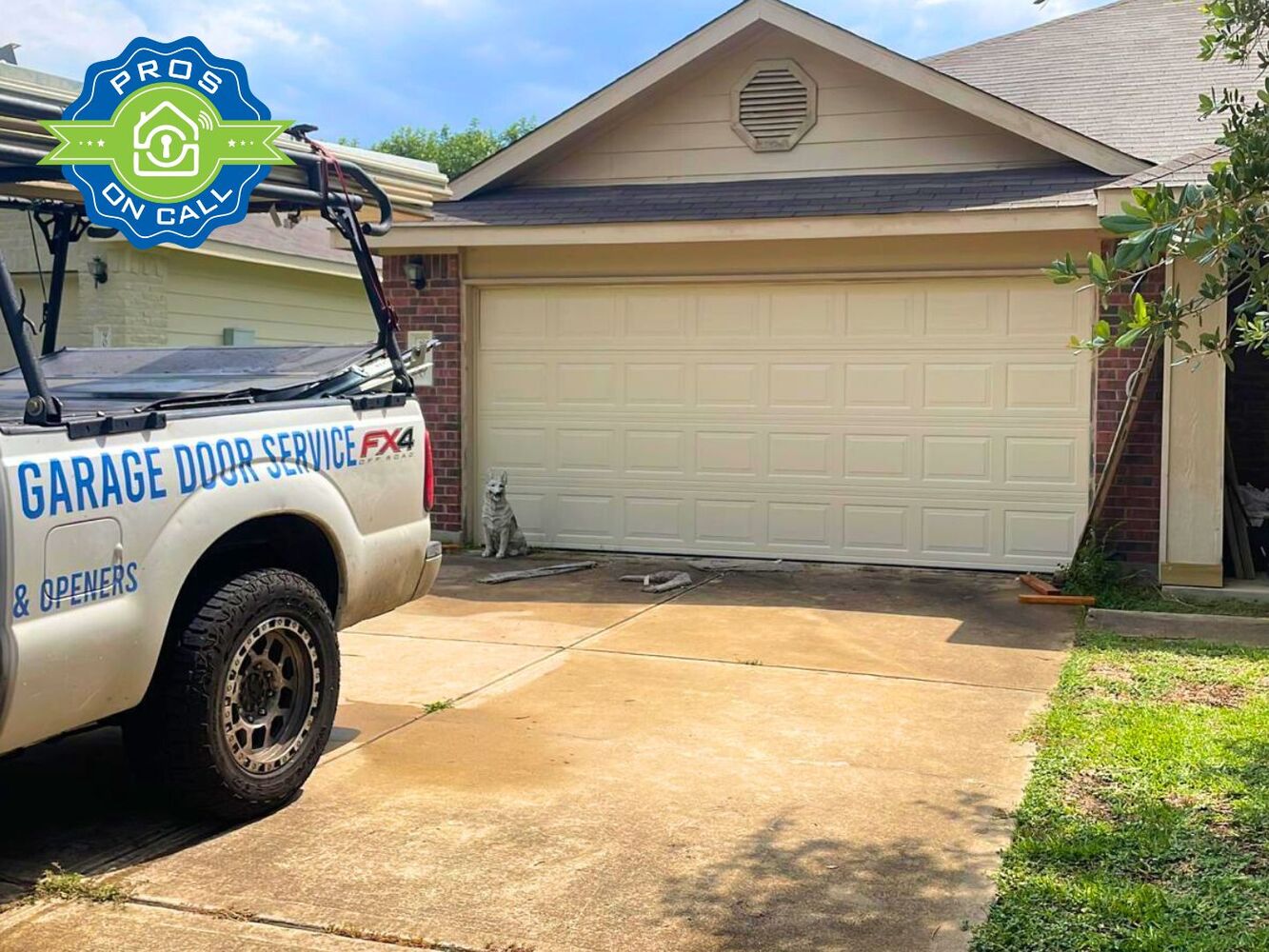
Should you pay extra for an insulated garage door? In Texas, where summer temperatures hit 100 degrees and above and winter can dip to freezing, the answer is almost always yes - but the level of insulation you need depends on your specific situation.
Here's the truth about garage door insulation: energy savings, comfort improvements, noise reduction, and when the upgrade actually pays for itself.
What Is Garage Door Insulation?
Garage door insulation is material sandwiched between door panels to slow heat transfer. The job it does is simple in concept: slow the movement of heat through the door in both directions, so your HVAC system does less work and your garage stays livable. In Texas, that means keeping brutal summer heat outside and holding onto your heated air during the occasional hard freeze. The measurement that matters here is R-value, which indicates thermal resistance. Higher R-value means better insulation, though as you'll see below, the returns diminish once you pass R-16 for most residential situations.
Common R-values for garage doors break down like this: R-0 means a single-layer steel or aluminum door with no insulation at all. R-4 to R-8 is basic insulation using polystyrene foam backing. R-12 to R-16 is the good-insulation range, built with a polyurethane foam core. R-18 and above is premium and commercial-grade territory. An R-16 insulated door uses measurably less energy than an uninsulated door when your garage shares a wall with your home - enough to make a noticeable difference on your electricity bill through a Texas summer.
COMMON GARAGE DOOR R-VALUES
R-0
A single-layer steel or aluminum door with no insulation at all.
R-4 to R-8
Basic insulation using polystyrene foam backing.
R-12 to R-16
The good-insulation range, built with a polyurethane foam core.
R-18 and above
Premium and commercial-grade territory.
Types of Garage Door Insulation
Polystyrene Insulation (R-4 to R-8)
Polystyrene doors use rigid foam panels inserted between door layers. The construction is straightforward: steel front and back panels with polystyrene boards fitted between the ribs, though small air gaps remain at the panel joints. That gap is the limitation - it lets heat sneak through even when the foam itself is doing its job.
These doors typically land at R-4 to R-8 and cost $100-200 more than a non-insulated door. For a detached garage that you don't heat or cool, polystyrene is a reasonable choice. It's lightweight, which means less strain on your opener, and it beats having nothing at all. For an attached garage in Austin or Houston, though, you'll want the step up to polyurethane.
- Best for: Detached garages in Texas, budget-conscious upgrades
- Cost premium: $100-200 over non-insulated
Polyurethane Insulation (R-12 to R-18)
Polyurethane is the clear winner for Texas attached garages. Instead of slotting foam boards between panels, liquid polyurethane is injected and expands to fill the space completely - no gaps, no thermal breaks, no air pockets where heat can slip through. The result is continuous insulation that also bonds the steel layers together, which adds real structural rigidity to the door.
That R-12 to R-18 range means substantially better performance than polystyrene, and the added structural strength is particularly relevant in Texas, where coastal wind codes and clay-soil foundation movement can both put stress on a door over time. The tradeoff is weight: a polyurethane door is heavier and may require a 1/2 HP opener rather than a 1/3 HP model. The $300-600 premium over a non-insulated door pays for itself in an attached-garage scenario - typically within five to eight years.
- Best for: Attached garages, temperature-sensitive storage, workshop spaces
- Cost premium: $300-600 over non-insulated
Reflective/Radiant Barriers
Reflective barriers use aluminum foil backing to bounce radiant heat away from the garage interior. They work best during Texas summers, when direct sun on a south- or west-facing door would otherwise drive temperatures up significantly. In winter they contribute very little, since their strength is reflection rather than retention.
Most mid-grade doors include some reflective component as part of the package. On its own, a radiant barrier adds only R-1 to R-2, so think of it as a supplement to polystyrene or polyurethane insulation rather than a stand-alone solution. For a door with heavy summer sun exposure, it's a worthwhile bonus.
- Best for: Supplementing other insulation, sunny exposure doors, summer heat reduction
Cost of Insulated vs. Non-Insulated Doors
The table below shows installed pricing for a standard 16x7 double garage door. These ranges reflect what Texas homeowners typically pay for material and professional installation combined - not just the door itself. The premium column is what matters most for your ROI calculation.
| Insulation Type | Door Cost | Installation | Total | Premium Over Non-Insulated |
|---|---|---|---|---|
| Non-insulated steel | $600-900 | $300-400 | $900-1,300 | -- |
| Polystyrene (R-8) | $800-1,200 | $300-400 | $1,100-1,600 | $200-300 |
| Polyurethane (R-16) | $1,200-1,800 | $300-500 | $1,500-2,300 | $600-1,000 |
| Premium insulated (R-18) | $1,800-2,500 | $400-500 | $2,200-3,000 | $1,300-1,700 |
The upgrade decision comes down to one question: is that $200-1,000 premium worth it? The next section works through the actual return on investment.
Energy Savings: The Real Numbers
The energy math depends heavily on how your garage connects to your home and how much you use the space. These scenarios use a 400 sq ft garage that shares a wall with the house, a Texas electricity rate of $0.14/kWh (2025 average), six months of A/C usage per year, and three months of heating.
Attached Garage Scenarios (Texas Climate)
Starting from an R-0 baseline, an uninsulated door in this scenario runs a summer cooling load of 2,400 kWh and a winter heating load of 800 kWh - an annual cost of $448 attributable to that garage envelope.
An R-8 polystyrene door cuts the summer cooling load to 1,920 kWh and the winter load to 680 kWh, bringing annual cost to $364 and annual savings to $84. At that rate, the $200-300 polystyrene premium pays back in roughly 2.4-3.6 years.
An R-16 polyurethane door reduces the summer cooling load to 1,680 kWh and the winter load to 600 kWh, for an annual cost of $319 and annual savings of $129. The $600-1,000 premium pays back in 4.7-7.8 years, and after that you pocket the savings for the remaining 15-25 years of the door's life.
An R-18 premium door pushes savings to $151 per year, but the payback period stretches to 8.6-11.3 years. The extra step from R-16 to R-18 makes sense only if you have specific reasons - living space above the garage, an actively conditioned workspace, or maximum noise-reduction priority.
Keep in mind that these numbers assume the garage door makes up roughly a seventh of the garage perimeter. If your garage has large windows or poorly insulated walls, the door upgrade alone will deliver proportionally less.
ATTACHED GARAGE SAVINGS BY R-VALUE
R-0 baseline
An uninsulated door runs a summer cooling load of 2,400 kWh and a winter heating load of 800 kWh, an annual cost of $448.
R-8 polystyrene
Brings annual cost to $364 and annual savings to $84, paying back the $200-300 premium in roughly 2.4-3.6 years.
R-16 polyurethane
Annual cost of $319 and annual savings of $129. The $600-1,000 premium pays back in 4.7-7.8 years.
R-18 premium
Pushes savings to $151 per year, but the payback period stretches to 8.6-11.3 years.
Detached Garage Scenarios
For a detached garage that you don't heat or cool, energy savings from door insulation are modest - generally $10-30 per year from reduced opener strain. That pushes payback into the 10-20 year range on energy alone, which means the financial case is thin. The real reasons to insulate a detached garage are protection and usability: paint and chemicals degrade in 110-degree heat, vehicle batteries and fluids suffer in temperature extremes, and moisture condensation damages tools and stored items. If you ever plan to convert the space to a workshop, insulating now costs less than retrofitting later.
Beyond Energy Savings: Other Benefits
Energy bills are only part of the picture. Insulated doors deliver three other advantages that are harder to put a number on but matter just as much to day-to-day life.
Noise Reduction
An uninsulated steel door is essentially a drum: every operation sends metal-on-metal clanking through the door and into the house, and the hollow construction amplifies vibration rather than absorbing it. An insulated door with R-12 or higher cuts that operational noise substantially because the foam layer dampens vibration and the triple-layer construction absorbs sound before it travels. If your bedroom sits above or beside the garage, or if you leave early in the morning while others are sleeping, the quieter operation alone is often enough to justify the upgrade.
Door Durability and Strength
Polyurethane foam does something polystyrene cannot: it bonds the steel layers of the door together, creating a composite structure that is measurably more rigid. That rigidity translates to less panel flexing and bowing over the years, and it makes the door noticeably more dent-resistant than a single-layer steel door would be. In coastal Texas counties where building codes require wind-load ratings, insulated doors frequently satisfy the structural requirement through that added rigidity - the insulation R-value is almost a side benefit compared to the structural certification.
The $600-1,000 insulation upgrade typically saves $100-150 annually in energy costs while providing comfort and durability benefits that pay dividends for decades.
Temperature-Sensitive Storage Protection
A Texas garage without insulation can reach 110-120 degrees on a summer afternoon when it's 95 outside. An R-8 door holds that to 100-105 degrees; an R-16 door brings it down to roughly 90-95 degrees. That 15-25 degree reduction matters enormously for anything you store there. Paint and chemicals degrade quickly at high temperatures. Seasonal decorations absorb humidity and fall apart. Tools rust from condensation. Vehicle batteries lose capacity faster in extreme heat. A chest freezer running in an uninsulated garage works twice as hard and may fail early. Replacing damaged storage items once over the life of the door can easily cost more than the insulation upgrade itself.
Workshop or Living Space Conversion
If you use your garage as a workshop, the insulated door stops being a nice-to-have and becomes mandatory. An uninsulated garage in a Texas summer is simply not usable for extended work - temperatures climb too high to be safe or comfortable, and the cooling costs to fight that heat in an uninsulated box are prohibitive. A well-insulated garage workshop can run $80-150 per month to cool in summer versus $250-400 without insulation, a difference of $70-150 per month. Over a summer, that savings alone can approach the cost of the insulation upgrade.
Home Resale Value
Garage door replacement consistently ranks among the highest-ROI home improvements in remodeling industry surveys, typically returning a large share of the project cost at resale. An insulated door signals to buyers that the home has been maintained thoughtfully, and in markets like Austin where energy efficiency is a genuine selling point, the upgrade can justify a higher asking price. The perceived value increase generally runs $500-1,500, which is meaningful for a project in the $600-1,000 premium range.
When Insulation Is Essential
Your Garage Shares a Wall with Living Space
When your garage and your home share a wall, the garage essentially becomes part of your home's thermal envelope - and an uninsulated door is a large hole in that envelope. In summer, the garage heats up and pushes that heat into adjacent rooms, forcing your HVAC to work harder and driving up your electricity bill. In winter, the reverse happens. R-16 is the minimum we'd recommend for this situation, and most Texas homes - where attached garages are the norm - fall into this category.
R-value recommendation: R-16 minimum
You Have Rooms Above the Garage
Hot air rises, and a garage that hits 110 degrees in summer will push heat straight up into any living space above it. Bedroom floors feel uncomfortably warm, the HVAC struggles to hold temperature in those rooms, and energy waste is significant. This is one of the clearest cases for stepping up to R-16 or R-18, and it's worth also insulating the garage ceiling if it isn't already done.
R-value recommendation: R-16 to R-18
Bonus upgrade: Also insulate garage ceiling if not already done ($1-2 per sq ft).
You Heat or Cool Your Garage
If you're running a workshop, home gym, or hobby space in your garage, the door is the single largest heat-loss and heat-gain surface you're fighting. An uninsulated door can bleed out a large share of your conditioned air, making the space nearly unusable in summer or winter without enormous HVAC expense. With R-16 or R-18, that loss drops enough to make the space genuinely comfortable and the operating costs manageable.
The monthly cooling numbers show just how fast this pays back. An uninsulated garage workspace costs $250-400 per month to cool through a Texas summer; an R-18 insulated garage drops that to $120-180. The difference is $130-220 per month, which adds up to $780-1,320 over a single summer season.
R-value recommendation: R-18 (maximum insulation)
WHEN INSULATION IS ESSENTIAL
Your garage shares a wall with living space
The garage essentially becomes part of your home's thermal envelope, and an uninsulated door is a large hole in that envelope.
You have rooms above the garage
Hot air rises, and a garage that hits 110 degrees in summer will push heat straight up into any living space above it.
You heat or cool your garage
The door is the single largest heat-loss and heat-gain surface you're fighting.
Texas Coastal Areas (Wind Zones)
Coastal Texas building codes often require garage doors to carry a wind-load rating, which means structural reinforcement and impact resistance. Insulated polyurethane doors naturally meet many of these requirements because the bonded foam core adds the rigidity that wind ratings demand. In most coastal counties, an insulated door isn't just a comfort upgrade - it's the product category that satisfies the code.
R-value recommendation: R-12 minimum (dictated by structural needs, insulation is a bonus)
You Store Sensitive Items
Paint, chemicals, electronics, and photos all suffer in extreme temperature swings. Batteries degrade faster in intense heat. Liquids freeze and expand. Humidity damages paper goods and photos. An R-16 door keeps the garage 15-20 degrees cooler in summer and 10-15 degrees warmer in winter, which is often the difference between items surviving the season and needing replacement. Some home insurance policies also have requirements around climate-controlled storage for certain valuables - worth checking your policy.
When You Can Skip Insulation
Completely Detached Garage
A detached garage with no shared walls, no heating or cooling, and infrequent use is the clearest case where you can save $200-800 and stick with R-0 or R-4. You're not losing conditioned air through the door because there's no conditioned air to lose. The one caveat: if you think you might convert the space to a workshop later, insulate now. Retrofitting costs more than getting it right on the initial installation.
Rental Property (Short-Term Hold)
If you're selling within two to three years, the payback period on an insulation upgrade will almost certainly exceed your ownership timeline. The new buyer may replace the door entirely anyway. In this situation, money is better spent on curb appeal - paint, landscaping, things that sell quickly and visibly. A quality insulated door does help a home sell faster, but you likely won't recoup the full cost premium in a short-hold scenario.
In most coastal counties, an insulated door isn't just a comfort upgrade - it's the product category that satisfies the code.
Severe Budget Constraints
A non-insulated door is better than a broken door. If the insulation premium genuinely strains the budget, prioritize safety features - sensors, auto-reverse, proper spring tension - over R-value. You can add a DIY insulation kit later for $100-200 and pick up R-4 to R-8 as a stopgap until budget allows for a full replacement.
Insulation Retrofit Options
DIY Insulation Kits
If you already have an uninsulated door and aren't ready to replace it, retail insulation kits from Home Depot, Lowe's, or Amazon run $50-150 for a double garage door. They come as foam board panels or reflective foil-backed foam that you cut to size and attach with adhesive or clips. Installation takes two to four hours and adds R-4 to R-8 of effective insulation. The limitation is that retrofit kits can't replicate what factory-injected polyurethane does: they add weight, may void the door's warranty, and don't bond the panels together, so you get no structural benefit. For a detached garage, a kit is a reasonable stopgap. For an attached garage where performance matters, it's a bridge solution while you save for a full replacement.
Professional Retrofitting
Some contractors offer spray foam between existing panels or replacement of individual panels with insulated versions. Cost runs $400-800 for a professional retrofit. At that price point, the math usually favors replacing the entire door with a factory-insulated model instead - you get a full warranty, a known R-value, better results, and often a price that isn't dramatically higher than the retrofit quote.
Calculating Your Personal ROI
The payback calculation is straightforward once you have your numbers. Start by finding your premium for insulation: get quotes on both an insulated and a non-insulated door, and subtract to find the upgrade cost. Then estimate annual savings based on your situation. For an attached garage, figure $80-150 per year as a reasonable range for a Texas climate, with $115 as a working average if you don't want to get more precise. For a heated or cooled garage, take your current monthly conditioning cost, apply a rough 40% reduction for R-16 insulation, and multiply by the number of months you're running the system. For a detached, unheated garage, assume $20 per year.
Divide the premium by the annual savings to get your payback period in years. After that point, every year of savings is pure return for the remaining lifespan of the door.
A Dallas attached-garage scenario makes the math concrete: a $600 R-16 upgrade saving $120 per year pays back in 5 years, then generates savings for the remaining 15-25 years of the door's life with no further investment.
Making the Right Choice for Your Home
Choose R-18 (Premium) If:
You have living space above the garage, you actively heat or cool the garage for a workshop or gym, you're in a premium neighborhood where buyers expect top-tier finishes, or noise reduction is critical because a bedroom shares a wall with the garage. The installed cost of $1,800-2,500 carries a payback of 8-12 years on energy alone, so this option makes the most sense if you're planning to stay in the home for a decade or more.
Choose R-12 to R-16 (Best Value) If:
Your garage is attached to the house, you're in a Texas climate with extreme summer temperatures, you store temperature-sensitive items, you want quieter operation, or the door faces direct sun exposure on the south or west side. Installed cost of $1,200-1,800 with a 5-8 year payback makes this the right choice for almost every Texas homeowner with an attached garage.
CHOOSING YOUR R-VALUE
R-18 (Premium)
The installed cost of $1,800-2,500 carries a payback of 8-12 years on energy alone.
R-12 to R-16 (Best Value)
Installed cost of $1,200-1,800 with a 5-8 year payback makes this the right choice for almost every Texas homeowner with an attached garage.
Choose R-4 to R-8 (Basic) If:
Your garage is detached but you want some insulation, your budget is limited, or the door is used infrequently. Installed cost of $800-1,200 with a 3-5 year payback on an attached garage (or 10-plus years on a detached one) makes this a modest but reasonable upgrade.
Choose R-0 (None) If:
Budget is genuinely tight and a working door is the priority, the garage is fully detached with no temperature control, you're selling within one to two years, or you need a replacement door right now and can add insulation later. Installed cost of $600-900 with no energy savings - acceptable only when the alternatives aren't practical.
Texas-Specific Recommendations
Texas is a big state with real climate variation, and the right R-value for Houston isn't necessarily the right one for Amarillo.
Houston/Gulf Coast
High humidity and extreme summer heat drive the case for R-12 to R-16, and coastal county building codes frequently require wind-load ratings that insulated doors naturally satisfy. Winters are mild, so the insulation benefit is primarily a summer-heat story here. Payback on an attached garage runs roughly 5-7 years.
Dallas/Fort Worth
Dallas gets both extremes: brutal summers and genuine freezes in winter, including ice storms that can last several days. R-16 is the right call here. Clay soil also shifts foundations seasonally, and the added rigidity of a polyurethane door handles that movement better than a single-layer steel door. Payback on an attached garage is typically 4-6 years.
Austin/San Antonio
Intense summer heat with moderate winters puts Austin and San Antonio in the R-12 to R-16 range. In both markets, buyers have come to expect energy efficiency as a baseline, so the insulation upgrade also strengthens the home's appeal at resale. Payback runs 5-7 years for attached garages.
West Texas/Panhandle
Temperature swings are the most extreme in this region - scorching in summer, genuinely cold and windy in winter. R-16 to R-18 is justified here, and wind load is a real structural consideration rather than just a coastal concern. Payback of 6-8 years on an attached garage is realistic.
General Texas rule: R-12 minimum for any attached garage.
TEXAS-SPECIFIC RECOMMENDATIONS
Houston/Gulf Coast
High humidity and extreme summer heat drive the case for R-12 to R-16. Payback on an attached garage runs roughly 5-7 years.
Dallas/Fort Worth
Brutal summers and genuine freezes in winter make R-16 the right call here. Payback on an attached garage is typically 4-6 years.
Austin/San Antonio
Intense summer heat with moderate winters puts these markets in the R-12 to R-16 range. Payback runs 5-7 years for attached garages.
West Texas/Panhandle
The most extreme temperature swings justify R-16 to R-18. Payback of 6-8 years on an attached garage is realistic.
Common Myths About Insulation
Myth #1: "Insulation only matters in cold climates"
In Texas, summer heat is actually the stronger argument for insulation. Keeping 105-degree air from pouring through an uninsulated door is just as valuable as keeping cold out - in some ways more so, because your A/C runs for six months compared to three months of heating.
Myth #2: "I can just add insulation to any door"
Retrofit kits add weight that the opener and springs weren't balanced for, may void the door warranty, and can't replicate the structural bonding of factory-injected polyurethane. They're a reasonable stopgap, not a permanent solution.
Myth #3: "Higher R-value is always better"
Returns diminish sharply above R-16 for most homes. The step from R-16 to R-18 might save $10-20 per year more in energy - not worth a $300-500 premium unless you have a specific reason for maximum insulation.
Myth #4: "Insulated doors are too heavy for standard openers"
Modern 1/2 HP openers handle insulated doors without issue, and that's now the standard residential opener anyway. Weight is a real spec to check, but it's not a reason to avoid insulation.
Myth #5: "Insulation makes doors more expensive to repair"
Panel replacement costs are similar whether the door is insulated or not, and insulated doors are more durable to begin with - they dent less and warp less, which means fewer repair calls over the life of the door.
COMMON MYTHS ABOUT INSULATION
Insulation only matters in cold climates
In Texas, summer heat is actually the stronger argument for insulation.
I can just add insulation to any door
Retrofit kits add weight that the opener and springs weren't balanced for, and may void the door warranty.
Higher R-value is always better
Returns diminish sharply above R-16 for most homes.
Insulated doors are too heavy for standard openers
Modern 1/2 HP openers handle insulated doors without issue, and that's now the standard residential opener anyway.
Insulation makes doors more expensive to repair
Insulated doors are more durable to begin with, so they dent less and warp less, which means fewer repair calls.
The Bottom Line
For attached garages in Texas, an insulated door pays for itself and then keeps paying. The energy savings justify the cost within 5-8 years, and after that you have 15-plus years of benefit remaining. Improved comfort, quieter operation, better durability, and protection for stored items all add up on top of the utility savings.
For a heated or cooled garage - a workshop, home gym, or hobby space - the math is even clearer. The operating cost reduction can pay back the insulation premium in as little as one to three years.
For a detached garage you don't condition, the energy ROI is poor. The case for insulation is about protecting what you store and keeping the space usable, not about the electricity bill.
The best value for most Texas homeowners is an R-12 to R-16 polyurethane insulated door. It sits at the sweet spot between performance and cost: noticeable energy savings, real noise reduction, structural benefits, and a reasonable 5-8 year payback on a door that will last 20-30 years.
Need Expert Advice on Garage Door Insulation?
Pros On Call helps Texas homeowners select the right insulation level for their specific situation. We'll measure your space, talk through how you use the garage, walk through the expected savings at each R-value, and give you honest advice - including telling you when a less expensive option makes more sense.
We provide free energy assessments of your garage, R-value recommendations matched to your climate zone, pricing across all insulation levels, and installation by licensed professionals.
Call 24/7: (888) 601-6005
Family owned and operated since 2010 | Texas License #B19847
Content strategy and SEO by Optymizer
Next article: Garage Door Safety Features: What's Required and What's Recommended