
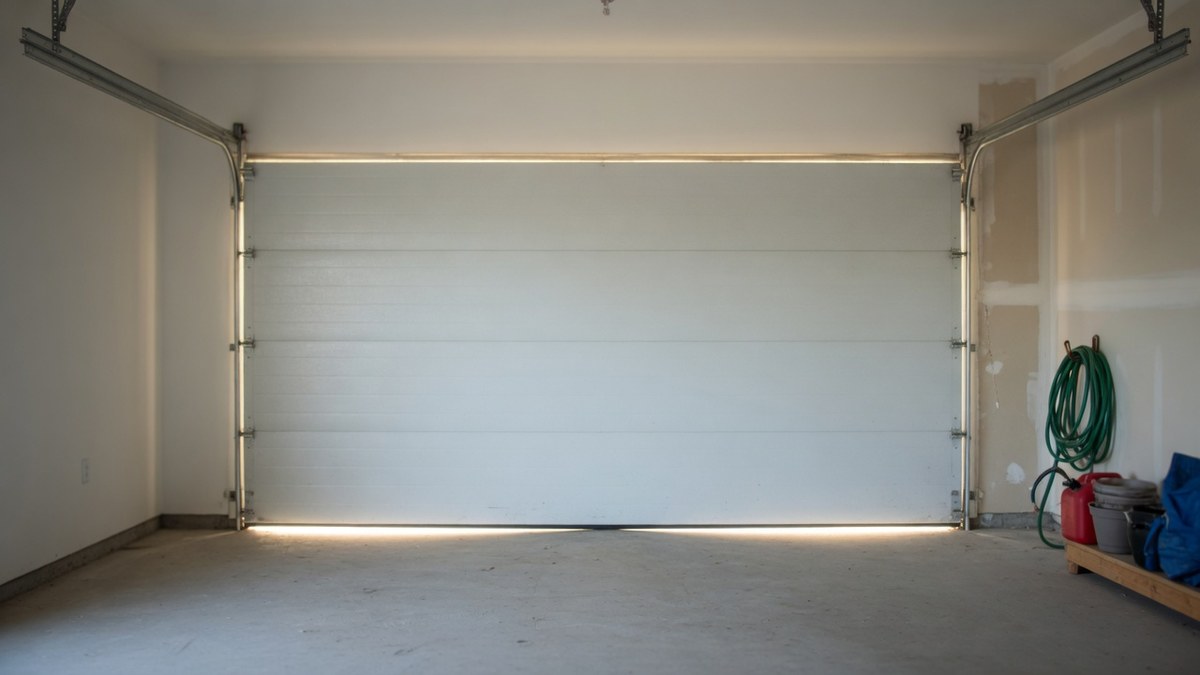
Your garage door is making a grinding noise. Or it's sticking halfway up. Or worse - it just came off the tracks completely.
Track problems are the #3 most common garage door issue we fix across Texas, right behind springs and openers.
Here's the good news: Some track issues are easy DIY fixes. Others require professional help but aren't expensive.
Let me show you how to diagnose track problems, what you can safely fix yourself, and when to call for professional track repair or replacement.
How Garage Door Tracks Work
Understanding the system helps you diagnose what's gone wrong. A garage door rides on two vertical tracks that guide it from the floor up to the ceiling, then hands it off to a pair of horizontal tracks that support the door while it's fully open. A curved transition section connects the two runs, and rollers - small wheels mounted to the door's edge - ride inside the track channel the entire way.
For any of that to work, the tracks have to be in good shape on three fronts: perfectly aligned both vertically and horizontally, spaced identically on both sides, straight with no bends or dents, and bolted tight at every bracket. When any one of those conditions fails, the door binds, makes noise, or comes off the track entirely.
ROLLER TYPES
Steel rollers
Cost $5-$10 each and do the job, but they're noisy, they create more friction against the track surface, and they wear out in five to seven years.
Nylon rollers
Run $10-$20 each and are quieter, gentler on the track interior, and low-maintenance - they typically last ten to fifteen years.
Ball-bearing rollers
Available in both steel and nylon, add smoothness and reduce friction further compared to plain-bearing rollers.
Common Track Problems
Misaligned Tracks
Of all the track problems we see across Austin, San Antonio, and McAllen, misalignment is the one that sneaks up on homeowners. The door starts feeling slightly stiff, then the grinding begins, and eventually it crooked-closes or refuses to move past a certain point.
The telltale signs are a door that binds or sticks, visible gaps between a roller and one side of the track, a rubbing noise during travel, and a door that looks crooked when it reaches the closed position. Misalignment usually traces back to mounting brackets that have vibrated loose over years of use, foundation settling from Texas clay soil, an impact event, or a poor original installation. If you catch it early, a moderately handy homeowner can correct it with a wrench, a level, and a rubber mallet.
DIY Fix Potential: Moderate (if caught early)
HOW GARAGE DOOR TRACKS WORK
Vertical tracks
Guide it from the floor up to the ceiling.
Curved transition section
Connects the two runs.
Horizontal tracks and rollers
Support the door while it's fully open. Rollers - small wheels mounted to the door's edge - ride inside the track channel the entire way.
Bent Tracks
A bent track is harder to miss and harder to fix. You'll see a visible crimp or bow in the metal, the door will stop dead at the damaged section, and the sounds shift from a rub to a full grind or scrape. Rollers sometimes jump out of the track entirely when they hit the bend.
Most bent tracks come from a vehicle backing into the door, the door closing on an obstruction, or, less commonly, age-related metal fatigue in a track that's been in service for two decades or more. Straightening is sometimes possible on minor bends, but the repaired section is permanently weakened - most of the time, replacement is the smarter call.
DIY Fix Potential: Low (usually needs replacement)
Obstructed Tracks
This one has the highest DIY success rate because the fix is often just cleaning. The door stops at a specific point, makes a grinding noise at that same spot every time, and when you look closely you can see debris, rust buildup, a broken roller piece, or old gummed-up lubricant sitting inside the track channel.
Regular cleaning prevents most obstruction problems entirely. Texas garages collect dust, sawdust, road debris blown in, and the occasional rock that rides in on a tire - all of it eventually migrates into the track.
DIY Fix Potential: High (simple cleaning)
Broken or Loose Mounting Brackets
The brackets are what hold the track to the wall and ceiling framing. When they loosen or fail, the track starts pulling away from its mounting surface. You'll notice the door getting progressively harder to operate, a visible gap where a bracket used to sit flush against the wall, and vibration during every cycle that gradually makes things worse.
Vibration from the opener and the door's weight work bolts loose over time, and foundation movement accelerates that process in Texas homes built on clay. Tightening loose brackets is straightforward work. Brackets that have actually cracked or pulled through the mounting surface are a different story and warrant a professional look.
DIY Fix Potential: Moderate (tightening is easy)
This one has the highest DIY success rate because the fix is often just cleaning.
Worn Track Surface
Track wear is the slow-burn failure mode. The interior channel becomes rough or corroded, rollers start leaving grooves in the metal, the door drags instead of gliding, and noise increases steadily. By the time the surface is visibly rough to the eye, the damage is usually too far along to clean or sand back to serviceable condition.
Steel tracks in humid or coastal Texas climates rust faster than those in drier inland areas. Cheap big-box tracks use thinner gauge steel that corrodes and wears out in a fraction of the time a quality track would last.
DIY Fix Potential: Low (track replacement needed)
| Track Problem | DIY Fix Potential |
|---|---|
| Misaligned tracks | Moderate (if caught early) |
| Bent tracks | Low (usually needs replacement) |
| Obstructed tracks | High (simple cleaning) |
| Broken or loose mounting brackets | Moderate (tightening is easy) |
| Worn track surface | Low (track replacement needed) |
DIY Track Maintenance & Minor Repairs
Monthly Track Maintenance (10 Minutes)
Ten minutes a month extends track life significantly. The goal is to keep the channel clean, the hardware tight, and your eyes on anything developing before it becomes a real problem.
Start by wiping the inside of the tracks with a damp cloth - no harsh chemicals, just enough moisture to pick up dirt and dust, then dry completely. Next, look for anything sitting in the track path and remove it. Run your eyes along both tracks looking for gaps between a roller and the track wall, any visible straightness issues, or bends. Finally, go around every bracket bolt with a wrench and snug anything that's worked loose - stop short of over-tightening, which can distort the bracket.
Easy DIY Fixes
For obstructed tracks, the sequence is: disconnect the opener using the red emergency handle so the motor can't engage while you're working, manually lift the door above the problem area, scrub the track interior with a stiff brush, wipe it clean with a damp cloth, dry it thoroughly, then lower the door and test.
- Disconnect opener (red handle)
- Manually lift door above problem area
- Use stiff brush to clean track
- Wipe with damp cloth
- Dry completely
- Lower door and test
Tightening loose brackets is even simpler, but check alignment after you're done - tightening can shift a bracket that was holding the track at a slight angle.
- Use socket wrench or adjustable wrench
- Tighten all mounting bolts
- Check track alignment after tightening
- Test door operation
Minor alignment adjustment requires a light touch: the goal is to move the track in small increments and verify with a level each time rather than hammering it into position all at once.
- Loosen track bracket bolts slightly
- Tap track gently with rubber mallet
- Check alignment with level
- Tighten bolts when aligned
- Test door operation
Skill required: Basic homeowner Tools needed: Wrench, level, rubber mallet, cloth Time: 15-30 minutes
When DIY Isn't Enough
Some track problems look manageable from the outside but cross a line where attempting a home repair creates more risk than it resolves. If the track is bent more than slightly, if the door has come completely off its tracks, if you've tried alignment and can't get it right, if multiple tracks are affected, or if the door won't move at all - stop and call a professional. Operating a door with seriously damaged tracks means the door could drop without warning, and a residential garage door weighs 200 to 400 pounds.
Calling us early also prevents a recoverable situation from becoming a replacement-level event: a door that binds and grinds is damaging its rollers, its opener drive, and its panels every cycle it runs in that condition.
Track problems? Call (888) 601-6005 for professional diagnosis
Professional Track Repair
Track Realignment
Professional realignment is warranted when misalignment is significant enough that the minor-adjustment DIY approach won't hold, when foundation settling has shifted multiple points along the track, or when a homeowner has already tried to adjust and couldn't get it square. The job requires disconnecting the opener, taking precise measurements to establish true alignment, loosening all mounting brackets simultaneously, adjusting the track to specification, verifying with a level, and torquing everything back down before testing the full travel cycle.
Cost: $125-$250
Time: 1-2 hours
Bent Track Repair
Whether a bend can be straightened or needs full replacement depends on severity. Minor bends - the kind where the door still moves but binds slightly - can sometimes be straightened with the right tools. The repair costs $100-$175 and is worth attempting before committing to replacement. Severe bends are a different calculation: straightening weakens the metal at the bend point, and a track that fails again in that spot puts the door at risk of dropping. Replacement runs $200-$400 and gives you a track with no compromised sections.
Professional assessment determines: Repair vs. replace
Track problems are the #3 most common garage door issue we fix across Texas, right behind springs and openers.
Track Replacement
Full track replacement is the right answer when tracks have severe bends or crimps, when rust has eaten through the metal, when the track surface is worn to the point of causing accelerating roller damage, when multiple sections have problems, or when the track is past 20 years old. The process involves securing the door safely before removing the old hardware, installing new tracks, aligning them precisely, mounting every bracket at proper torque, and running a full operational test before calling the job done.
Professional track replacement pricing covers labor and materials both:
- Single track: $200-$300
- Both tracks: $350-$500
- Includes labor and materials
Time: 2-3 hours
Emergency Track Repair
A door that's completely off its tracks, stuck open where it's a security risk, or preventing a car from leaving the garage is a same-day call. We offer 24/7 emergency service across Texas, and emergency calls carry a $100-$150 premium over standard rates. If the door still closes, still provides some security, and you have another way in and out, you can schedule a standard appointment - but don't delay more than a day or two, because a damaged track that's still operating is causing more damage with every cycle.
Full track replacement is the right answer when tracks have severe bends or crimps, when rust has eaten through the metal, when the track surface is worn to the point of causing accelerating roller damage, when multiple sections have problems, or when the track is past 20 years old.
Track Alignment: The Critical Factor
Why Alignment Matters
Alignment is the single factor that affects every other part of the garage door system. When the tracks are true, the door glides on its rollers with minimal friction, the springs carry the load evenly across both sides, and the opener motor runs near idle load. When tracks are off - even by a fraction of an inch - every component works harder. Friction increases, rollers wear out faster, springs develop uneven tension, noise builds, and the opener motor runs hot trying to compensate. A door that's been running on misaligned tracks for years will typically need rollers, and sometimes springs or an opener, replaced alongside the track work.
How to Check Alignment
Four tests cover alignment thoroughly. The visual check is first: stand in front of the door and look at both tracks from the same angle - they should be perfectly parallel with identical spacing from top to bottom and no visible twists or bends. Next, place a level against the face of each vertical track; a properly installed track is plumb. Then place the level on each horizontal track - it should be level or pitched slightly down toward the back of the garage to keep the door from drifting forward. Finally, watch the rollers during a full open-and-close cycle: each roller should stay centered in the channel with no gap on either side, maintaining consistent contact through the entire travel.
If any test flags a problem, the tracks need adjustment.
Texas-Specific Alignment Challenges
Texas clay soil is the hidden factor in a lot of track calls we run across the state. The clay expands during wet periods and contracts during drought, and that movement translates directly into house movement - sometimes two to three inches across a seasonal cycle. Garage walls and framing shift with the foundation, and the track brackets go with them. A door that aligned perfectly when installed can drift out of spec over a single wet season. We recommend checking alignment quarterly in Central Texas and South Texas, and watching for the pattern of doors sticking after heavy rain or operation changing between summer and winter - both are signs that foundation movement is working on your tracks.
Metal expansion from extreme heat adds a secondary variable. Austin and San Antonio summers push garage temperatures well past 100 degrees, and metal tracks expand measurably at those temperatures. Tracks installed to tight tolerances in January sometimes bind in July. This is one reason proper installation leaves small accommodation gaps rather than fitting tracks dead-tight.
Roller and Track Relationship
Roller Types
The rollers your door uses have a direct effect on how long the tracks last. Steel rollers cost $5-$10 each and do the job, but they're noisy, they create more friction against the track surface, and they wear out in five to seven years. Nylon rollers run $10-$20 each and are quieter, gentler on the track interior, and low-maintenance - they typically last ten to fifteen years. Ball-bearing rollers (available in both steel and nylon) add smoothness and reduce friction further compared to plain-bearing rollers. If you're replacing rollers anyway, the nylon ball-bearing upgrade is worth the extra cost in track preservation alone.
FOUR WAYS TO CHECK TRACK ALIGNMENT
Visual check
Stand in front of the door and look at both tracks from the same angle - they should be perfectly parallel with identical spacing from top to bottom and no visible twists or bends.
Vertical track level check
Place a level against the face of each vertical track; a properly installed track is plumb.
Horizontal track level check
Place the level on each horizontal track - it should be level or pitched slightly down toward the back of the garage to keep the door from drifting forward.
Roller check
Watch the rollers during a full open-and-close cycle: each roller should stay centered in the channel with no gap on either side, maintaining consistent contact through the entire travel.
When Rollers Damage Tracks
A worn roller doesn't just fail - it damages the track it's riding in. Rollers that have lost their bearing surface grind against the track wall and carve grooves into the metal. A broken roller is worse: the jagged metal scrapes along the track, gouging the surface, binding the door, and eventually knocking it off the track entirely. We see this pattern regularly - a homeowner waits on a noisy roller until the door stops working, and then the repair includes both rollers and track replacement because the damage propagated from one to the other.
The prevention window is replacing rollers every seven to ten years, upgrading to nylon at replacement time, and keeping them lubricated monthly. The lubrication goes on the rollers themselves, never in the track channel.
Track Problems From Impact Damage
Common Impact Scenarios
Vehicle impact is the most common cause of bent tracks. Backing into the door bends the bottom section of the vertical track, and the impact often also damages one or more door panels - so the full repair scope is broader than just the track. Closing on an obstruction (a bicycle, a trash can, a tool left on the floor) bends the track or knocks it out of alignment and sometimes damages door panels at the same time. A spring failure that drops the door without the gradual let-down of a working spring can bend both tracks and damage rollers in a single event.
Assessing Impact Damage
Minor impact leaves a small dent in the track while the door still moves, though with some binding or noise. Track straightening is possible here and costs $100-$200. Moderate impact leaves a visible bend and the door either binds severely or comes off the track - replacement is the likely outcome at $300-$500. Severe impact bends the track badly, prevents any door operation, and typically damages panels as well - the total bill in those cases runs $800-$1,500 or more depending on how many components took the hit.
Foundation Issues and Tracks
How Foundation Settlement Affects Tracks
Texas clay soil presents a challenge that homeowners in other states rarely think about. The clay expands when wet and contracts when dry, and across a full weather cycle it can move a foundation two to three inches or more. That movement works its way up through the wall framing and into the track mounting points. The result is progressive misalignment, seasonal variation in how the door operates, and often one side drifting worse than the other because foundation movement is rarely uniform.
Signs of Foundation Problems
Beyond the garage door, foundation movement shows up as cracks developing in drywall, interior doors and windows that suddenly stick or gap, floors that slope where they were level before, and gaps opening between trim and walls. On the track side, the specific signs are mounting brackets pulling away from the wall, the track no longer sitting plumb, bolts that loosen repeatedly no matter how often you tighten them, and gaps appearing at the mounting points.
IMPACT DAMAGE BY SEVERITY
Minor impact
Leaves a small dent in the track while the door still moves, though with some binding or noise. Track straightening is possible here and costs $100-$200.
Moderate impact
Leaves a visible bend and the door either binds severely or comes off the track - replacement is the likely outcome at $300-$500.
Severe impact
Bends the track badly, prevents any door operation, and typically damages panels as well - the total bill in those cases runs $800-$1,500 or more depending on how many components took the hit.
When foundation movement is the root cause, track realignment buys temporary improvement. The tracks will drift again as the foundation continues to move. The durable fix is addressing the foundation, and in those cases we're honest with customers that track work without foundation work is a temporary solution.
Track Replacement: When and Why
When to Replace Tracks
Age alone is a reason to consider replacement: tracks past 20 years have accumulated fatigue, the metal is often corroded or surface-worn, and a proactive replacement is cheaper than an emergency call when one fails. Severe damage - bends that can't be straightened safely, rust-through, multiple problem areas along the same track - makes replacement the only real option. Some homeowners choose replacement as an upgrade when converting from extension springs to torsion springs, since torsion systems put different loads on the track hardware and heavier-gauge tracks perform better with that configuration.
Track Quality Levels
Track quality varies more than most homeowners realize. Budget tracks from big-box stores use thin gauge steel that rusts quickly and wears through in a fraction of the time a quality track lasts - we don't recommend them. Standard residential tracks use 17-gauge steel, perform well for most doors, and last 15-20 years under normal conditions. Heavy-duty tracks in 14-16 gauge steel are worth specifying for heavy or oversized doors and for any homeowner who wants to minimize future maintenance - they exceed 20-year service life and are the right call when you're already paying for a full replacement.
WHEN TO REPLACE TRACKS
Age
Tracks past 20 years have accumulated fatigue, the metal is often corroded or surface-worn, and a proactive replacement is cheaper than an emergency call when one fails.
Severe damage
Bends that can't be straightened safely, rust-through, multiple problem areas along the same track - makes replacement the only real option.
Upgrading to torsion springs
Some homeowners choose replacement as an upgrade when converting from extension springs to torsion springs, since torsion systems put different loads on the track hardware and heavier-gauge tracks perform better with that configuration.
Track Replacement Cost
DIY track replacement is possible but demands real skill: tracks cost $100-$200 for materials, the alignment work is unforgiving of small errors, and a track that's slightly off will cause problems from day one. Professional installation runs $200-$300 for a single track and $350-$500 for both, including alignment and a full operational test. That price also covers the liability of knowing the job was done to spec - an improperly installed track is a falling-door risk.
Preventing Track Problems
Best Practices
The maintenance rhythm that keeps tracks in good shape is straightforward. Monthly, clean the tracks with a damp cloth, do a quick visual inspection, snug any loose hardware, and check roller condition. Quarterly, do a more thorough inspection with a level, look specifically at mounting bracket condition, and run a smooth-operation test from full open to full close. Once a year, have a professional run through the system - they'll catch alignment drift that's too subtle to see by eye and address minor issues before they grow into expensive repairs.
What Accelerates Track Wear
Forcing a door that's binding, hitting the door with a vehicle, closing on an obstruction, lubricating the tracks instead of the rollers, and ignoring early warning noises - these are the behaviors that turn a $150 service call into a $500 track replacement. The flip side is equally simple: operate the door gently, clear the area before closing, deal with problems when they're small, and get a professional through the system annually.
MAINTENANCE RHYTHM
Monthly
Clean the tracks with a damp cloth, do a quick visual inspection, snug any loose hardware, and check roller condition.
Quarterly
Do a more thorough inspection with a level, look specifically at mounting bracket condition, and run a smooth-operation test from full open to full close.
Once a year
Have a professional run through the system - they'll catch alignment drift that's too subtle to see by eye and address minor issues before they grow into expensive repairs.
Texas-Specific Protection
Quarterly alignment checks are more important in Texas than in most states because of the foundation movement issue described above. Keep hardware snugged regularly rather than waiting for the annual visit. After storms, clear debris from the tracks - Central Texas storms blow in enough material to obstruct a track in a single event. Garage ventilation helps in summer by keeping peak temperatures lower, which reduces thermal expansion stress on the tracks and every other component in the system.
Track Repair vs. Door Replacement
When Track Replacement Makes Sense
If the door is less than ten years old, in otherwise good condition, quality construction, and the problem is isolated to the tracks, repair is almost always the right call. Track replacement at $350-$500 against a new door at $1,200-$2,500 is a straightforward comparison in those cases - the savings are real and the door has plenty of useful life remaining.
When Full Door Replacement Makes Sense
When a door is 15 or more years old and the track problem is one item on a longer list - worn panels, failing springs, an opener that's on its last legs - the math shifts. Repairing the tracks, then the springs, then the opener over the next two years adds up to more than a new door costs, and the new door comes with modern safety features, better energy performance, a warranty, and 20-30 years of reliable service ahead of it.
TEXAS-SPECIFIC TRACK PROTECTION
Quarterly alignment checks
More important in Texas than in most states because of the foundation movement issue described above.
Keep hardware snugged
Keep hardware snugged regularly rather than waiting for the annual visit.
Clear debris after storms
Central Texas storms blow in enough material to obstruct a track in a single event.
Garage ventilation
Helps in summer by keeping peak temperatures lower, which reduces thermal expansion stress on the tracks and every other component in the system.
The 50% Rule
A useful benchmark: if the total cost of all needed repairs would exceed roughly half the cost of door replacement, replacing the door is typically the better investment. By way of example - track replacement at $400, panel replacement at $500, and spring replacement at $250 adds up to $1,150. If a new door runs $1,800, those repairs represent more than half the replacement cost. In that scenario, most experienced technicians would recommend replacement. We walk customers through this calculation honestly during diagnosis so the decision is based on real numbers, not guesswork.
Insurance and Off-Track Repairs
Homeowner's insurance may cover off-track damage when the failure was triggered by a covered event: a storm, a fallen tree, or some other sudden external cause. Age-related spring failure and normal component wear are typically excluded, as is damage from lack of maintenance. If the off-track event caused significant damage and there is a plausible covered cause, it is worth calling your insurance company and documenting the situation thoroughly with photos and written estimates before the repair happens.
Home warranties vary widely in what they cover for garage doors. Check your policy for coverage limits, deductibles, excluded causes, and whether you need to use a network provider or can choose your own technician and seek reimbursement.
IF SOMETHING GOES WRONG
Door off the track
Leave it exactly where it is. Don't try to lift it, push it, or walk under it. Clear the area underneath, disconnect the opener so it can't try to run a cycle, and call a professional.
Door still operational but suspect
Test it carefully through one slow cycle with your hand on the disconnect cord. If it binds, grinds, or moves unevenly, disconnect the opener and call for an assessment rather than continuing to run it.
Safety Considerations
When Tracks Are Dangerous
A garage door that's off its tracks is a genuine hazard. The door - which weighs 200 to 400 pounds - is no longer constrained by the track system and can drop suddenly with minimal provocation. Severely bent tracks create the same risk: the door's path becomes unpredictable, cables can snap under asymmetric load, and any attempt to operate the door manually can end with it falling. Loose tracks that haven't failed yet are in the same category - they may hold for another cycle or may not. Don't operate a door with visibly damaged or loose tracks.
Safety Protocols
If the door comes off the track, the right response is to leave it exactly where it is. Don't try to lift it, push it, or walk under it. Clear the area underneath, disconnect the opener so it can't try to run a cycle, and call a professional. We handle off-track doors every week and have the equipment to restrain the door safely before attempting any repair.
If you suspect track damage but the door is still operational, test it carefully through one slow cycle with your hand on the disconnect cord. If it binds, grinds, or moves unevenly, disconnect the opener and call for an assessment rather than continuing to run it.
Track emergency? Call (888) 601-6005 - 24/7 service across Texas
WHY DAMAGED TRACKS ARE DANGEROUS
Off-track door
The door - which weighs 200 to 400 pounds - is no longer constrained by the track system and can drop suddenly with minimal provocation.
Severely bent tracks
The door's path becomes unpredictable, cables can snap under asymmetric load, and any attempt to operate the door manually can end with it falling.
Loose tracks that haven't failed yet
They may hold for another cycle or may not.
Our Track Repair Service
Pros On Call handles track repair and replacement across Texas, from Austin and San Antonio to McAllen and every market in between. We're licensed under #B19847 and have been serving Texas homeowners since 2010.
Every track call includes professional diagnosis, a written estimate before any work starts, quality parts, precision alignment with a full operational test at completion, and warranty coverage on the work performed. Same-day service is typically available.
Here's what a typical track service call covers:
- Track realignment ($125-$250)
- Minor bend repair ($100-$175)
- Track replacement ($200-$500)
- Mounting bracket repair
- Roller replacement
- Complete inspection
- Same-day service available
Why homeowners across Texas call us: licensed under #B19847, 15 or more years of field experience, family owned since 2010, fair pricing with no hidden charges, and every job backed by a warranty.
Call (888) 601-6005 for track repair
Available 24/7 across Texas
WHAT A TRACK SERVICE CALL COVERS
Track realignment
$125-$250
Minor bend repair
$100-$175
Track replacement
$200-$500
Same-day service
Same-day service available.
Final Track Repair Advice
Track problems don't stay small. A strange noise this month is a door that won't move next month if the underlying issue isn't addressed - we've seen that pattern more times than we can count. Cleaning and tightening are genuinely effective DIY work, and minor alignment adjustments are within reach for a handy homeowner. But bent tracks, a door off its rails, complex alignment problems, and anything that raises a safety question belong with a professional.
Tracks carry the full weight of the door through every cycle, and a failure isn't just an inconvenience - it's a falling-door event waiting for the right moment. Small investment in maintenance and timely repair prevents that outcome.
Track issues? Get professional assessment today.
Properly aligned tracks mean smooth, safe operation for years to come.
Content strategy and SEO by Optymizer