
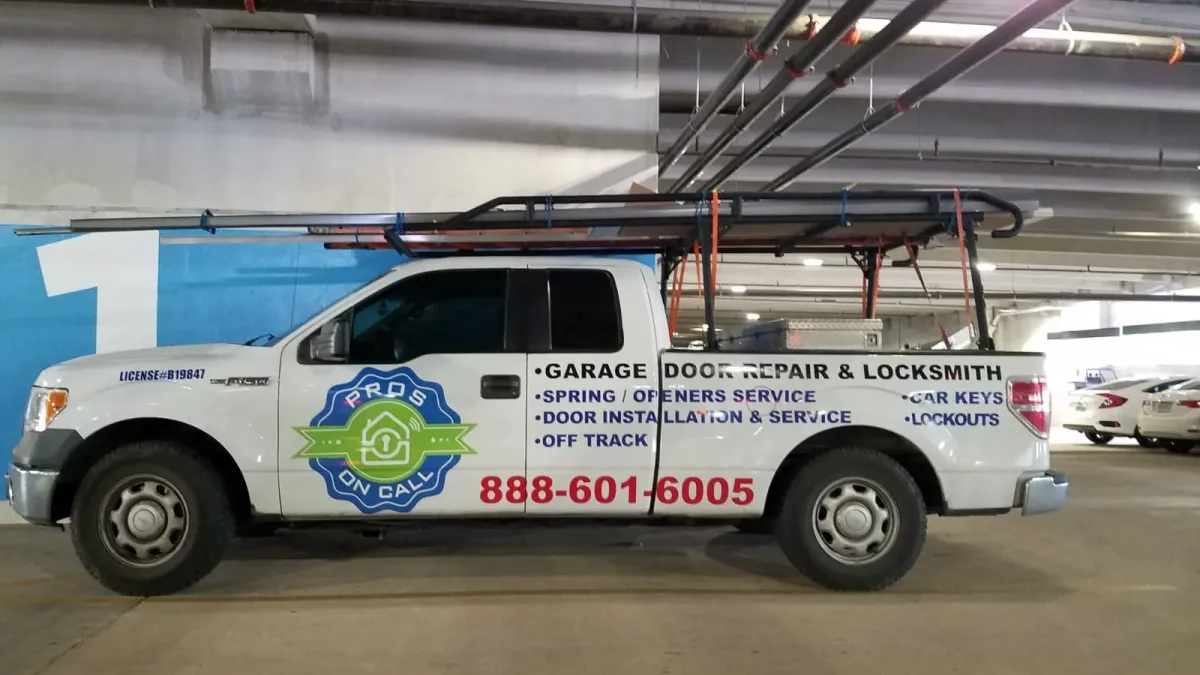
Choosing the right garage door repair company can mean the difference between a quick, professional fix and a nightmare of poor service, hidden fees, and safety risks. With hundreds of garage door companies operating across Texas, from legitimate family businesses to fly-by-night scammers, knowing how to identify quality service protects your home, your budget, and your safety.
Need a trusted garage door repair company in Texas? Call Pros On Call at (888) 601-6005. Family owned since 2010, licensed (#B19847), insured, and available 24/7 statewide.
Why Choosing the Right Company Matters
Safety Implications
A garage door is not just a large moving object. It is a tensioned mechanical system with real potential to injure or kill when handled carelessly. The springs alone store enough energy to send a coiled cable snapping across a garage at high speed if they fail during service. That risk goes up sharply when an undertrained technician rushes a job. The basic numbers tell the story:
- Springs under 400-600 pounds of tension
- 150-400 pound door overhead
- Electrical components and fast-moving parts
- Pinch points throughout the system
Improperly repaired doors cause real harm. A spring installed at the wrong tension can fail days after service, sending the door crashing down without warning. Opener sensors that are not properly aligned will allow the door to close on a person, a pet, or a vehicle. Electrical shortcuts create fire hazards. These are not edge cases. They are the predictable outcomes of cutting corners on a system that operates under significant mechanical force.
Real Texas incident (Dallas, 2021): Unlicensed "repair company" installed spring incorrectly. Door fell three days later, crushing homeowner's truck ($18,000 damage). Company had disappeared; no insurance, no recourse.
THE BASIC NUMBERS
Springs
The springs alone store enough energy to send a coiled cable snapping across a garage at high speed if they fail during service.
Overhead door
A garage door is not just a large moving object.
Electrical and moving parts
Electrical components and fast-moving parts.
Pinch points
Pinch points throughout the system.
Financial Protection
The sticker price of a repair quote tells you almost nothing about what you will actually spend. Cheap upfront service tends to cost far more over time because inferior parts fail faster, failed parts damage adjacent components, and repeated service calls add up quickly.
The cheap-upfront pattern plays out the same way almost every time:
- $99 "special" uses inferior parts that fail within months
- Repeat repairs needed, sometimes two or three times within a year
- Failed components can damage the opener or tracks
- Eventually requires complete system replacement
Example: Houston homeowner paid $99 for spring replacement. Spring broke again in 4 months, damaged opener ($450 to replace). Total cost: $549 vs. $250 for quality repair initially.
Warranty problems compound the financial risk. Shoddy work voids manufacturer warranties and often comes with no labor warranty at all. When the company has already moved on or dissolved, there is no one to call back. Dishonest companies also inflate bills through unnecessary recommendations. "safety upgrades" that do not exist, part replacements when an adjustment would fix the issue, and scare tactics designed to push you toward expensive work you do not need.
Long-Term Reliability
A quality repair done once is a fundamentally different outcome than a series of band-aid fixes that return you to the same problem every few months. A company with real expertise diagnoses the root cause, uses parts appropriate for your specific door, and tells you what else to watch before it becomes a failure. That kind of service relationship saves money and frustration over years, not just weeks.
Poor workmanship, by contrast, produces recurring problems, escalating repair costs, and eventual full replacement far earlier than the system's natural lifespan would suggest.
Essential Qualifications to Verify
Business Licensing and Insurance
Texas does not require a specific state license to work on garage doors the way it does for electricians or plumbers, but that does not mean anyone with a truck can legally operate a service business. Every legitimate garage door company must be properly registered as a business entity in Texas, and that registration is publicly verifiable. Before you hire anyone, check the basics:
- Registered business entity with Texas Secretary of State
- Assumed name certificate (DBA) if applicable
- Sales tax permit from Texas Comptroller
Verification takes about five minutes and is entirely public:
- Ask for business name and registration number
- Check Texas Secretary of State website (sos.texas.gov)
- Search the business entity database
- Verify active status
Watch out for companies that claim no license is required in Texas as a way to avoid scrutiny, while it is technically true for the trade itself, a legitimate business still must be properly registered. Other warning signs include an inability to provide a business name, a different name on the truck versus the invoice, and no physical business address.
VERIFYING A LICENSE TAKES FIVE MINUTES
1. Ask
Ask for business name and registration number.
2. Check
Check Texas Secretary of State website (sos.texas.gov).
3. Search
Search the business entity database.
4. Verify
Verify active status.
Insurance requirements
Insurance is where the real financial protection lives for you as a homeowner. If a technician damages your car, your door frame, or anything else in your garage during service, you have no recourse against an uninsured company. The minimum you should ask for is general liability coverage of at least $1 million and workers' compensation if the company has employees.
General liability insurance protects your property and covers damage caused during service. Workers' compensation covers their employees and shields you from liability if a worker is injured on your property. Both should be current, and you should ask for a certificate of insurance rather than taking the technician's word for it.
A 2020 San Antonio claim shows what happens without it:
- Technician dropped door panel, damaged homeowner's car
- Company had no insurance
- Homeowner paid $3,500 out of pocket
- Company filed bankruptcy
With proper insurance, a claims process handles the damage and the homeowner pays nothing. The difference is entirely about whether you verified coverage before the work started.
Verifying insurance takes one call and is worth doing before any technician arrives:
- Request certificate of insurance
- Call the insurance company to verify the policy
- Check coverage amounts
- Confirm the policy is current
For Pros On Call: Texas License #B19847, fully insured, certificate available on request, coverage verified annually.
Unlicensed "repair company" installed spring incorrectly. Door fell three days later, crushing homeowner's truck ($18,000 damage). Company had disappeared; no insurance, no recourse.
Experience and Expertise
Years in business matter because they are a proxy for accountability. A company that has been operating in Texas for a decade has a reputation to protect, a track record you can investigate, and a financial stake in doing good work. Fly-by-night operators disappear precisely because they have none of those ties. For local companies, five or more years in business is a reasonable floor; larger regional companies should have ten or more. National franchises offer brand-name consistency but vary significantly in local execution.
A few quick checks will tell you most of what you need to know:
- Check Better Business Bureau (BBB.org)
- Google business listing showing year established
- Ask for customer references
- Review the "About Us" section of their website
Specialty expertise
Not all garage door companies have equal depth across all system types. For residential work, look for experience with single and double car doors, standard and custom sizes, all major opener brands, smart home integration, and insulated doors suited to the Texas climate. If you have an oversized or commercial door, verify the company has handled high-cycle springs and heavy-duty systems before.
Quality companies service all major door brands. Clopay, Amarr, Wayne Dalton, CHI Overhead Doors, Raynor, Haas, Overhead Door Corporation, and all common opener brands including LiftMaster, Genie, Chamberlain, Craftsman, Linear, and Marantec. A company that only works on one brand, refuses to service older systems, or immediately recommends replacement for any problem is telling you something important about how they operate.
QUICK CHECKS FOR EXPERIENCE
Better Business Bureau
Check Better Business Bureau (BBB.org).
Google business listing
Google business listing showing year established.
Customer references
Ask for customer references.
About Us section
Review the "About Us" section of their website.
Technician Training and Certification
Training and certification are voluntary in the garage door industry, which means they function as a signal of genuine professionalism rather than a legal requirement. The International Door Association (IDA) offers the most recognized credentials, including the Certified Door Technician (CDT), Certified Door Consultant (CDC), and Master Certified Technician designations. Each requires full training and ongoing education, which keeps technicians current with evolving technology. Major manufacturers like LiftMaster and Clopay also offer brand-specific certifications that authorize technicians to perform warranty work.
Beyond credentials, professional companies conduct background checks, drug testing, driving record verification, and references checks on their technicians. These are not bureaucratic boxes. They reflect that technicians come to your home, work in a garage that typically connects to your living space, and have access to your vehicles. That context demands professional-grade screening.
Red Flags to Avoid
Pricing Red Flags
Too-good-to-be-true prices
The bait-and-switch is the most common predatory tactic in the garage door industry. A "$49 garage door repair" ad gets the technician into your home; once there, the advertised special does not apply to your actual problem, and the pressure is on to approve an expensive repair. The way to defeat this tactic is to ask specifically what the advertised price covers before scheduling, get a written estimate before any work begins, and refuse surprise upsells once the technician is on-site.
No written estimates
Any legitimate company will give you a written estimate before touching your door. The estimate should break down parts and labor separately, show a clear total, and leave no room for hidden fees. Be wary of technicians who claim they cannot quote without seeing the door. That can be legitimate for genuinely complex diagnostics, but the moment they are on-site they should provide a written number. If you only get a vague verbal quote like "it will run a few hundred, maybe more once we get into it," that vagueness is deliberate and it protects the company, not you.
Cash-only demands
Companies that insist on cash are signaling that they want no paper trail. Credit and debit card payments create a dispute mechanism if the work is fraudulent or incomplete. Legitimate companies accept cards and provide detailed receipts with full business information on the invoice.
High-pressure sales tactics
A professional company respects your decision timeline, provides an estimate for you to review at your own pace, and is willing to return for scheduled work rather than insisting on same-day service. Watch for "must decide today" pricing, artificial urgency, refusals to let you get a second opinion, and any trace of intimidation. Those are not aggressive sales tactics. They are signs you are being manipulated.
PRICING RED FLAGS
Too-good-to-be-true prices
The bait-and-switch is the most common predatory tactic in the garage door industry.
No written estimates
Any legitimate company will give you a written estimate before touching your door.
Cash-only demands
Companies that insist on cash are signaling that they want no paper trail.
High-pressure sales tactics
A professional company respects your decision timeline and is willing to return for scheduled work.
Service Red Flags
Unlicensed and uninsured contractors
The unlicensed operator typically presents as a "buddy with a truck" or someone who does this on the side, and the price will be noticeably lower than licensed companies. That gap exists because they are not carrying insurance, not paying licensing fees, and often not using quality parts. If something goes wrong, there is no liability protection, no warranty to enforce, and no business address to show up at.
No physical business address
A company with only a cell phone number, a P.O. Box, or a different address on the invoice versus the website is one you cannot find when something goes wrong. A physical address lets you verify the business exists, gives you somewhere to direct a complaint, and indicates a local Better Business Bureau presence you can check.
Poor online presence
No website, no Google Business listing, no reviews, or a social media presence that is only a few weeks old are all signs of a company that either just launched or has been cycling through new identities. Quality companies have professional websites, verified Google Business listings, reviews spanning multiple years across several platforms, and real photos of their work and team, not just stock images.
Inability to provide references
A company with a real track record will readily offer recent customer references, long-term testimonials, and links to review platforms. Defensiveness when asked, vague claims that "all our customers prefer privacy," or a list of generic testimonials with no way to verify them are all warning signs.
Refusal to provide warranty
Parts on new garage door components carry manufacturer warranties ranging from one to ten years. Any company doing professional labor should back that work for at least one to three years. A written warranty document with clear terms is the baseline expectation. "Garage doors aren't warrantied" is simply false, and a thirty-day warranty with a long list of exclusions is barely better than no warranty at all.
SERVICE RED FLAGS
Unlicensed and uninsured contractors
If something goes wrong, there is no liability protection, no warranty to enforce, and no business address to show up at.
No physical business address
A company with only a cell phone number or a P.O. Box is one you cannot find when something goes wrong.
Poor online presence
No website, no Google Business listing, no reviews, or a social media presence that is only a few weeks old.
Refusal to provide warranty
A written warranty document with clear terms is the baseline expectation.
Technician Behavior Red Flags
Arriving in an unmarked vehicle
A branded vehicle with the company logo, phone number, and professional lettering is a basic marker of a legitimate operation. A technician showing up in a personal car with no markings, or with makeshift signage, is not someone the company has invested in presenting professionally.
No company uniform or ID
Professional technicians carry a company uniform or shirt, a name tag or ID badge, and business cards. These are not formalities. They confirm you are dealing with who you think you are.
Recommending complete replacement for minor issues
This is among the most financially damaging tactics. "The whole door needs replacing" when springs and panels could be repaired, "the opener is obsolete" when a straightforward repair would fix it, "the tracks are shot" when they need adjustment, or "can't get parts for this model" (false for most systems). Each of these can add hundreds or thousands of dollars to your bill needlessly.
Replacement genuinely makes sense when the door is 20 or more years old, multiple major components have failed simultaneously, there is severe structural damage, safety standards are outdated with no sensors, or the cost to repair exceeds roughly half of replacement cost. Outside those situations, get a second opinion before agreeing to anything over $1,000.
A branded vehicle with the company logo, phone number, and professional lettering is a basic marker of a legitimate operation.
Questions to Ask Before Hiring
Initial Contact Questions
1. "Are you licensed and insured in Texas?"
A legitimate company answers yes immediately, provides the license number without hesitation, and offers to email an insurance certificate. Hesitation, defensiveness, or claims that licensing is not required in Texas are all disqualifying responses.
2. "How long have you been in business?"
Strong answers name a specific founding year and connect it to local Texas service history. Vague timeframes, claims of being new but highly experienced, or an inability to give a specific date suggest the company either recently launched or has been operating under rotating names.
3. "Do you provide written estimates?"
The right answer is yes, always, before any work begins. If the technician dodges with a vague "it usually runs a few hundred" or gives only verbal numbers, that vagueness is a deliberate tactic. It leaves you with no documentation if the final bill looks nothing like what was discussed.
4. "What brands do you work with?"
Quality companies list multiple major brands and confirm familiarity with your specific door and opener. A company that only works with one brand, cannot identify common brands by name, or recommends a specific replacement before seeing the door is a concern.
5. "Do you offer emergency service?"
For broken springs that prevent you from opening your door, or a door stuck open overnight as a security risk, emergency availability matters.
- 24/7 emergency availability
- Same-day service
- Clear emergency pricing
- Dedicated emergency line
On-Site Estimate Questions
6. "Can you show me what's wrong?"
A professional technician shows you the problem, explains what failed and why, and demonstrates the issue where it is safe to do so. Refusing to show you, telling you that you "wouldn't understand," or giving vague explanations without pointing to anything specific are red flags.
7. "What are my options for repair?"
Good service presents multiple paths when they exist. Economy versus premium parts, repair versus replacement with an honest cost-benefit comparison. A technician who presents only one option, always the most expensive, is not serving your interests.
8. "What's included in your warranty?"
Ask for specific durations on parts and labor coverage, what is covered and what is excluded, and a written warranty document. Vague terms, "manufacturer warranty only," or a very short warranty period are all signs the company does not stand behind its work.
9. "Can I see your license and insurance?"
A professional technician has copies in the vehicle and hands them over without hesitation. "Left it at the office" or "I'll email it later" followed by silence means the documentation does not exist.
10. "Do you guarantee the price quoted?"
A written estimate from a reputable company is a firm price. Any changes require your explicit approval first. "This is approximate," "we may find other problems," or "could cost more once we start" are all signals the quote is not real.
A technician who presents only one option, always the most expensive, is not serving your interests.
Before Work Begins Questions
11. "What exactly will you be doing?"
Ask for a step-by-step explanation of the work: which parts are being replaced, how long the job will take, and what you will notice when it is complete. Vague answers at this stage tend to produce vague work.
12. "Will you clean up after the work?"
Professional service includes removing all debris and hauling away old parts. Leaving your garage littered with broken spring remnants and packaging is not acceptable.
13. "How should I prepare for your arrival?"
A prepared technician will tell you specifically what to clear, whether vehicles need to be out, and any access requirements for your particular repair.
14. "What if the problem isn't fixed?"
Any professional company guarantees their work and will return at no charge if the issue persists. Get clarity on the callback policy before work starts, not after.
How to Compare Multiple Quotes
Getting Multiple Estimates
Getting two or three written estimates is one of the most effective ways to protect yourself, and it costs nothing. Compare not just the numbers but the professionalism of each company's communication, the quality of their explanation, and how the technician treats you during the estimate. Schedule estimates on the same day or consecutive days while the details are fresh, allow about thirty minutes per visit, and take notes on each one.
Provide the same information to every company: door age if known, a description of the current problem, any previous repairs, and your availability for the actual service call. This creates a fair comparison baseline.
What to Compare
Price is only one dimension. A company with a strong review record, a longer warranty, faster availability, and better-quality parts may be worth paying more for, especially when the alternative is repeating the repair in six months. Look at:
- Years in business and review ratings across Google, BBB, and Facebook
- Length of parts and labor warranties and the clarity of warranty terms
- How quickly they can schedule and whether emergency availability exists
- Brand names of parts used, spring cycle ratings, and upgrade options offered
- Whether the estimate includes a safety inspection, lubrication, and adjustments
- Punctuality for the estimate appointment and overall communication quality
Price Comparison Guidelines
Prices vary legitimately based on parts quality, technician experience level, warranty coverage, and overhead from carrying proper insurance and licensing. Here are typical Texas ranges to give you a baseline. Spring replacement runs $125-$175 on the budget end, $150-$250 for standard work, and $200-$350 for premium parts. Opener repair is $100-$200 for minor fixes, $200-$350 for major repairs, and $300-$600 for full replacement.
The cheapest option usually means cheaper parts. A $99 spring replacement uses 7,000-cycle springs, may skip the safety inspection, and comes with a short or no warranty, and may be performed by someone without proper licensing. A $250 spring replacement uses 15,000-cycle springs, includes a full safety inspection and a one to three year warranty, and is done by a licensed, insured professional.
Long-term cost: a $99 spring that fails in 18 months costs $198 over three years. A $250 spring that lasts seven or more years costs $250 over seven years.
Be suspicious of a quote that is more than 50% cheaper than the others with no clear explanation, or one that jumps dramatically between the phone estimate and the on-site visit. A different price for cash versus credit card is also a warning sign.
WHAT TO COMPARE
Years in business and reviews
Years in business and review ratings across Google, BBB, and Facebook.
Warranty terms
Length of parts and labor warranties and the clarity of warranty terms.
Scheduling and availability
How quickly they can schedule and whether emergency availability exists.
Parts and inspection
Whether the estimate includes a safety inspection, lubrication, and adjustments.
Checking Reviews and References
Where to Find Reliable Reviews
Texas homeowners have several reliable platforms for researching garage door companies, and the best approach is to cross-reference at least two or three before making a decision. Each platform captures a different slice of customer experience:
- Google Business Reviews. Most visible and widely trusted, with response from the business and a review history spanning years
- Better Business Bureau (BBB). Accreditation status, A+ to F ratings, complaint history, and how disputes were resolved
- Facebook Reviews. Community-level feedback from people who may share your neighborhood or city
- Yelp. Detailed written reviews with photo documentation; filter for recent reviews and check reviewer history
- Angi (formerly Angie's List). Verified service reviews with project cost information
How to Read Reviews
Volume and recency both matter, but patterns tell you the most. A company with consistent punctuality mentions, repeated professionalism notes, fair pricing comments, and examples of problem-solving over years of reviews is showing you something real. Similarly, multiple bait-and-switch complaints, recurring quality issues, billing disputes, and warranty problems that appear across many different reviews point to a systemic problem, not a single bad day.
When you encounter negative reviews, read them for specifics. A review with concrete details, a reasonable complaint, and a professional tone from someone looking for resolution carries more weight than a vague or emotional post. Pay particular attention to how the company responds: professional responses address the concern specifically, offer to make it right, and take responsibility where appropriate. Defensive responses that blame the customer, attack the reviewer, or make no attempt to resolve the issue tell you how the company behaves when something goes wrong.
WHERE TO FIND RELIABLE REVIEWS
Google Business Reviews
Most visible and widely trusted, with response from the business and a review history spanning years.
Better Business Bureau (BBB)
Accreditation status, A+ to F ratings, complaint history, and how disputes were resolved.
Facebook Reviews
Community-level feedback from people who may share your neighborhood or city.
Yelp and Angi
Detailed written reviews with photo documentation, plus verified service reviews with project cost information.
Verifying References
When you call a company's references, go beyond "did they do good work?" The questions that surface the most useful information are:
- "Was the company punctual?". Reveals whether they respect your time
- "Did the repair fix the problem?". Indicates technical quality
- "Were there any surprise charges?". Tests pricing honesty
- "How was their communication?". Shows responsiveness and clarity
- "Would you hire them again?". The most direct measure of satisfaction
- "How long ago was the service?". Lets you assess whether a repair has held up
- "Did they clean up after themselves?". Indicates respect for the customer's property
Pros On Call Garage Door Services
Pros On Call has been a family-owned Texas operation since 2010. That fifteen-plus year history is not just a marketing line. It means there are thousands of Texas homeowners who can tell you what our service actually looks like, a reputation we work to protect on every call, and a company that will still be here when you need a follow-up.
We hold Texas License #B19847, carry full liability coverage with workers' compensation, and make our insurance certificate available on request. Our technicians are employees, not subcontractors. They are background-checked, uniformed, and driving marked company vehicles. We serve Austin, Houston, Dallas, San Antonio, Fort Worth, El Paso, Arlington, Plano, and all major Texas metro areas with local technicians, not out-of-state crews dispatched to your zip code.
Every estimate is written, detailed, and firm before any work starts. No hidden fees, no cash-only demands, no pressure tactics. We use premium spring ratings and name-brand components and back our parts and labor with a written warranty. If something is not right after we leave, we come back.
For broken springs, doors off track, opener failures, or any security concern that needs same-day attention, we are available 24/7.
Call (888) 601-6005 for reliable garage door repair throughout Texas. Licensed, insured, and family owned since 2010. License #B19847.