
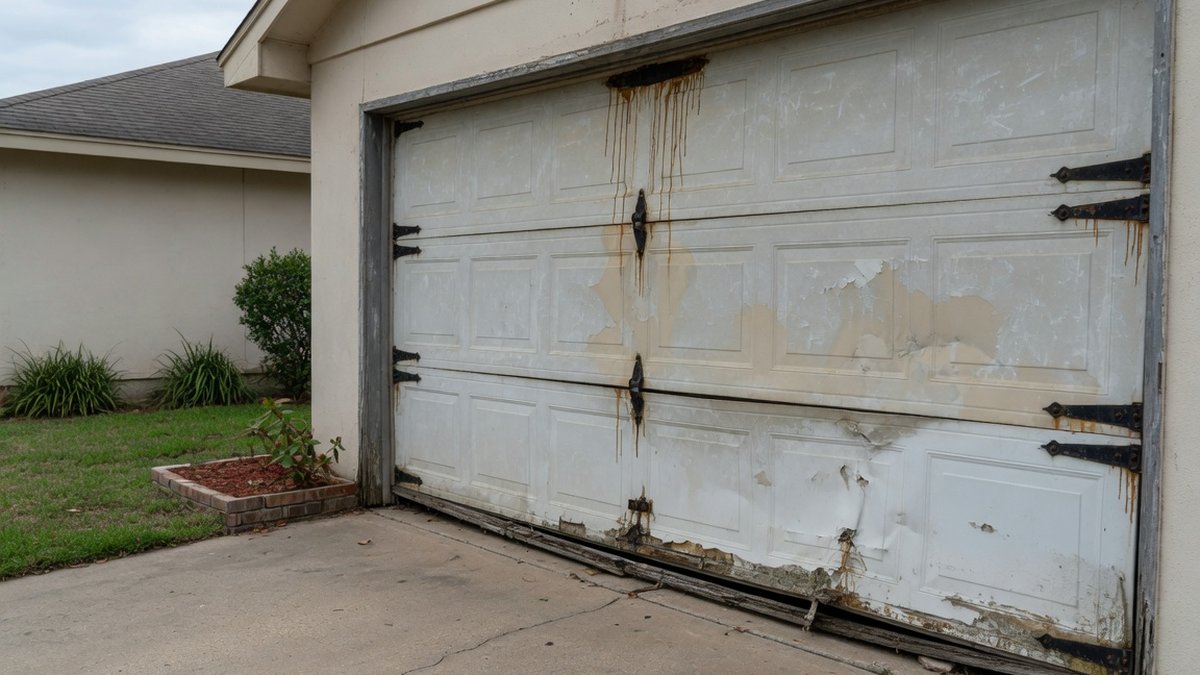
Your garage door won't open smoothly. Maybe it's making strange noises, moving slowly, or just looks tired and outdated. The question every Texas homeowner faces: repair it or replace it?
After servicing thousands of garage doors across Texas since 2010, we know the signs that mean "repair" versus those screaming "replace." Some problems are quick fixes. A broken spring, worn rollers, or minor adjustments. But other signs point to a door that's reached the end of its useful life, where repairs become throwing good money after bad.
This guide covers 12 definitive signs your garage door needs replacement, not just another repair.
Sign #1: Your Garage Door is 15-20+ Years Old
Age alone doesn't trigger replacement, but it's the lens through which everything else gets evaluated. A 25-year-old door showing one symptom is a very different situation from a 25-year-old door showing five. The Texas climate accelerates that calculation considerably. Extreme heat, intense UV exposure, and humidity chew through panels, seals, and springs faster than in milder states. Coastal areas around Houston deal with salt air on top of all that.
Here is roughly what to expect by door tier: budget doors last 10-15 years, mid-range doors 15-20, and premium doors 20-30, with maintenance and local conditions shifting those numbers in either direction. The more useful frame is cycle count. Most springs are rated for 10,000-15,000 cycles, and an average household runs through about 1,500 cycles per year. A 15-year-old door has put its original springs through roughly 22,500 cycles. Well past their design life, even if they haven't snapped yet.
If a door is 20+ years old and showing problems, or 15+ years old with multiple issues, replacement is almost always the smarter financial call. We recently assessed a 1998 door in Pflugerville. 26 years old. Where the owner wanted to repair rusted panels, a broken spring, and worn rollers. The repair estimate came to $900. A new mid-range door installed ran $2,200. We recommended replacement: better insulation, a 20-year lifespan ahead, a full warranty, and dramatically improved curb appeal. The owner agreed it was the better investment.
EXPECTED LIFESPAN BY DOOR TIER
Budget doors
Budget doors last 10-15 years, with maintenance and local conditions shifting those numbers in either direction.
Mid-range doors
Mid-range doors 15-20, with maintenance and local conditions shifting those numbers in either direction.
Premium doors
Premium doors 20-30, with maintenance and local conditions shifting those numbers in either direction.
Sign #2: Visible Sagging When the Door is Open
A sagging garage door is a structural failure, not a cosmetic issue, and it carries real safety risk. The stakes are especially high if you have children or pets who move through the garage. There is a simple test: disconnect the opener by pulling the red emergency cord, manually lift the door halfway, let go carefully, and watch. A balanced door stays put at any height. A sagging door drops to one side, sags in the middle, or falls closed when released.
Springs are the most common cause. A broken or tension-lost torsion spring, stretched extension springs, or unequal tension where one side is working harder than the other. Panel-level problems also cause sag: warped panels (especially common in wood doors exposed to Texas humidity), bent reinforcement struts, or compromised structural integrity. Track issues round out the list. Bent or misaligned tracks, loose mounting brackets, or frame shift from foundation settling.
If the sag traces to springs only and the door is otherwise sound and under ten years old, spring replacement resolves it. But if panels are warped or structurally damaged, if the door is over 15 years old, or if previous repairs haven't held, replacement is the right call. Don't sit on this one. A door that fails suddenly is a serious hazard.
WHAT CAUSES A SAGGING DOOR
Springs
A broken or tension-lost torsion spring, stretched extension springs, or unequal tension where one side is working harder than the other.
Panel-level problems
Warped panels, especially common in wood doors exposed to Texas humidity, bent reinforcement struts, or compromised structural integrity.
Track issues
Bent or misaligned tracks, loose mounting brackets, or frame shift from foundation settling.
Sign #3: Broken Springs. Repeated Failures
One spring replacement over a door's lifetime is completely normal. Springs are wear parts rated for a finite number of cycles, and reaching the end of that rating after seven to ten years is expected, not a sign the door itself is failing. The red flag is a pattern: springs breaking every two to four years, both springs failing within a short window, or a spring snapping again within 12 months of the last repair.
Repeated failures point to an underlying problem. The door may be too heavy for its springs. Either because the door gained weight from absorbed moisture or added insulation, or because the springs were undersized from the factory. An imbalanced door makes one spring carry a disproportionate share of the load. Track misalignment and warped panels create the same problem. Foundation settling (extremely common in Texas clay soil) can distort the frame enough that the door never closes squarely, putting constant stress on whatever spring is working hardest.
The math is straightforward. Spring replacement in Texas runs $200-350 per service call. If you're replacing springs every three years, that's $600-1,050 over nine years, and the door still has all its other original problems. A mid-range door with new high-cycle springs installed runs $2,200-3,000 and gives you 15-20 years of reliable service. In our experience, once a door over ten years old has needed two spring replacements, the door is the better investment.
Sign #4: Cracked, Rusted, or Damaged Panels
Panel damage matters beyond appearances because compromised panels affect how the door tracks, how well it insulates, and whether it can actually keep weather out. The type and extent of damage determines whether individual panel replacement or full door replacement makes financial sense.
Steel doors in Texas deal primarily with rust. Surface rust on a young door is often manageable, but structural rust. The kind that creates soft spots, holes, or loss of rigidity. Means the door is failing. Bottom panels rust fastest because they sit closest to a wet concrete floor. Coastal Texas accelerates all of it with salt air. Wood doors face a different set of problems: rot at the bottom sections, delamination where layers separate, and warping from the humidity cycles that Texas puts a door through every summer. Cracks at hinge points are a specific concern because those areas carry concentrated stress loads with every cycle.
Single-panel replacement makes sense when the door is under ten years old, the damage is isolated, a matching panel is still available, and the installed cost stays under $400. Once you're looking at two or more panels, a door over 12 years old, discontinued panel styles, or a repair estimate that runs past half the cost of a new door, replacement wins. Two panels run $450-850 installed; three panels run $650-1,200. A basic insulated steel door installed starts around $1,200-1,800. That math closes quickly.
One Texas-specific note: hail damage across multiple panels sometimes falls under homeowner's insurance. It's worth a call to your carrier before paying out of pocket, particularly in the Dallas-Fort Worth and Austin corridors where hail storms are frequent.
PANEL DAMAGE BY MATERIAL
Steel doors
Deal primarily with rust. Structural rust, the kind that creates soft spots, holes, or loss of rigidity, means the door is failing.
Wood doors
Face a different set of problems: rot at the bottom sections, delamination where layers separate, and warping from the humidity cycles that Texas puts a door through every summer.
Sign #5: Constant Need for Repairs
Every system reaches a point where the repairs are chasing the age of the components rather than fixing discrete problems. Garage doors are no different. When the bill for keeping an old door running starts to approach what a new door would cost, the old door stops making financial sense.
A practical guideline: if annual garage door repair costs are running $200 or more, replacement deserves a serious look. A single spring replacement at $300, rollers at $200 a year later, a panel repair at $250 the year after, and another spring failure at $300 the year after that adds up to $1,050 over four years, and the door is still old, still accumulating fatigue, and still guaranteed to need more work. A new door at $2,200 recovers that investment in saved repairs within eight years while giving you 15-20 years of reliable operation.
The pattern to watch is cascading failure. One worn component stresses adjacent ones. A broken spring overworks the opener motor. A bent track chews through rollers faster. Seized rollers put lateral force on panels. When one thing fails, it is often because several things are failing simultaneously. The door has simply reached end-of-life, and each repair is plugging a different hole in the same aging hull. Three repairs in 12 months is a clear signal to stop spending on the old door.
Sign #6: Excessive Noise During Operation
A healthy garage door is not silent, but it should not be announcing itself to the neighborhood. The acceptable baseline is a quiet motor hum, soft roller movement, and brief startup noise. Anything beyond that warrants attention.
Grinding usually points to worn roller bearings, a track obstruction, or damaged gears in the opener. Squeaking and squealing often trace to dry rollers or hinges that need lubrication. A cheap, easy fix. Banging and jerking typically mean a broken spring (the door jerks because the counterbalance is gone), loose hardware, or a roller that has jumped its track. Scraping is almost always track misalignment or a bent panel dragging against the frame. Loud chain noise is somewhat expected with chain-drive openers, but excessive chain noise means the chain needs tension adjustment or replacement.
Most noise problems run $100-300 to fix. If the noise resolves and stays resolved, repair is the right call. If noise returns, comes from multiple sources at once, or involves structural grinding where panels contact the frame, that is the door telling you it is past the point of quiet fixes. There is also a Texas-specific quality-of-life factor: bedrooms above the garage are common in newer Texas construction, and a loud door at 6 a.m. is a real problem. Modern doors with nylon rollers, belt-drive openers, and insulated panels operate at a fraction of the noise level of a 15-year-old steel chain-drive setup.
WHAT THE NOISE IS TELLING YOU
Grinding
Usually points to worn roller bearings, a track obstruction, or damaged gears in the opener.
Squeaking and squealing
Often trace to dry rollers or hinges that need lubrication, a cheap, easy fix.
Banging and jerking
Typically mean a broken spring, loose hardware, or a roller that has jumped its track.
Scraping
Almost always track misalignment or a bent panel dragging against the frame.
Loud chain noise
Somewhat expected with chain-drive openers, but excessive noise means the chain needs tension adjustment or replacement.
Sign #7: Increased Energy Bills
Garage doors do not usually make the short list when homeowners look for energy waste, but in Texas they deserve a spot on it. Most Texas homes have an attached garage sharing a wall with conditioned living space. An uninsulated door. R-value of 0-2. Lets garage temperatures climb to 120-130 degrees on a summer afternoon. That heat conducts through the shared wall and directly into the work your air conditioner is already doing.
A modern insulated door (R-12 to R-18) keeps the same garage 30-35 degrees cooler under peak summer conditions. The difference in cooling load is meaningful. Annual energy savings from upgrading an uninsulated door to a properly insulated one typically run $200-400 in a Texas-sized home, which points to a seven to eight year payback on a mid-range door, and the door has a 20-year lifespan.
Gaps and failed seals multiply the problem. Every quarter inch of gap along a 16-foot door equals four linear feet of opening, which is the rough equivalent of leaving a small window open all summer. Old doors accumulate these gaps as bottom seals fail, panels warp, and frames settle. Before spending on energy improvements elsewhere in your home, do a simple check: on a hot afternoon, feel the shared garage wall from inside the house. If it is noticeably warm, or if the room adjacent to the garage is consistently harder to cool than the rest of the house, the door is part of the problem.
Sign #8: Door Off-Track or Misaligned
A single off-track event from an obvious cause. A vehicle bumped the door, something heavy struck it. Is a one-time repair, not a replacement trigger. A $200-400 track realignment is entirely reasonable in that scenario. The concern is a door that keeps coming off track without a clear impact cause, or that realigns but returns to the same problem within a few months.
Recurring off-track issues almost always have structural roots. Texas clay soil is famously expansive. It swells when wet and contracts when dry, which causes the foundation and framing around the garage opening to shift over time. When the opening goes out of square, the tracks can't keep a door properly aligned no matter how many times a technician realigns them. Damaged tracks (bent from impacts or worn from years of service), seized rollers that drag instead of roll, and warped panels that shift the door's weight distribution all cause the same recurring problem.
If track realignment solves the problem once, repair makes sense. If you need new tracks on both sides and the door is aging, the math changes: full track replacement runs $400-700, and a new door with fresh tracks, springs, and hardware installed starts around $1,800. At that point, the new door is a better investment than salvaging an old door on new tracks. If foundation settling is severe enough to distort the opening significantly, the foundation issue may need to be addressed first. We can assess and point you toward a foundation specialist when needed.
Recurring off-track issues almost always have structural roots.
Sign #9: Visible Daylight or Water Entry
Light visible around a closed garage door means gaps, and gaps in Texas mean summer heat pouring in, winter cold following, and storm water finding its way onto your garage floor. The question is whether those gaps are a seal problem or a structural problem.
Seals wear out on their own schedule. Bottom seals typically every three to five years in Texas, side and top seals every five to seven. Replacing worn seals runs $100-250 and is a routine maintenance item. If fresh seals don't close the gaps, the door itself is the problem: warped panels that leave the bottom edge uneven, tracks that have pulled away from the door jamb, or a frame that has settled enough to create gaps no seal can bridge.
Water intrusion in Texas is not a minor annoyance. The state regularly sees rain events delivering two to four inches per hour. A gap at the door bottom during those events means water on the floor, rust on stored tools, potential mold growth. Particularly a concern in the Houston area where humidity is already high year-round. Wind-driven rain during a thunderstorm gets past failed side weatherstripping even when the floor seal is intact. If previous seal replacements have not solved the water problem, or if gaps exceed an inch in any section, the door structure itself needs attention.
Sign #10: Opener Runs But Door Doesn't Move
Before concluding the door needs replacement, run through a quick checklist. Check whether the manual release cord has been pulled, whether the wall button lock is engaged, whether a spring is broken (the door will feel extremely heavy to lift manually), and whether the chain or belt on the opener has failed. Any of those conditions is a fixable problem, not a replacement driver.
The replacement signal is progressive difficulty. If you have noticed the door getting gradually harder to open by hand, the opener straining noticeably, or the motor running while the door barely moves, and this has been building over months. The door is the problem, not the opener. The most common culprits are springs that have lost tension without fully breaking (still providing some counterbalance, but not enough), increased friction from binding tracks or seized rollers, and door panels that have warped or absorbed moisture and become significantly heavier than they were originally.
The mistake we see regularly is upgrading to a more powerful opener when the opener isn't actually the problem. A standard half-horsepower unit handles a properly balanced door. When it can't, the door is off-balance, and putting a three-quarter or one-horsepower opener on the same failing door just masks the underlying problem while it continues to worsen. The right sequence: disconnect the opener and try to lift the door manually. If it's genuinely difficult, the door is the problem. Fix the door first, then evaluate whether the opener needs updating.
BEFORE YOU ASSUME REPLACEMENT
Manual release cord
Check whether the manual release cord has been pulled.
Wall button lock
Check whether the wall button lock is engaged.
Broken spring
Check whether a spring is broken, the door will feel extremely heavy to lift manually.
Chain or belt failure
Check whether the chain or belt on the opener has failed.
Sign #11: Significant Safety Concerns
Garage door openers are subject to a two-part federal safety standard under UL 325. Openers manufactured since January 1, 1991 must reverse on contact. The door stops and backs off when it physically encounters resistance. Openers manufactured since January 1, 1993 must add a second layer of protection: photo-eye sensors (or edge sensors) that reverse the door when they detect an obstruction in the path before contact ever happens. A door old enough to predate the 1991 contact-reversal rule, one made before the 1993 photo-eye requirement that was never retrofitted, or one where the auto-reverse has failed and gone unaddressed is a genuine hazard in a household with children or pets.
We have seen what happens when these systems are absent or broken. A Dallas family had a child run under a closing door that was installed in 1989. No auto-reverse, no photo-eye sensors. The mother saw it happen and got to the button in time. In San Antonio, a dog got struck by a door whose auto-reverse was present but adjusted so far out of spec it might as well not have been there. An Austin homeowner couldn't get his car out during a storm because a flooded garage had shorted the opener and the manual release didn't function. These are not edge cases. They reflect real patterns in how old doors fail.
Cost of injury far exceeds cost of new door. We've seen homeowners delay replacement, then have scary near-miss incidents. Not worth the risk.
If your door lacks functional auto-reverse, has non-functional or missing photo-eye sensors, has a manual release that doesn't work, or operates erratically. Falling suddenly, jerking unpredictably. Replacement is not optional. Modern doors meeting UL 325 certification include adjustable force limits, pinch-resistant panel design, reliable manual release, and bottom-bracket cables that prevent freefall if a spring breaks.
Sign #12: You're Ready for Smart Home Integration
This one is not a "must replace" situation, but it is a good reason to pull the trigger when other factors are already pointing that direction. If your door needs work anyway and you have been thinking about smart home features, now is the time to do both.
Current smart garage systems. Built around platforms like MyQ. Let you open and close the door from a smartphone, receive notifications whenever the door moves, schedule automatic closing, and grant temporary access to delivery drivers. They integrate with Alexa, Google Assistant, and Apple HomeKit for voice control. Battery backup, standard on most modern openers, is particularly relevant in Texas where summer storms knock out power with regularity.
Some older openers can accept a MyQ retrofit kit for around $100, but that solution only makes sense if the door itself is reliable. A smart feature layer on a failing door gives you an app that lets you monitor unreliable hardware from anywhere. The better outcome is a new door with a modern opener that has smart features built in. A system where the hardware and the software are designed to work together from day one.
A smart feature layer on a failing door gives you an app that lets you monitor unreliable hardware from anywhere.
Making the Replace vs. Repair Decision
The clearest framework is counting how many of the twelve signs apply. Zero to two signs generally supports repair. Three to four signs is the range where replacement starts making financial sense. Five or more signs, and replacement is the stronger call. Any safety concern from Sign #11 moves the answer to replace immediately, regardless of the count.
The financial version of that analysis: take your recent repair spending over the past three years, add the cost of the repairs you know are needed now, estimate your annual energy waste from a poor-sealing uninsulated door, and compare the total to the cost of a new door. If those costs over two years are approaching more than half the price of a new door, replacement wins. New doors at the budget end run $1,200-1,800 installed; mid-range doors with R-16 insulation and carriage-house style run $2,200-3,200; premium doors with wood-look panels, R-18 insulation, and a smart opener run $3,500-5,500. The five-year math typically looks like this: the repair path costs $2,700 or more (initial repairs, follow-on repairs, ongoing energy waste) while still leaving you with an aging door. The replacement path nets around $700 after energy savings, and you have a new door with 15 or more years of life ahead of it.
COUNTING THE SIGNS
Zero to two signs
Generally supports repair.
Three to four signs
The range where replacement starts making financial sense.
Five or more signs
Replacement is the stronger call. Any safety concern from Sign #11 moves the answer to replace immediately.
What Replacement Looks Like
The process is straightforward. A free evaluation starts with measuring the opening, assessing the current door's condition, and reviewing door options. Material (steel, wood, aluminum, composite), style (traditional, carriage house, modern), insulation level, color, and window options. Standard doors typically take one to two weeks to arrive; custom orders run three to four weeks. Installation day runs four to six hours: removing the old door, setting new tracks and hardware, installing panels, springs, and cables, connecting the opener, and testing everything. The technician walks you through the new system before leaving.
Financing is available through most garage door companies in Texas. 0% for 12-24 months is common and gets approved in minutes. If a basic insulated door is what fits the budget right now, that is a completely valid starting point. The installation quality and warranty support are identical regardless of which door tier you choose.
Get a Free Evaluation from Pros On Call
If you are seeing multiple signs from this list, the right first step is an honest, no-pressure assessment. We will inspect your door, tell you plainly whether repair makes sense or whether the door has passed that point, explain what replacement would cost, and let you decide. We have been doing this across Texas since 2010. Thousands of doors installed and thousands more evaluated and honestly sent home with a repair recommendation when that was the right call.
Call (888) 601-6005 for a free evaluation. We serve Austin and surrounding areas, Houston and Greater Houston, the Dallas-Fort Worth Metroplex, San Antonio and the Hill Country, and communities statewide. Texas License #B19847.
Family owned and operated since 2010, Pros On Call provides fast, friendly service for locks, doors, and garages all over Texas. Content strategy and SEO by Optymizer.