
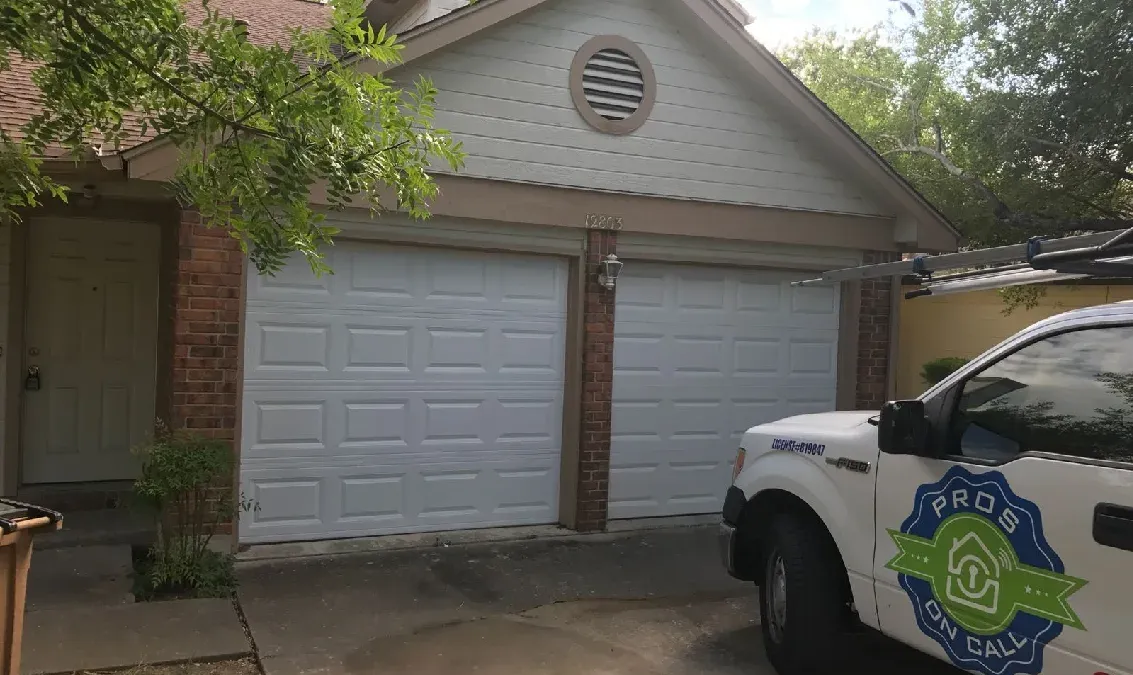
You're standing in your garage, looking at that door you've opened and closed thousands of times. Maybe it's making new noises. Maybe it's moving slower. Maybe you're just wondering: How much longer will this thing last?
Here's the straight answer from 15+ years servicing garage doors across Texas:
A quality garage door lasts 15-30 years with proper maintenance.
But that's a huge range. The difference between 15 years and 30 years comes down to three things: quality of the original door, Texas weather impact, and how well you maintain it.
Let me break down exactly what determines your garage door's lifespan, what to expect from different components, and how to know when replacement makes more sense than another repair.
Average Garage Door Lifespan by Material
Different materials age differently, especially under Texas heat. The material you choose at install sets a ceiling on how long your door can last, and Texas conditions push most materials toward the lower end of their range without consistent care.
Steel Garage Doors: 15-25 Years
Steel is the most common garage door material. It handles the physical demands of daily use well and comes in a wide range of price points. Gauge thickness makes a significant difference to how long the door holds up: a lower gauge number means thicker, stronger steel. Here is how the numbers break down:
- 24-gauge steel (thin): 15-20 years
- 16-18 gauge steel (thick): 20-25 years
Insulated steel panels expand and contract less than single-layer doors, reducing stress on frame and panel seams. Premium paint finishes resist Texas UV better and delay surface degradation.
What fails first: paint and finish fade from sun exposure, the bottom panel develops rust where it contacts the weather seal and wet concrete, and cosmetic dents accumulate. Ignored, these allow water infiltration that shortens remaining life quickly.
Texas reality: Coastal areas like Houston and Corpus Christi see rust issues faster than inland cities because salt air accelerates corrosion. Regular cleaning and touch-up paint on chips are the difference between 15 years and 22 years.
Wood Garage Doors: 15-20 Years
Wood doors offer real curb appeal, but they demand consistent maintenance in Texas. Cedar and redwood outlast pine because their natural oils resist moisture and insects. The bigger factor is finish quality: a properly sealed wood door needs annual refinishing, and skipping even one cycle lets moisture in at the bottom panels where rot starts. Our dramatic temperature swings cause repeated expansion and contraction that warps wood faster than in more stable climates.
What fails first is usually warping from the heat and moisture cycle, followed by rot in the bottom panels and finish degradation from sun exposure. UV-resistant sealers and consistent annual maintenance are the practical path to reaching 20 years.
Aluminum Garage Doors: 20-25 Years
Aluminum does not rust, which makes it popular in coastal Texas markets where steel would corrode. It is lightweight and takes powder-coat finishes well. The trade-off is softness: aluminum dents more easily than steel, and in hail-prone areas that matters. Thicker gauge still matters here as it does with steel.
What fails first tends to be cosmetic: dents from impact, finish oxidation that gives the surface a white powdery appearance, and panel separation on insulated versions.
Aluminum does not rust, which makes it popular in coastal Texas markets where steel would corrode.
Fiberglass Garage Doors: 15-20 Years
Fiberglass is a specialized choice, used primarily where rust and moisture are the primary concerns. It is not common in Texas, and our intense sun destroys fiberglass faster than in cooler northern climates. UV exposure causes yellowing and brittleness over time. In hail zones, fiberglass cracks more readily than steel or aluminum.
Vinyl/Composite Doors: 20-30 Years
Vinyl and composite doors do not rust, require minimal maintenance, and good-quality versions handle Texas heat well. That last qualifier matters: manufacturing quality varies enormously between brands, and a budget vinyl door in Texas heat will not reach its theoretical lifespan. Solid-core composite holds up better than hollow vinyl under thermal stress. Seal degradation and UV-related fading are what fail first.
MATERIAL LIFESPAN, AT A GLANCE
Steel, 15 to 25 years
Handles the physical demands of daily use well and comes in a wide range of price points.
Wood, 15 to 20 years
Offers real curb appeal, but demands consistent maintenance in Texas.
Aluminum, 20 to 25 years
Does not rust, which makes it popular in coastal Texas markets where steel would corrode.
Fiberglass, 15 to 20 years
A specialized choice, used primarily where rust and moisture are the primary concerns.
Vinyl or composite, 20 to 30 years
Do not rust, require minimal maintenance, and good-quality versions handle Texas heat well.
Component Lifespan: What Wears Out First
Your garage door is a system, not a single object. The panel you see from the street may last 25 years, while the springs inside will need replacement two or three times over that same period.
Springs: 7-15 Years
Springs fail more often than any other garage door component, and when a spring breaks the door typically stops working immediately. Standard torsion springs are rated for 10,000 cycles. At the average household rate of roughly 1,500 cycles per year, that works out to about 6-7 years. High-cycle springs rated for 25,000 cycles stretch that to 15-17 years under the same use pattern.
Texas heat accelerates metal fatigue, and standard springs may give only 5-6 years in Texas versus 7-8 in cooler climates. Annual lubrication and periodic balance checks extend spring life by reducing stress on the metal with each cycle.
Four signs tell you a spring is near failure:
- Door opens noticeably slower than it used to
- Visible gaps in the spring coils
- Door feels heavy when you lift it manually
- A loud bang from the garage. That is a spring breaking
If your springs are approaching their cycle limit, proactive replacement is far less disruptive than an emergency call when the car is trapped inside.
Garage Door Opener: 10-20 Years
Budget openers typically reach 10-12 years; mid-range quality gets you 15-17 years; premium brands from Chamberlain, LiftMaster, or Genie can run 18-20 or more years with proper care.
Daily cycle count matters more than age alone: a household that opens the door seven or more times a day will wear an opener faster than one using it four times. Unventilated garages routinely reach 120 degrees in summer, and that sustained heat stress shortens the life of logic boards and motor components significantly.
What fails first: logic board failure from heat stress, motor gear wear, chain or belt drive wear, and limit switch degradation. Annual professional tune-ups and keeping the garage ventilated make a measurable difference in electronics longevity.
Daily cycle count matters more than age alone: a household that opens the door seven or more times a day will wear an opener faster than one using it four times.
Rollers: 5-15 Years
Steel rollers last 5-7 years and are noisy without frequent lubrication. Nylon rollers with sealed ball bearings last 10-15 years and run quietly with minimal attention. The upgrade costs around $40 more. Track condition affects rollers directly: misaligned tracks force rollers to run at an angle, which destroys them prematurely regardless of material quality.
Warning signs: grinding or scraping during operation, jerking or hesitation, visible cracks in the roller body, or rollers that do not spin freely by hand.
Cables: 8-12 Years
Cables carry the door's full weight on every cycle, making them a safety-critical component. Aircraft-grade cable resists fraying better than standard cable, and proper spring balance is essential: when springs are out of adjustment, cables absorb load they were not designed for. Humidity accelerates rust on cable surfaces, particularly in coastal areas.
Never delay cable replacement. Broken cables can cause the door to fall suddenly.
Warning signs: visible fraying at any point on the cable, surface rust, a door that hangs crooked when closed, or broken strands visible to the naked eye. Any of these warrant a call before the next cycle.
Tracks: 20-30+ Years
Tracks are the longest-lasting component and routinely outlive everything else if installed correctly and not physically damaged. Texas clay soil introduces one complication: foundation movement. Expansive clay shifts under homes during wet and dry cycles, and that movement can gradually pull track mounting brackets out of alignment. Quarterly tightening of mounting hardware and an annual alignment check catch this early.
Warning signs: visible bends or dents in the track, a door that binds at the same point every cycle, gaps between the roller and track surface, or loose mounting brackets.
Weather Seals: 2-5 Years
Weather seals have the shortest service life of any component, and Texas is particularly hard on them. UV radiation degrades rubber faster here than in northern climates: standard rubber seals typically last 2-3 years before cracking, while UV-resistant seals stretch to 4-5 years. Treat seals as a scheduled replacement item. Every 3 years is a reasonable default.
A cracked or compressed seal allows pests into the garage, lets conditioned air escape, and permits water intrusion at the bottom of the door. UV protectant applied every 3-6 months extends seal life between replacements.
Warning signs: visible cracks in the rubber, gaps between the seal and the floor, pests appearing in the garage, or daylight visible under a closed door.
Need component replacement? Call (888) 601-6005 for same-day service
Factors That Shorten Garage Door Lifespan
Texas is not a forgiving environment for garage doors.
Climate and Weather (Texas-Specific)
No single factor shortens garage door lifespan more consistently in Texas than the climate itself. Garage interiors regularly hit 110 degrees or more in summer, accelerating metal fatigue in springs and stressing opener electronics. UV radiation in Texas is more intense than in northern states, destroying paint finishes, seals, and plastic components faster than manufacturers' specs, which are often based on temperate-climate assumptions.
Coastal homeowners in Houston, Corpus Christi, and the surrounding area face salt air that accelerates rust on steel components. The Rio Grande Valley and McAllen see extreme heat combined with periodic high humidity. Hail is a real structural concern in North Texas, capable of denting panels, cracking windows, and damaging finishes in a single storm. Temperature swings of 100-degree afternoons and 65-degree nights stress panel seams, spring metal, and wood grain consistently.
Usage Frequency
Cycle count is how garage door components are actually rated, and heavier use burns through those rated cycles faster. A household using the door four times daily runs about 1,500 cycles per year. A busier household at seven or more cycles daily reaches 2,500 or more.
For springs rated at 10,000 cycles, that is the difference between roughly 6.7 years and 4 years. High-use households get meaningfully more value from upgrading to high-cycle components at installation: the $50-75 premium on springs pays back in delayed replacement costs and avoided emergency service calls.
| Daily Cycles | Annual Cycles | Spring Life at 10,000 Cycles |
|---|---|---|
| 4 times daily | About 1,500 cycles per year | Roughly 6.7 years |
| 7 or more times daily | 2,500 or more cycles per year | Roughly 4 years |
Lack of Maintenance
The gap between a 12-year door and a 25-year door is almost entirely maintenance. Neglected doors fail at 10-12 years because unlubricated springs fatigue faster, rollers seize and drag on tracks, hardware vibrates loose, and seals that were never replaced let water and pests work on the structure from the inside. Annual maintenance costs $100-$150. Early replacement costs $1,500-$3,000.
Poor Installation
Improper installation creates problems that compound over years. Misaligned tracks put rollers under lateral stress they were not designed for. Wrong spring tension overloads cables and hardware on every cycle. An undersized opener runs the motor harder and hotter than it should. The $200-$400 cost of professional installation prevents thousands of dollars in early failures.
Low-Quality Components
A budget door at $800-$1,000 with a 10-15 year lifespan typically needs full replacement before a quality door installed at the same time would need its first major repair. Mid-range doors in the $1,500-$2,500 range reach 15-20 years with maintenance. Premium doors at $3,000-$5,000 can reach 25-30 years. Quality doors come with thicker gauge steel, high-cycle springs, nylon ball-bearing rollers, superior paint and insulation, and better weather sealing.
Environmental Exposure
Shaded garage doors outlast doors in direct Texas afternoon sun by several years, because UV exposure is the primary driver of seal and finish degradation. Coastal homes deal with salt air corrosion; dusty rural environments push grit into rollers and tracks; homes near trees accumulate debris at the base of the door that traps moisture against the bottom seal and panel. Clean more frequently and inspect seals more often in those environments.
SIX FACTORS THAT SHORTEN LIFESPAN
Climate and weather
Garage interiors regularly hit 110 degrees or more in summer, accelerating metal fatigue in springs and stressing opener electronics.
Usage frequency
Cycle count is how garage door components are actually rated, and heavier use burns through those rated cycles faster.
Lack of maintenance
Neglected doors fail at 10 to 12 years because unlubricated springs fatigue faster and rollers seize and drag on tracks.
Poor installation
Misaligned tracks put rollers under lateral stress they were not designed for.
Low-quality components
A budget door typically needs full replacement before a quality door installed at the same time would need its first major repair.
Environmental exposure
Shaded garage doors outlast doors in direct Texas afternoon sun by several years.
Signs Your Garage Door Is Nearing End of Life
Multiple Component Failures
A single broken spring on an otherwise sound door is a clear repair situation. When the spring breaks and the opener is struggling and the panels are dented and the rollers are worn, multiple systems have reached their limits at the same time. That pattern almost never stops with the repairs you can see today. The general rule: if repair costs exceed half of what a new door would cost installed, replace.
Structural Problems
Panel separation on insulated doors, bent or twisted door frames, severe warping on wood doors, and rust-through on steel panels are signs of fundamental failure, not wear. These cannot be fixed by replacing a part, and replacement is the only practical path.
Safety Concerns
Auto-reverse systems that cannot be adjusted to proper sensitivity, cables fraying at multiple points, tracks bent beyond safe repair, or a door that descends faster than it should because the spring system is compromised. These are not conditions to monitor and revisit. If safety systems cannot be restored to proper function, replace the door.
STRUCTURAL AND SAFETY WARNING SIGNS
Structural problems
These cannot be fixed by replacing a part, and replacement is the only practical path.
Safety concerns
If safety systems cannot be restored to proper function, replace the door.
Obsolete Technology
Doors more than 20 years old predate modern safety standards and security features. They lack auto-reverse sensors, use fixed security codes that are easy to clone, and have no smartphone integration. Single-layer construction with no insulation means the garage acts as a direct thermal bridge to conditioned living space. Modern doors include photo-eye sensors, auto-reverse on obstruction, rolling-code security, quiet belt-drive openers, and insulated panels.
Repeated Repairs and Energy Inefficiency
When you are cycling through component failures every few months, the pattern itself is diagnostic. If you have spent $800 or more on repairs over two years on a door that is 12 years old or more, replacement is almost certainly the better financial decision.
Old single-layer doors have no meaningful insulation. Gaps around aged seals let conditioned air out, and attached garages without an insulated door become a significant thermal load on the home's HVAC system in Texas summers. Modern insulated doors reach R-values of 16-19, which can reduce energy costs by $100-$300 per year depending on garage size and how it connects to the house.
Not sure repair or replace? Call (888) 601-6005 for honest assessment
How to Extend Your Garage Door's Lifespan
Want 25-30 years from your door instead of 12-15? Here's how:
HOW TO EXTEND YOUR GARAGE DOOR'S LIFESPAN
Monthly Maintenance (15 Minutes)
Visually check springs, cables, rollers, tracks, and seals, then lubricate all moving parts with silicone spray.
Annual Professional Tune-Up ($100-$150)
A technician checks springs approaching their cycle limit, inspects cables for wear, corrects track alignment drift, recalibrates the opener, and tightens loose hardware - catching most emergency failures before they happen.
Upgrade to Quality Components
High-cycle springs cost $50 more and last 2-3x longer; nylon rollers cost $40 more and run quieter with twice the lifespan; a quality opener costs $100-$200 more and lasts roughly 50% longer.
Texas-Specific Protection
Apply UV protectant to seals every 3-6 months, add an awning or overhang to reduce direct sun exposure, and keep the garage ventilated so the opener and electronics run cooler.
Use Door Properly
Avoid repeatedly closing against an obstruction to preserve auto-reverse sensitivity, never force a binding door before finding the cause, and match the opener to the door weight to prevent motor strain.
Address Problems Immediately
A strange noise usually means lack of lubrication - a quick fix; slow operation often points to spring tension needing adjustment; even a small gap in the seal warrants a $40 replacement to keep pests out.
Quality Installation
A professional installation ensures proper track alignment, correct spring tension, an opener calibrated to the door weight, and all safety features verified and working from day one.
When Replacement Makes More Sense Than Repair
Replace When:
Replacement is the right call when the door is 15 or more years old and having major problems, when multiple systems are failing at once, or when safety concerns cannot be fixed. It is also the right call when the cost of the repairs you need right now exceeds half of what a new door would cost installed: spending $800 to repair a door that costs $1,600 to replace is rarely a good investment when the door is already aging. Old uninsulated doors pay for their own replacement in energy savings within 5-7 years. If the opener lacks rolling-code security or the frame has structural damage, replacement is the only path to a safe, functional system.
Repair When:
Repair makes clear sense when the door is less than 10 years old and a single component has failed while everything else is in good condition. A spring replacement on an 8-year-old quality-brand door with a functioning opener and sound panels buys another decade of service. If the repair cost is well under a third of replacement cost and structural integrity is intact, repair.
REPLACE OR REPAIR
Replace when
The door is 15 or more years old and having major problems, or multiple systems are failing at once.
Repair when
The door is less than 10 years old and a single component has failed while everything else is in good condition.
Replacement Timing and Cost
Best Time to Replace:
Spring and fall are the most practical replacement windows in Texas. Moderate temperatures mean better installation conditions, and seasonal sales often coincide with these periods. Replacing before failure gives you time to choose the door you actually want, plan the installation around your schedule, and avoid emergency pricing. Home renovations are a natural replacement window because you can coordinate contractors and match the new door to updated exterior finishes.
Worst Time to Replace:
Replacing after a catastrophic failure limits your options to what is in stock, eliminates time to compare prices, and adds an emergency installation premium. If you are already in home sale negotiations and the door becomes a buyer objection, time pressure pushes you toward overpaying. Practical takeaway: if your door is 12 or more years old, start budgeting for replacement now.
Cost Scenarios
When a 15-year-old door needs spring replacement ($250), opener repair ($200), roller replacement ($150), and a panel replacement ($400), that is $1,000 in immediate repairs. A 15-year-old door with that many concurrent failures will likely need another spring ($250), cable work ($200), opener replacement ($400), and more panels ($500) within two years. The two-year total to keep the old door running is roughly $2,350. A new door installed runs $1,800-$2,500 with warranty coverage, modern safety features, and a 20-30 year service life.
By contrast, an 8-year-old door needing only a spring replacement ($250) with a functioning opener and sound panels is a clear repair. Spending $250 to buy another decade of service on a quality door makes obvious sense against a $1,800-$2,500 replacement.
TWO-YEAR COST COMPARISON
Keep repairing the old door
The two-year total to keep the old door running is roughly $2,350.
Replace it instead
A new door installed runs $1,800-$2,500 with warranty coverage, modern safety features, and a 20-30 year service life.
The Math:
A useful formula for borderline cases:
If (Door Age x $150) + Current Repair Cost > Replacement Cost: Replace
Example with a 15-year-old door needing $1,000 in repairs:
- 15 x $150 = $2,250 (accumulated age-related risk)
- Plus $1,000 in current repairs
- Total: $3,250
- New door installed: $2,000
Replace. The formula weights both what you are spending today and the statistical risk of further failures on an aging system.
THE BORDERLINE FORMULA
The rule
If (Door Age times $150) plus Current Repair Cost is greater than Replacement Cost, replace.
15-year-old door example
15 times $150 equals $2,250 in accumulated age-related risk, plus $1,000 in current repairs, for a total of $3,250 against a $2,000 new door.
FAQ: Garage Door Lifespan Questions
How often should garage doors be replaced?
Most doors in Texas need replacement every 15-20 years. A well-maintained quality door in a favorable environment can reach 25-30 years. Budget or neglected doors in harsh conditions may need replacement as early as 10-12 years.
What is the average life of a garage door spring?
Standard springs are rated for 10,000 cycles, which works out to roughly 6-7 years at average household use. High-cycle springs rated for 25,000 cycles reach 15-17 years under the same conditions. Texas heat reduces those figures by roughly 15-20% compared to cooler climates.
Should I replace my garage door opener with a new door?
If the opener is 10 or more years old, replacing it alongside the door makes sense: installation is already underway, and new openers include security and smart-home features worth having. If the opener is 5 years old or less and working well, keep it. If it lacks modern auto-reverse and rolling-code security, replace it regardless of age.
Can I replace just one garage door panel?
Single-panel replacement is possible if the panel style is still manufactured and the sun-faded color of the existing panels can be matched. Both conditions get harder to meet as doors age. If multiple panels are damaged, the style has been discontinued, or the door is already 15 or more years old, full replacement is usually the better call.
TWO MORE COMMON QUESTIONS
Replace the opener with a new door?
If the opener is 10 or more years old, replacing it alongside the door makes sense. If it is 5 years old or less and working well, keep it.
Replace just one panel?
Possible if the panel style is still manufactured and the sun-faded color of the existing panels can be matched.
How do I know if my garage door needs replacing?
Replace when multiple expensive repairs are needed at once, when the door is 15 or more years old and having major problems, when safety features cannot be properly restored, when structural damage is present, or when the cost of repairs you need now exceeds half of replacement cost.
Our Replacement Service
At Pros On Call, we help homeowners make smart repair vs. replace decisions.
We offer: Honest assessment (repair or replace) Multiple options at different price points Quality doors that last in Texas climate Professional installation Warranty coverage Same-day service available
We stock and install four brands that have proven reliable in Texas conditions, covering a range from strong everyday value to full premium construction:
- Clopay (premium quality)
- Amarr (excellent value)
- Wayne Dalton (trusted performance)
- CHI Overhead Doors (quality construction)
WHY HOMEOWNERS CALL PROS ON CALL
Honest assessment
We help homeowners make smart repair vs. replace decisions.
Four proven brands
Clopay, Amarr, Wayne Dalton, and CHI Overhead Doors, covering a range from strong everyday value to full premium construction.
Most replacements move from first call to installed door in four to five days. Here is what that looks like in practice:
- Day 1: Assessment and measurement
- Day 2-3: Door order and delivery
- Day 4: Professional installation (4-6 hours)
- Day 5+: Enjoy your new door for 20+ years
Serving all of Texas since 2010 Call (888) 601-6005 for free replacement estimate Licensed #B19847 - Family owned and operated
Final Recommendations
After 15 years and thousands of garage doors serviced across Texas, the pattern is consistent.
For new doors, invest in quality from the start: high-cycle springs, insulated construction, nylon rollers, and a quality brand opener. The $500-$800 difference between a budget install and a quality install pays back multiple times over the door's service life.
For existing doors, maintenance is the deciding factor. Monthly DIY care takes 15 minutes and costs nothing but silicone spray. Annual professional service at $125 catches predictable failures. Replace components before they fail, not after.
For aging doors, watch for the pattern of multiple failures, apply the 50% rule to repair versus replacement decisions, and plan ahead. Waiting for catastrophic failure forces emergency decisions and emergency pricing.
For Texas specifically: UV protectant on seals, regular paint touch-up on steel doors, proper ventilation for the opener, and quality finishes from the start. The climate is harder on garage doors here than most manufacturers account for.
Your garage door works hard. Give it consistent care, and it will serve you well for decades.
Questions about your door's remaining life? Call (888) 601-6005 for honest assessment Available 24/7 across Texas
We will tell you if repair makes sense, or if it is time for an upgrade.
Because that is what honest professionals do.
Content strategy and SEO by Optymizer