
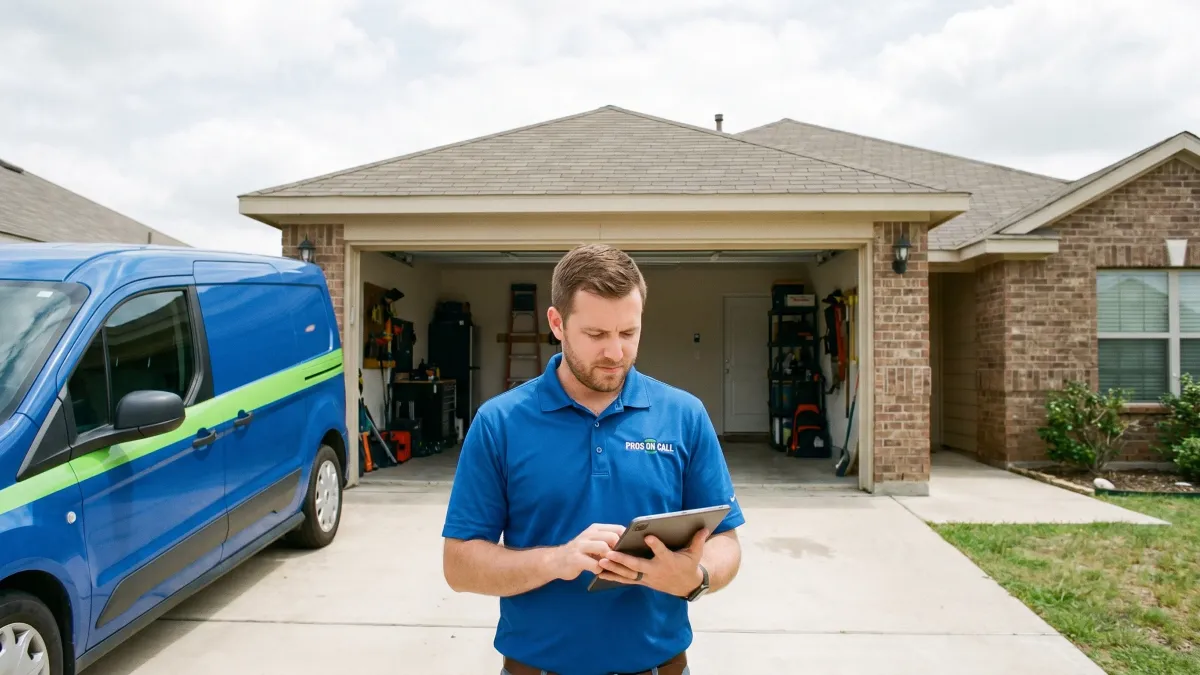
Your garage door is the largest moving part of your home, and for most Texas families, it's the primary entry point used daily. Understanding the full range of residential garage door services available helps you maintain this critical home system, avoid emergency repairs, and maximize your investment in what may be a $1,500-$5,000+ asset.
Need residential garage door service in Texas? Call Pros On Call at (888) 601-6005 for installation, repair, and maintenance. Available 24/7 statewide. License #B19847.
Types of Residential Garage Door Services
Installation Services
New construction installation:
When building a new Texas home, a professional measurement visit is the first step. Opening dimensions, headroom, depth, and side clearances all determine which doors and hardware will fit. A licensed installer also checks code compliance, confirms spring tension matches the door weight, and recommends insulation levels and opener horsepower before anything is ordered. Smart home integration - app-connected openers, cameras, and keypads - is cheaper to plan now than to retrofit later.
Typical timeline: 4-6 hours for standard installation
Replacement installation:
Replacing an existing door is more involved than it might appear. The old door and its hardware must be removed safely, the frame and tracks inspected for damage or wear, and the new door installed with fresh springs. Springs from the old door cannot simply be reused: they are matched to the previous door's weight and dimensions, and transferring worn springs to a new door creates a mismatch that puts extra load on the opener and shortens the service life of everything in the system. Every replacement includes safe removal and disposal of the old door, frame and track inspection, new spring installation sized to the replacement door, opener compatibility verification, and a full balance and safety test before the technician leaves.
| Door Type | Installed Cost Range |
|---|---|
| Basic single door | $800-$1,500 installed |
| Insulated double door | $1,200-$2,500 installed |
| Premium/custom doors | $2,500-$5,000+ installed |
Every installation includes a complete set of services, from the mechanical assembly through to walking the homeowner through the controls. Nothing should be left half-done at the end of the job.
Installation includes:
A finished installation covers every step from spring tensioning to the homeowner walkthrough - nothing ships half-done. The sequence matters: springs must be sized before panels go up, sensors verified before the opener is programmed. Every item below is completed before the technician leaves.
- Complete door assembly
- Spring installation and tensioning
- Track and roller installation
- Weather sealing
- Opener connection (if applicable)
- Safety sensor setup
- Operation training
Repair Services
Repair is the service most Texas homeowners need first. Springs, openers, cables, panels, rollers, and tracks all have predictable wear cycles, and the cost range for each repair type varies enough that knowing what you are dealing with before you call saves time on the phone. The Common Garage Door Repairs section below covers each repair type in detail, including what causes the failure, what the fix involves, and what parts and labor typically cost. Pricing spans from around $100 for a cable swap to $350 or more for a spring set on a heavy two-car door.
Maintenance Services
A scheduled tune-up does two things: it catches worn parts before they cause a failure, and it extends the life of parts that are still in good condition by keeping them properly lubricated and adjusted. For most Texas homes, the $75-$125 annual visit prevents repairs that cost two to four times more.
Full tune-up includes:
Inspection: The technician checks every mechanical component for wear, alignment, and safe operating condition - springs, cables, rollers, tracks, hinges, weather seals, safety sensors, and opener performance. Finding a roller with a cracked bearing or a cable with early fraying during an inspection costs far less than finding the same problem after a failure.
Lubrication: Proper lubrication reduces friction, noise, and wear on every part that moves with each cycle. Springs, unsealed rollers, hinges, bearing plates, and the opener's chain or belt all need a fresh application of the right product. The wrong lubricant - WD-40 is the most common mistake - strips away existing film and leaves parts drier than before.
Adjustments: Small drift in opener settings causes the motor to work harder than needed and shortens its service life. Limit switches, force settings, spring tension, and safety sensor alignment are all checked and corrected as needed during a proper tune-up.
Texas pricing: $75-$125 per visit
Recommended frequency:
For most Texas homes, once a year is the right interval. That covers the spring tension check, cable inspection, full lubrication, hardware tightening, and safety sensor test that keep the system running cleanly between visits. If your door opens six or more times a day, or if your home is within 20 miles of the Gulf Coast where salt air corrodes springs and cable hardware at a faster pace, move to every six months. The extra visit costs less than one avoided spring replacement.
WHAT A FULL TUNE-UP COVERS
Inspection
The technician checks every mechanical component for wear, alignment, and safe operating condition.
Lubrication
Springs, unsealed rollers, hinges, bearing plates, and the opener's chain or belt all need a fresh application of the right product.
Adjustments
Limit switches, force settings, spring tension, and safety sensor alignment are all checked and corrected as needed.
Emergency Services
Pros On Call dispatches 24 hours a day, 7 days a week across Texas for situations that cannot safely wait until morning. The four scenarios that come in most often as genuine emergencies are a broken torsion spring (door too heavy to lift safely), a door derailed from its tracks (unstable under spring tension - do not force it), an opener that has stopped responding entirely (door stuck open overnight is a security risk), and collision damage that prevents the door from closing or sealing. All four share the same thread: the door is creating an active security or safety problem right now, not just an inconvenience. After-hours calls (6 PM to 8 AM weekdays) add $75-$150 to standard rates; weekends add $50-$100; holidays add $100-$200. Parts pricing is the same regardless of when you call. The full emergency section below covers how to assess your situation and what to do while you wait for the technician.
FOUR SCENARIOS THAT COME IN MOST OFTEN
Broken torsion spring
Door too heavy to lift safely.
Door derailed from its tracks
Unstable under spring tension, do not force it.
Opener stopped responding entirely
Door stuck open overnight is a security risk.
Collision damage
Prevents the door from closing or sealing.
Garage Door Installation Process
Pre-Installation Assessment
Before anything gets ordered or installed, a professional assessment protects both the homeowner and the installer. Measurements a few inches off can mean a door that physically cannot be installed - a problem that is expensive and slow to correct after parts have arrived.
1. Measurements: Five dimensions determine what will fit: opening width and height, headroom above the opening, backroom depth, side room beside the opening, and ceiling height. Getting any of these wrong means returning the door or modifying the framing - an expensive and slow fix after parts have already arrived. Track systems require specific headroom, and an opener that lacks mounting clearance cannot be installed at all.
2. Structural assessment: The existing structure has to be sound before new hardware goes up. The technician checks the header beam for adequacy and damage, verifies that the wall framing can handle the door weight, confirms the concrete is level, locates existing track mounting points, and identifies whether there is a proper electrical outlet for the opener within reach. A header that is undersized or water-damaged will not safely support the load of a full door and must be addressed before installation proceeds.
ASSESSMENT, STEPS 1 AND 2
1. Measurements
Five dimensions determine what will fit: opening width and height, headroom above the opening, backroom depth, side room, and ceiling height.
2. Structural assessment
The technician checks the header beam for adequacy and damage, verifies that the wall framing can handle the door weight, and confirms the concrete is level.
3. Door selection guidance: Texas heat, humidity, and in coastal areas salt air all affect which door materials and insulation levels make sense for a given home. A door that performs well in a dry climate may underperform in Houston or Corpus Christi. A licensed installer will walk through climate-appropriate insulation levels, material durability for the local environment, hurricane rating requirements for coastal homes, and how to match the door style to the home's exterior without blowing the budget.
4. Opener compatibility: The door's weight and size determine the horsepower requirement. Getting this wrong means premature motor failure or a door that strains in cold weather. Belt drive motors run quieter than chain drive and are worth the small premium for attached garages with living space above. Battery backup is a practical addition for Texas homes that lose power during summer storms.
Installation Steps
A licensed installer works through a fixed sequence on every job - skipping steps or reordering them creates safety problems that are not always obvious until the door fails under load. Here is how a proper installation runs from start to finish.
PROFESSIONAL INSTALLATION SEQUENCE
Remove old door
The technician disconnects the opener, releases all spring tension safely using winding bars, removes the door panels section by section, pulls the tracks and hardware, and disposes of the old materials.
Prepare the opening
The frame is cleaned and inspected for rot or damage, any structural issues are repaired, a new bottom weather seal is fitted, track mounting points are marked, and the opening is verified level and plumb before any new hardware goes up.
Install track system
Vertical tracks are mounted to the frame, curved transition sections connect them to the horizontal runs, horizontal tracks are attached to the ceiling framing, and every section is leveled, secured, and fitted with roller brackets.
Assemble door panels
Panels are connected in sequence with hinges, rollers are installed in the brackets, and each section is lifted into the track and stacked in the opening, held temporarily until the spring system is ready to take the load.
Install spring system
The torsion spring shaft is mounted above the door, bearing plates are set on each end, springs are threaded onto the shaft, cable drums are installed, and lift cables are attached to the bottom corners of the door.
Tension springs
The technician calculates the correct number of turns based on door weight and height, winds the springs with steel winding bars, locks the set screws, then tests door balance by lifting it to the halfway point and confirming it holds position without drifting.
Install opener
The motor unit is mounted to the ceiling, the rail and trolley are attached and connected to the door bracket, safety sensors are wired and aimed at the floor, the wall button is wired, and all remotes are programmed.
Final adjustments and testing
The technician runs a full balance test, adjusts opener force and limit switches, verifies safety sensor alignment by triggering the door onto a 2x4, and lubricates all moving parts before the homeowner walkthrough.
Total installation time: 4-7 hours
Post-Installation Services
The job is not finished when the installer closes their toolbox. A quality installation ends with a proper handoff so the homeowner knows how to operate the door safely, what to watch for, and what is covered under warranty.
Operation demonstration: Before the technician leaves, they walk through every control and function so there are no surprises the first time something needs to be done manually. That means the manual disconnect procedure, the emergency release cord (critical during Texas power outages), how to program remotes and the keypad, and how to check that the safety sensors are still aligned.
Maintenance instructions: A short briefing on what to do between annual service visits keeps the door in better condition and extends part life. The technician should cover which lubricant to use and how often, what to look and listen for during the door's daily cycle, and which tasks require professional tools and should not be attempted without them.
Warranty registration: Most manufacturers require registration within 30-60 days of installation to activate the full warranty term. A door warranty typically runs 1-10 years depending on material and brand; opener warranties run 1-5 years; installation labor is typically covered for 1-2 years; and springs carry a 1-3 year warranty from most quality manufacturers.
Your garage door is the largest moving part of your home, and for most Texas families it is the primary entry point used daily.
Follow-up service: Springs settle during the first weeks of use, so a 30-day adjustment check should be included at no charge. Many installers also include the first-year maintenance visit with a new installation. Ask about preferred-customer scheduling and whether parts will remain available for your specific door model before the job is over, not after.
Common Garage Door Repairs
Your garage door cycles 1,500 to 2,000 times a year in the Texas heat. Parts wear in a predictable order, and knowing which repair you likely need saves time on the phone and money at the invoice.
Spring replacement is the most common call Pros On Call receives. Torsion springs are rated by cycle count, and Texas summers accelerate metal fatigue. A standard spring rated at 10,000 cycles may wear out in five years on a door that opens four times a day. When a spring snaps, you will hear a loud bang and the door will feel impossibly heavy on manual operation. The fix is replacing both springs, not just the broken one, because the surviving spring is equally worn. See the full breakdown at /blog/garage-door-spring-replacement-guide.
Opener failure is the second most common call. The logic board, drive gear, and safety sensors are the parts that wear first. A door that reverses immediately after touching the floor usually has limit switches out of adjustment. A door that hums but does not move often has a stripped drive gear. A door that ignores the wall button but responds to the remote points to a wall-button wiring problem. Most opener repairs run $100-$300; full replacement runs $300-$500 with installation. /blog/garage-door-opener-buyers-guide covers what to look for if replacement makes more sense.
TWO MOST COMMON REPAIR CALLS
Spring replacement
When a spring snaps, you will hear a loud bang and the door will feel impossibly heavy on manual operation.
Opener failure
The logic board, drive gear, and safety sensors are the parts that wear first.
Cable and roller issues tend to appear together because both wear at similar rates. Frayed cables or cables sitting off the drum produce a crooked door, one side hanging lower than the other. Replacing both cables at once is standard practice. Rollers are often ignored until they seize or crack, which puts side load on the tracks and accelerates track wear. Nylon rollers with sealed bearings last longer and run quieter than stamped-steel rollers; the $30-$50 upgrade is worth it on any door that will stay in service for another five-plus years.
Panel damage after a vehicle bumps the door is a common request. A single dented section can often be replaced if the manufacturer still carries matching stock, but older or discontinued styles usually require full door replacement because the cosmetic mismatch is too visible to correct otherwise. Get photos, confirm parts availability, and decide whether a panel swap or a new door makes more sense given the age of the system.
TWO MORE COMMON REPAIRS
Cable and roller issues
Frayed cables or cables sitting off the drum produce a crooked door, one side hanging lower than the other.
Panel damage
A single dented section can often be replaced if the manufacturer still carries matching stock.
Track problems split into two categories: gradual misalignment from hardware backing off over time, and sudden bends from vehicle contact. Gradual misalignment is a quick fix. A single hard bump that bends a vertical section typically requires track replacement on that section. Texas clay soil can shift foundations slightly over years, which is worth mentioning to the tech when booking because it changes which repairs are durable and which are temporary patches.
For a complete cost breakdown on any of these repairs, see /blog/how-much-does-garage-door-repair-cost and /blog/garage-door-broken-usual-suspects.
Preventive Maintenance for Texas Homeowners
Maintenance is the category most Texas homeowners skip, and it is why so many emergency calls happen the day someone needs to leave for the airport. A $75-$125 tune-up prevents repairs that cost two to four times more and prevents the inconvenience of a door failing on a 98-degree August evening.
Texas conditions accelerate wear in ways that homeowners in cooler states rarely deal with. Summer heat above 95 degrees dries out lubricants in roller bearings and hinges, softens rubber seals, and causes metal-to-metal contact. High humidity along the Gulf Coast and in East Texas corrodes springs and cable hardware. Central Texas adds fine dust and hail to the list. Together these factors make annual maintenance more necessary here than in most parts of the country.
TRACK PROBLEMS AND TEXAS WEAR FACTORS
Track problems
Split into two categories: gradual misalignment from hardware backing off over time, and sudden bends from vehicle contact.
Texas-specific wear
Summer heat above 95 degrees dries out lubricants, softens rubber seals, and causes metal-to-metal contact.
Quarterly tasks you can do yourself:
A 15-minute walk-around three or four times a year catches most problems before they become expensive. Pull the door off the opener and lift it manually to the halfway point, then let go: it should hold position without drifting. A door that falls means the springs are losing tension; one that shoots upward is over-tensioned. Check the weatherstripping along the sides and bottom - Texas heat degrades rubber fast, and a bottom seal that no longer conforms to the floor lets in water, insects, and summer heat. Listen during operation: grinding or scraping is metal-to-metal contact, popping usually means a dry hinge pin, and a high-pitched squeal points to roller bearings that need attention. Every three to four months, apply a silicone or lithium-based garage door lubricant to the rollers, hinges, and spring coils. Skip WD-40 - it is a degreaser, not a lubricant, and it removes the protective film already on the parts.
Annual professional tune-up:
Once a year, a licensed technician handles the work you cannot safely do yourself: checking and adjusting spring tension with winding bars and load calculations specific to your door weight, inspecting both lift cables for fraying along their full run, testing auto-reverse force by triggering the door onto a 2x4, tightening all track and bracket bolts that vibrate loose under daily use, and verifying the opener's limit and force settings. For coastal Texas homes within 20 miles of the Gulf, that interval shortens to every six months - salt air corrodes springs and cable hardware faster than inland conditions.
For more detail on what a tune-up covers, see /blog/garage-door-maintenance.
Emergency Services
A garage door emergency is not the same as a garage door inconvenience. Understanding the difference helps you decide whether to call at 11 PM or wait until morning, which affects what you will pay on the invoice.
Genuine emergencies are situations where the door is creating an active safety or security risk right now. A door that is stuck in the open position late at night is an emergency because your home is exposed. A broken spring on the door you need to leave through in the morning is an emergency when it means your vehicle is trapped inside a closed garage with no manual release you can safely operate. A door that came off the tracks and is hanging at an angle is an emergency because it is under spring tension in an unstable position, and attempting to force it creates a real risk of injury.
A loud noise, a door that hesitates slightly, or a door that has been slowly getting slower over the past month, those are not emergencies. They are deferred maintenance calls that you can schedule during normal business hours and pay standard rates.
THREE GENUINE EMERGENCIES
Door stuck open overnight
An emergency because your home is exposed.
Broken spring with vehicle trapped
An emergency when it means your vehicle is trapped inside a closed garage with no manual release you can safely operate.
Door off the tracks
An emergency because it is under spring tension in an unstable position, and attempting to force it creates a real risk of injury.
What to do when a real emergency hits:
Stop operating the door immediately. Do not force a door that came off its tracks, and do not pull the emergency release cord and try to lift a door with a broken spring by hand. A single-car garage door weighs 130-160 pounds; a two-car door can reach 200-250 pounds. Without the springs assisting, that weight comes down fast and without warning.
If the door is stuck open overnight, lock the interior door between the garage and the house and call for service. If the door is stuck closed and you have another exit or another vehicle, weigh whether the situation is truly urgent: the premium for after-hours versus standard-hours service runs $75-$150, which may be worth saving if you can wait until morning.
When you call, tell the dispatcher exactly what the door is doing, whether anything looks visibly damaged, and whether the door is in an open or closed position. That detail helps the technician arrive with the right parts and avoid a second trip.
Pros On Call dispatches 24/7 across Texas. Call (888) 601-6005 and a live dispatcher answers.
Emergency pricing:
After-hours calls (6 PM to 8 AM weekdays) add $75-$150 to the standard repair rate. Weekend service adds $50-$100. Holiday service adds $100-$200. These premiums apply to the dispatch and labor; parts are priced the same regardless of time of day. A reputable company quotes the total before any work begins, including the after-hours premium, so there are no surprises at the invoice.
| Service window | Added premium | Best for |
|---|---|---|
| Standard hours (8 AM to 6 PM weekdays) | None - base rate only | Non-urgent repairs, maintenance, planned installs |
| After hours (6 PM to 8 AM weekdays) | +$75-$150 | Vehicles trapped, door stuck open overnight |
| Weekends | +$50-$100 | Situations that cannot wait until Monday |
| Holidays | +$100-$200 | Active security risk or trapped vehicle |
Choosing a Residential Garage Door Service Provider in Texas
Texas does not require an unlicensed contractor to post a license number, so the barrier to entry for anyone claiming to do garage door work is low. Homeowners who call the first number from a Google search sometimes end up with untrained technicians who carry no insurance and use low-grade parts to keep quotes competitive. Here is how to separate qualified providers from the ones to avoid.
Licensing and insurance are the baseline, not a bonus.
In Texas, garage door companies that also perform locksmith services must hold a license from the Texas Department of Public Safety. Pros On Call carries License #B19847. Ask any company you consider for their license number and verify it at the DPS website before authorizing work - unlicensed work on a security-related system creates homeowner liability and voids manufacturer warranties on most products. Ask for a certificate of liability insurance as well, not just a verbal assurance. The technician will be working under spring tension, and any property damage during an uninsured job becomes your problem.
Transparent pricing before the work starts.
A written estimate, broken down by labor and parts, is the standard. If a company will not put numbers on paper before starting, call someone else. The estimate should name the parts being used, including spring type and cycle rating - "spring replacement" on an estimate that leaves those details blank is an invitation to receive economy-grade hardware at standard prices. Get a complete out-the-door number that includes the service call fee and any after-hours premium before authorizing anything.
Questions worth asking - and red flags to watch for:
Ask how long the company has operated under its current name in Texas, whether the technician is a W-2 employee or a subcontractor (subcontractor arrangements mean less direct control over who shows up), and what warranty covers both labor and parts. Quality companies offer 90-day to one-year labor warranties and one- to three-year parts warranties as standard terms.
A company that quotes a price over the phone without asking door size, door weight, spring type, or opener model is guessing. A company that opens with a "neighborhood discount" or a "limited-time inspection special" and then discovers $600 in required repairs is running a well-documented scam. Cash-only payment, no physical address, and no verifiable Google or BBB reviews all point to operations that will not be around when you need warranty service. The /blog/garage-door-broken-usual-suspects post covers scam patterns in more detail.
The technician will be working under spring tension, and any property damage during an uninsured job becomes your problem.
What a good service call actually looks like:
The technician arrives in a marked vehicle, observes the door before touching it, explains what they see, and gives you a written itemized estimate before starting work. After the repair, they test the full cycle, verify safety sensors, and clean up. You leave with documentation of what was done and warranty terms for both parts and labor. That is the standard Pros On Call holds its technicians to. See the full range of residential garage door services and the broader garage door service overview.
A written estimate, broken down by labor and parts, is the standard for any legitimate garage door company. If a company is reluctant to put numbers on paper before starting work, that is a clear signal to call someone else.
Frequently Asked Questions
How often should I have my garage door serviced in Texas?
Once a year is the baseline for most Texas homes. If you live within 20 miles of the Gulf Coast or your door opens six or more times a day, move to twice a year. Salt air and heavy use both accelerate spring and cable wear, and catching problems during a scheduled visit costs far less than catching them during a failure.
My garage door makes a loud bang when it opens or closes. What causes that?
A single loud bang, especially if it is followed by a door that feels very heavy or will not open at all, is almost always a broken torsion spring. The sound is the spring releasing its tension suddenly. Do not try to operate the door. Call a licensed technician for spring replacement. If the banging is a rhythmic clunking during normal operation, it is more likely a roller with a flat spot or a hinge with a loose pin, both of which are much less urgent.
Can I replace a garage door spring myself?
No. Torsion springs store hundreds of foot-pounds of energy and must be wound and unwound with steel winding bars and load calculations matched to the specific door weight. A spring that slips off a winding bar can break a wrist or worse. Extension springs carry similar risk. Professional spring replacement runs $150-$350, which is a low price relative to an injury that requires surgery. Do not attempt this without proper tools and training.
THREE QUICK FAQ ANSWERS
How often should the door be serviced?
Once a year is the baseline for most Texas homes. Move to twice a year within 20 miles of the Gulf Coast or heavy daily use.
What causes a loud bang?
A single loud bang, especially with a door that feels very heavy, is almost always a broken torsion spring.
Can I replace a spring myself?
No. Torsion springs store hundreds of foot-pounds of energy and must be wound and unwound with steel winding bars.
What is the difference between a torsion spring and an extension spring?
Torsion springs mount above the door opening on a horizontal shaft and work by twisting. Extension springs mount above the horizontal tracks on each side and work by stretching. Torsion springs are the current standard on most residential doors: they last longer, fail more predictably, and are safer when they break. Extension springs are still common on older homes and lighter single-car doors. The upgrade to torsion springs at replacement time is worth considering for any door that will stay in service for several more years.
My opener remote stopped working. Is that an opener problem or a remote problem?
Start with the wall button. If the wall button works but the remote does not, the problem is the remote, not the opener. Replace the battery first, then reprogram using the Learn button on the motor unit if a new battery does not help. Remote replacement runs $25-$50. If neither the wall button nor the remote works, the problem is in the opener itself - most likely the logic board, a power issue, or safety sensors out of alignment. The /blog/garage-door-opener-buyers-guide troubleshooting section covers this in more detail.
How much does it cost to add a new garage door to a home that has never had one?
New construction installation on an opening that already has a framed rough opening runs $800-$1,500 for a basic single door installed, $1,200-$2,500 for an insulated double door. Those figures include the door, the opener, and labor. If the opening requires framing or header work, or if there is no electrical outlet for the opener, those items add to the total. Get a full assessment from a licensed installer before budgeting because headroom, backroom, and side-room dimensions all affect what hardware can be used and how much labor is involved.
Ready to schedule service or get a quote? Call Pros On Call at (888) 601-6005. We handle installation, repair, maintenance, and 24/7 emergency service for residential garage doors across Texas. License #B19847.