
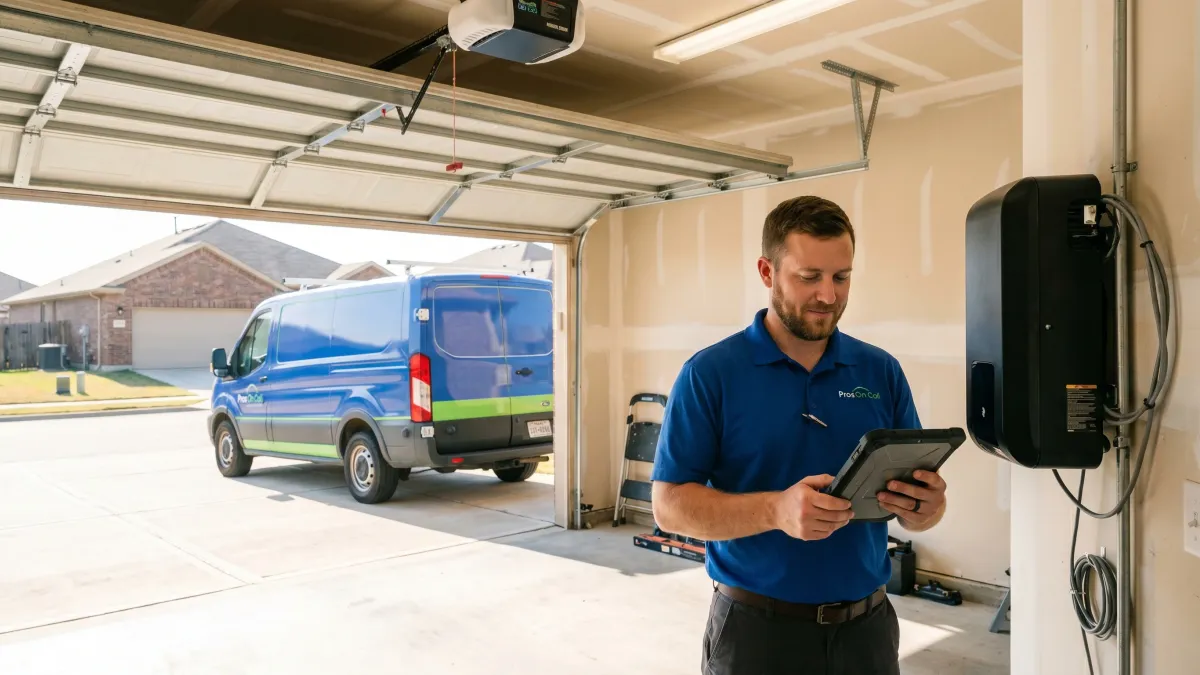
Weatherstripping creates an essential seal around your garage door, blocking air infiltration, pests, water, and debris. The rubber and vinyl strips look like a minor detail, but they do a lot of quiet work every day, and Texas conditions beat them up faster than most homeowners expect. Summers that run 100-plus degrees for weeks at a stretch, the occasional hard freeze, afternoon thunderstorms driving water sideways under the door. All of that accelerates the breakdown of even decent-quality seals.
The result is not just a gap you can feel. When weatherstripping fails, your conditioned air bleeds out, your energy bills creep up, and every scorpion, field mouse, or gap-seeking snake in the neighborhood gets an open invitation. Knowing how to spot the early signs of failure means you replace a $25 seal on your own schedule, not a $400 pest remediation or a repair bill from water-damaged storage.
Need garage door weatherstripping replacement? Call Pros On Call at (888) 601-6005. Professional installation throughout Texas. License #B19847.
Signs You Need New Weatherstripping
Weatherstripping fails in two categories. What you can see and what you feel. Most homeowners notice the performance problems first (a draft, a dust line, a higher electric bill) without connecting them to the seal. A quick visual inspection of the door bottom and perimeter usually confirms whether the seal is the culprit.
Visual Damage:
The rubber or vinyl should be smooth, pliable, and flush against the door or frame. Anything that looks dried out, cracked, or pulling away is no longer doing its job, regardless of how old it is. Texas UV is particularly hard on lower-quality materials, and a seal that looked fine last fall can be brittle by the following summer.
- Cracked or brittle rubber/vinyl
- Pulling away from door or frame
- Visible gaps when door is closed
- Torn or missing sections
- Flattened permanently (lost compression)
Performance Issues:
Performance problems are easy to miss because they develop gradually. A door that once felt tight and quiet starts letting in dust, then a noticeable draft, then visible light at the edges. Each of those is the seal telling you something. Do not wait until you spot a gecko inside the garage to make the inspection.
- Light visible around door edges
- Drafts felt near door
- Dust accumulation increasing
- Water entering during rain
- Pest intrusions
- Higher energy bills (attached garages)
Age-Related Replacement:
Even seals that pass a visual inspection eventually harden and lose the compression they need to function. Texas heat accelerates this timeline compared to cooler climates. The lifespan ranges below reflect that reality. If your door is within this window and you have not replaced the seal, it is worth pulling out a flashlight and checking.
- Bottom seal: 3-5 years (Texas climate)
- Side/top seals: 4-7 years
- Threshold seals: 10+ years
TWO WAYS WEATHERSTRIPPING FAILS
Visual damage
Cracked or brittle rubber and vinyl, pulling away from the door or frame, visible gaps when the door is closed.
Performance issues
Light visible around door edges, drafts felt near the door, dust accumulation increasing.
Age-related replacement
Even seals that pass a visual inspection eventually harden and lose the compression they need to function.
Types of Garage Door Weatherstripping
Not every seal is the same, and choosing the right type matters more in Texas than it does in, say, Minnesota, where freezing temperatures are the main enemy. Here the challenge is sustained UV exposure and extreme heat cycling that causes cheaper materials to harden, shrink, and pull away from surfaces. Understanding the options helps you pick something that holds up and does the job it is supposed to do.
Bottom Seals:
The bottom seal takes the most abuse because it contacts the floor on every cycle. Concrete is abrasive, and a door that opens and closes twice a day is wearing that seal down constantly. The three common styles each handle floor contact differently.
- T-style vinyl (most common, affordable)
- Bulb/bead seal (better compression)
- Threshold seal (floor-mounted, best for uneven floors)
Perimeter Seals:
The seals running up the sides and across the top of the door are protecting against wind-driven rain and air infiltration more than physical abrasion. Material quality matters here because they sit exposed to direct sun for hours every day. For Texas, EPDM rubber is the better call over basic vinyl. It handles UV and temperature swings without hardening as quickly.
- Vinyl weatherstripping (economical)
- EPDM rubber (UV-resistant, recommended for Texas)
- Brush seals (irregular gaps)
In Texas's extreme climate, worn weatherstripping costs you money through energy loss and allows pest entry.
DIY Replacement Guide
Replacing weatherstripping is one of the more straightforward garage door maintenance tasks you can do yourself, assuming the door itself is in good alignment and the retainer track is not damaged. The tools involved are basic. A utility knife, pliers, a measuring tape, and some dish soap. The time investment is modest. Where homeowners run into trouble is usually in the measuring or in trying to force a seal into a track without lubricant.
Bottom Seal Replacement:
The six steps below cover the complete swap from measurement through final gap check. Work with the door down and disconnected from the opener if possible. It keeps the door stationary while you slide the new seal into the retainer track.
BOTTOM SEAL REPLACEMENT
Measure door width
Measure the full width of the door panel at the bottom, not just the opening - most single doors run 8-9 feet and doubles 16 feet. Buy a seal at least 2 inches longer so you can trim to fit.
Remove old seal from retainer track
Slide the worn seal out of the metal retainer channel at the door bottom. On most doors it slides out from either end; if it is stapled or nailed, use a pry bar to pull the fasteners first.
Clean track thoroughly
Wipe the retainer channel with a damp rag to remove dirt, old grease, and rubber fragments. A clean channel lets the new seal seat evenly and grip without bunching.
Slide new seal into track using soapy water as lubricant
Mist the channel and the T-slot of the new seal with a few drops of dish soap and water. This temporary lubricant lets the rubber glide in without tearing and evaporates once installed.
Trim to exact length
With the seal fully seated, use heavy scissors or a utility knife to cut flush with the door edge on both sides. A clean cut prevents the ends from curling away from the floor.
Test door closure
Close the door and check the full bottom edge for gaps. The seal should compress evenly against the floor with no light visible. If a section gaps, press the retainer track tighter with pliers at that spot.
Cost: $15-$45 materials, 30-60 minutes time
Side/Top Seal Replacement:
The side and top seals are simpler to swap than the bottom seal because most attach with adhesive rather than sliding into a track. The surface prep matters. Adhesive fails fast on a dirty or oily frame, and the seal will start peeling within a few weeks if the mounting surface is not clean and dry. Take an extra five minutes on the prep and the seal will stay put.
- Remove old weatherstripping
- Clean mounting surfaces
- Apply new adhesive-backed strips
- Press firmly for secure adhesion
- Test door operation
Cost: $20-$60 materials, 1-2 hours time
SIDE/TOP SEAL REPLACEMENT
1. Remove
Remove old weatherstripping.
2. Clean
Clean mounting surfaces.
3. Apply
Apply new adhesive-backed strips.
4. Press
Press firmly for secure adhesion.
5. Test
Test door operation.
Benefits of Proper Weatherstripping
A good seal pays back more than most homeowners realize when they are standing in the hardware store weighing whether to buy the $18 vinyl strip or the $35 EPDM. The return on investment shows up across several areas, and the combined effect is meaningful over a few years.
Energy Savings:
Attached garages share at least one wall with the living space, sometimes two. When the garage runs 130 degrees in August because the bottom seal has been gone for two summers, that heat bleeds through shared walls and makes the HVAC work harder to keep the house comfortable. A functional seal does not eliminate the temperature differential, but it narrows it enough to show up on a power bill.
- Reduces garage temperature extremes
- Lowers HVAC costs (attached garages)
- Annual savings: $100-$300 in Texas
Pest Control:
Texas has a wide range of uninvited guests that are very good at finding gaps. Scorpions can squeeze through a crack the width of a credit card. Field mice need only a half-inch opening. Snakes entering a garage to hunt rodents is a real scenario in rural areas around San Antonio and the Hill Country. A properly sealed door removes the entry point before the problem starts.
- Blocks entry points for insects, rodents, snakes
- 80-90% reduction in pest intrusion
Weather Protection:
South Texas in particular. McAllen, the Rio Grande Valley. Sees heavy driving rain that gets under a garage door with very little encouragement. A threshold seal or a tight bottom seal keeps that water out of the garage and away from stored items, the water heater, or anything else sitting on the floor. In a tropical storm or hurricane-adjacent event, the difference between a sealed and an unsealed door shows up immediately.
- Prevents water entry
- Blocks wind-driven rain
- Protects stored items
WHERE THE PAYBACK SHOWS UP
Energy savings
A functional seal does not eliminate the temperature differential, but it narrows it enough to show up on a power bill.
Pest control
A properly sealed door removes the entry point before the problem starts.
Weather protection
A threshold seal or a tight bottom seal keeps that water out of the garage and away from stored items.
Noise Reduction:
This one is underrated. A garage door with good perimeter weatherstripping noticeably dampens outside noise. Traffic, lawn equipment, neighborhood dogs, and also makes the door operation itself quieter by reducing the metal-to-frame contact that produces rattling at the top and sides. If your garage doubles as a workspace or an exercise space, that matters.
- Dampens outside noise
- Quieter door operation
A garage door with good perimeter weatherstripping noticeably dampens outside noise.
When to Call Professionals
Most single-seal replacements are well within DIY reach. But some situations are genuinely better handled by a technician, not because the task is exotic, but because the variables under the door or around the frame complicate what should be a straightforward swap.
If the door is out of alignment, no seal will compress evenly across the full bottom edge. You will fix the seal and still see gaps because the door itself is hanging wrong. A technician will spot that alignment problem and address it at the same visit rather than having you do the seal work twice. Similarly, a retainer track that is bent, corroded, or pulling away from the door panel needs more than a new seal. The track repair comes first.
Uneven concrete floors are common in older homes across Austin and San Antonio, and a standard T-style bottom seal will not bridge a significant low spot the way a threshold seal will. If you have a persistent water intrusion problem that a new bottom seal has not solved, the floor profile is usually the reason. A threshold seal installed by a technician solves it.
Professional service recommended when:
Each of these situations adds complexity that makes the repair more than a simple material swap. A technician can assess all of them in a single visit and handle the combination efficiently.
- Multiple seals need replacement
- Door alignment issues present
- Floor very uneven (threshold seal better)
- Retainer track damaged
- Want long-lasting EPDM installation
Professional cost: $75-$300 depending on scope
The threshold for calling in help is simple: if the seal is not the only problem, or if the repair you made did not hold, bring someone out to look at the whole picture. Weatherstripping problems that come back quickly are almost always telling you something else is wrong.
Replace worn weatherstripping for energy savings and protection. Call Pros On Call at (888) 601-6005 for expert weatherstripping service in Texas. License #B19847.
Content strategy and SEO by Optymizer