"How much does a locksmith cost?" is the first question homeowners ask when they're locked out at midnight or need locks rekeyed after moving into a new home. The answer varies wildly based on service type, time of day, lock complexity, and whether you know what to expect from a licensed professional versus a scam operator.
In Texas, locksmith prices range from $50 for a simple daytime rekey to $400+ for emergency car lockouts with transponder key programming. Understanding what drives those costs helps you avoid overcharges and scam locksmiths who quote low on the phone but demand 3-4x more once they arrive.
This guide breaks down real locksmith prices across Texas metros (Austin, Houston, Dallas, San Antonio, Fort Worth, El Paso) for every common service, explains pricing structures, and covers the red flags that signal a locksmith scam. If you need a locksmith right now, call Pros On Call 24/7 at (888) 601-6005. Licensed service (License #B19847), upfront pricing, and no hidden fees across all major Texas metros.
How Locksmith Pricing Works: Understanding Service Call Structure
The 3-Part Pricing Model
Every legitimate locksmith invoice breaks into three components, and knowing them stops surprises when the bill arrives. The trip fee covers travel to your location and is non-refundable once a technician dispatches, even if you cancel. Labor covers time spent on the lock itself, billed either per hour or per service, and sometimes the first 15-30 minutes rolls into the trip fee. Parts cover any physical materials, from key blanks and new lock cylinders to screws and strike plates.
Trip fee / Service call fee: $50-$100, higher during nights, weekends, and holidays.
Labor charge: $50-$150 per hour or per service, depending on complexity.
Parts/materials: $20-$300+ depending on lock brand and grade, key type, and what the job actually requires.
A typical example: trip fee $75, rekey labor $40, two new keys $8. Total $123. That math is simple when you know all three numbers up front, which is exactly what you should ask for before a locksmith ever leaves their shop.
When Each Component Applies
| Service Type | Trip Fee | Labor | Parts |
|---|---|---|---|
| Lockout (picking/bypass) | Yes | Yes | No (unless lock damaged) |
| Rekey existing locks | Yes | Yes | Yes (new keys, pins) |
| New lock installation | Yes | Yes | Yes (hardware) |
| Lock repair | Yes | Yes | Maybe (if parts needed) |
| Key duplication only | No (shop service) | No | Yes (blank keys) |
Residential Locksmith Prices in Texas (By Service)
1. House Lockout Service
A house lockout is the most time-pressured residential service, which is exactly why unscrupulous operators target it. A licensed locksmith picks or bypasses your lock to gain entry without damaging anything. That non-destructive approach is the standard, not a premium option. Prices vary by time of day, with nighttime and holiday calls commanding a real premium because the locksmith is pulling an off-hours dispatch, not because your lock suddenly got harder.
| Time Window | Trip Fee | Labor | Total Cost |
|---|---|---|---|
| Daytime (8 AM - 6 PM) | $50-$75 | $50-$100 | $100-$175 |
| Evening (6 PM - 10 PM) | $75-$100 | $75-$125 | $150-$225 |
| Late night (10 PM - 6 AM) | $100-$150 | $100-$150 | $200-$300 |
| Weekend | Add 20-30% | Add 20-30% | $120-$250 |
| Holidays | Add 50-100% | Add 50-100% | $200-$400 |
Austin, Dallas, and Houston typically land at the higher end of each range because the cost of doing business is higher in those metros. San Antonio and Fort Worth run mid-range, while El Paso and smaller cities tend toward the lower end. Lock grade also moves the needle: a basic doorknob runs $100-$150, a standard deadbolt $125-$200, and a high-security Medeco or Mul-T-Lock can push $200-$350 because the pick-resistance built into those cylinders genuinely demands more skill.
What should always be included in the lockout price: a non-destructive entry attempt, testing the lock after entry to confirm it still works, and a recommendation about whether to rekey (since your key is missing and you don't know who has copies). What should never be added as a separate charge: a "difficulty fee" for a standard residential lock, or a broken-lock replacement fee for a lock the technician damaged themselves.
Red flag pricing: Phone quote of "$50 service call" followed by a $350 invoice because the lock was "high-security". On a standard Kwikset.
2. Rekeying Locks (Existing Hardware)
Rekeying is one of the most cost-effective security moves a Texas homeowner can make, particularly after buying a house, losing keys, or giving access to someone who no longer has it. The locksmith changes the internal pin stack so your old keys stop working and new ones cut to the fresh configuration become the only keys that open the lock. You keep your existing hardware, which is why the cost is so much lower than a full replacement.
| Service | Cost Range |
|---|---|
| Trip fee | $50-$100 |
| First lock rekey | $40-$75 |
| Each additional lock | $15-$30 |
| Keys (per key) | $2-$5 (standard), $8-$15 (high-security) |
| Total for 3 locks + 3 keys | $140-$280 |
Most locksmiths offer bulk discounts when you rekey several locks in a single visit. 3-5 locks typically gets 10-15% off, and 6 or more often qualifies for 20-30% or a flat-rate package. That makes rekeying the whole house at move-in the smartest play: one trip fee covers everything, and you know exactly who holds keys to your home.
A real example for a three-bedroom house with four exterior locks: trip fee $75, first lock $60, three additional locks at $25 each ($75), four keys at $4 each ($16). Total $226. High-security brands like Medeco or Assa Abloy add $20-$50 per lock because specialty driver pins are required, but standard Kwikset, Schlage, Yale, and Weiser all price the same.
One genuine DIY option worth knowing: Kwikset SmartKey locks rekey themselves with a reset tool and a new SmartKey blank for $3-$5 per lock, no technician needed. For everything else, call a pro.
3. New Lock Installation
Installing a new lock costs more than rekeying because you're paying for hardware in addition to labor, and sometimes the door itself needs modification. The locksmith removes the old hardware, installs the new deadbolt, doorknob, or handleset, and ensures proper alignment so the bolt engages cleanly. If your new lock doesn't match the existing bore pattern, expect an additional $50-$100 to drill or enlarge the hole.
| Lock Type | Trip Fee | Labor | Lock Hardware | Total Cost |
|---|---|---|---|---|
| Basic doorknob | $50-$75 | $50-$100 | $20-$60 | $120-$235 |
| Deadbolt (Grade 2) | $50-$75 | $75-$125 | $50-$150 | $175-$350 |
| Deadbolt (Grade 1) | $50-$75 | $75-$150 | $100-$300 | $225-$525 |
| Smart lock (keyless) | $50-$100 | $100-$200 | $150-$400 | $300-$700 |
| Handleset (front door) | $75-$100 | $100-$200 | $150-$500 | $325-$800 |
A common question is whether to supply your own hardware. For standard locks, letting the locksmith provide it usually makes sense. They source the right size, warranty the parts, and won't charge you extra for a return trip if the lock doesn't fit. For premium smart locks priced at $300 or more, buying from a retailer yourself and hiring the locksmith for installation only can save 20-40% on the hardware markup. Just confirm your model before purchasing; wrong bore size or backset means a wasted trip.
Additional charges that legitimately appear on installation invoices: strike plate reinforcement ($30-$75), door frame repair after a break-in ($75-$200), and smart lock programming and WiFi setup ($50-$100).
4. Lock Repair
Lock repair makes financial sense when the hardware is high-quality and the damage is limited. A sticky or jammed lock is often just a lubrication or alignment issue, fixable for $100-$175. Extracting a broken key from a cylinder runs $75-$150 and includes cutting a new key from the pieces. Replacing worn internal components (pins, springs, the cylinder housing itself) lands at $150-$300 depending on parts availability. Repair after a break-in attempt is the most variable: $200-$500 depending on how far the damage extends.
The honest decision point is this: repair makes sense for a Grade 1 or high-security lock that's less than ten years old with minor damage. For a Grade 3 builder-grade lock that's been on the door twenty years, replacement costs about the same and gets you meaningfully better security. Ask for quotes on both before authorizing any work.
5. Master Key System Setup
Master key systems let one key open every lock in a building while individual change keys only open the specific lock they're assigned to. Landlords, property managers, and small businesses use them to give the right access to the right people without duplicating a single key for everything. Setting one up costs more upfront because the locksmith is designing a key hierarchy, not just rekeying to a random configuration.
| System Size | Setup Cost | Per-Lock Cost | Example Total |
|---|---|---|---|
| Simple (2-5 locks) | $100-$200 | $40-$75 per lock | $300-$575 (5 locks) |
| Medium (6-15 locks) | $200-$400 | $30-$60 per lock | $700-$1,300 (10 locks) |
| Complex (16+ locks) | $500-$1,500 | $25-$50 per lock | $2,000-$4,000 (30 locks) |
Every setup includes system design, rekeying all locks into the hierarchy, cutting the master and change keys, and documentation showing which key opens which lock. Adding a sub-master level (a group of locks with their own sub-master key) adds 20-30% to the setup cost. A grand master that sits above multiple sub-master groups adds 50-100%.
Automotive Locksmith Prices in Texas
Car Lockout (Keys Locked Inside)
Car lockouts range from straightforward to genuinely involved depending on what technology is in the vehicle. Traditional keys with no chip run $75-$150 and take 10-30 minutes using a slim jim, wedge and rod, or lock picks. Transponder and chip-key vehicles run $100-$200 and take 20-45 minutes because the locksmith may need to work around electronic bypass protection. Smart key and push-button start systems run $150-$300 and can take up to an hour. Luxury vehicles (BMW, Mercedes, Audi) command $200-$400 because their anti-theft systems require specialized programming tools.
After-hours premiums apply here just as they do to residential work: add 50-100% to the base cost for nights, weekends, and holidays.
Car Key Replacement (Lost or Broken Keys)
Car key replacement is one of the most expensive locksmith services because it combines physical key cutting with electronic programming. A locksmith that comes to you typically costs meaningfully less than a dealership, and arrives the same day rather than asking you to wait for a key order.
| Key Type | Locksmith Cost | Dealership Cost | Savings |
|---|---|---|---|
| Traditional (no chip) | $50-$120 | $100-$200 | $50-$80 |
| Transponder key | $150-$300 | $250-$450 | $100-$150 |
| Key fob (remote) | $200-$400 | $300-$600 | $100-$200 |
| Smart key (push-button) | $300-$500 | $450-$700 | $150-$200 |
| Laser-cut key (sidewinder) | $200-$400 | $300-$550 | $100-$150 |
Several factors move the price. Older vehicles (pre-2000) have simpler keys and lower cost; 2000-2010 models introduced transponder chips that add programming cost; 2011-and-newer vehicles often use proximity fobs or push-button start systems that require dealer-level scan tools. Luxury brands always price higher. Vehicle year and make matter more than most people expect.
Here's one overlooked savings tip: always have two keys made at the same time. The second key made during the same visit typically runs 20-40% less than the first, because programming is already in progress and the setup cost is already paid. Losing your only key later means paying the full setup cost all over again.
Key Extraction (Broken Key in Ignition or Door)
A broken key in an ignition or door cylinder costs $100-$200 to extract, which includes cutting a new key from the recovered fragment and testing it. The price climbs if the key broke deep inside the ignition barrel (add $50-$100), if the barrel was damaged during the break (which can require full ignition replacement at $200-$500), or if the broken key carried a transponder chip that now needs to be programmed into a fresh key.
Commercial Locksmith Prices in Texas
Commercial locksmith work runs higher than residential because the hardware is built to a higher standard and the stakes are higher. A business locked out at opening or employees unable to exit safely are genuine emergencies. A standard office door lockout runs $100-$200 during business hours and $200-$400 after hours. Storefronts with multiple doors, roll-down gates, or alarm-integrated hardware push to $150-$300 and higher.
Hardware installation and access control costs scale with security level and door count:
| Lock Type | Cost Range |
|---|---|
| Grade 1 commercial deadbolt | $200-$400 per door |
| Panic bar / Exit device | $400-$800 per door |
| Access control (keypad) | $500-$1,200 per door |
| Magnetic lock | $300-$700 per door |
| Electric strike | $400-$900 per door |
A full access control system for ten doors (controller, readers, electric strikes, management software, and installation) typically runs $5,000-$15,000 depending on the system's complexity and the integrations required.
Commercial master key systems follow the same structure as residential but at larger scale. A small business with 5-15 doors expects $500-$1,500 in setup plus $40-$80 per lock; a medium business with 16-50 doors pays $1,500-$3,000 setup plus $30-$60 per lock. Facilities with 50+ doors typically need a custom quote starting around $5,000.
Emergency vs. Scheduled Service Pricing
When "Emergency" Actually Costs More (And When It Doesn't)
The after-hours premium is real and legitimate when the situation genuinely qualifies as an emergency. A lockout at 2 AM with an infant inside, a restaurant freezer that needs access now, a car stranded in an unsafe location. These warrant paying 50-200% over daytime rates because a licensed technician is leaving their home in the middle of the night to help you.
Not every late call is a true emergency, though. If you're locked out but can stay with a neighbor or at a nearby hotel until morning, waiting saves $85 or more on a typical house lockout. If you want new locks but there's no urgency, scheduling mid-week during business hours cuts the price 30-50% compared to an evening or weekend appointment.
Bundling services saves money regardless of timing. Rekeying all exterior locks in one visit means you pay a single trip fee for the whole job rather than one per lock or per day. Combining a lockout call with an immediate rekey, while the locksmith is already on-site, is often the most cost-efficient approach if you planned to rekey anyway.
Locksmith Scams: Pricing Red Flags and How to Avoid Them
The "$19 Locksmith" Scam
Texas has a well-documented problem with online locksmith scam operations, and knowing how they work is the best defense. The pattern is consistent: an ad for a "$19 service call" or "$35 lockout" appears in a Google search, the phone is answered by a call center that confirms the low price plus "labor," and an unlicensed technician arrives in an unmarked van and immediately claims the lock is "high-security" or "European." The final demand is $300-$500 in cash, with the implicit threat of leaving you locked out if you refuse.
Watch for these warning signs:
- Advertised price far below market ($19-$35 "service calls")
- Can't or won't give a firm total over the phone
- Unmarked van with no company logo
- Drills immediately without attempting to pick first
- Demands cash only, no receipt offered
- Won't show a Texas DPS locksmith license when asked
If this happens to you, refuse service before any work starts and tell them you're calling police if they won't leave. Report the incident to Texas DPS at dps.texas.gov/rsd/psb and file a complaint with local police.
Most residential locks can be picked non-destructively by a skilled locksmith.
The "Broken Lock" Upsell
This scam targets lockout calls. The technician arrives, examines the lock briefly, and announces it's "broken" or "damaged" and must be drilled and replaced. At $300-$500 total. The homeowner, locked out and without options, agrees. The reality is that most standard residential locks can be picked without damage by a trained locksmith. Drilling is a last resort reserved for snap-resistant high-security cylinders, locks already damaged from a break-in attempt, or electronic smart locks with dead batteries and no key override.
Before any drilling happens, ask why picking isn't possible and request a five-minute attempt first. If the lock is a standard Kwikset or Schlage, that request is completely reasonable. A legitimate locksmith will either comply or explain specifically why this particular lock resists picking, not just claim it's "hard."
The "After-Hours Emergency" Fee Scam
A locksmith quotes $150 for an evening lockout and the bill arrives at $450, padded with an "emergency fee," a "night premium," and a "difficulty charge" that were all mentioned quickly and quietly before they started. The protection is simple: before any work begins, ask for the TOTAL cost including every fee for the service at your specific address at the current time. Ask them to confirm it via text. Then ask explicitly: "Are there any other charges beyond that number?" A legitimate operator answers those questions clearly and stands behind the total.
Fair after-hours pricing runs 20-50% above daytime for evenings, 50-100% for late night and holidays.
Total should NOT exceed 2x the daytime rate for standard services. If your after-hours lockout bill is triple the posted daytime price, something is wrong.
How to Get Accurate Locksmith Quotes (and Avoid Surprises)
Information to Have Ready When Calling
Getting an accurate quote takes under two minutes with the right details. For a lockout: property type, lock type or vehicle year and make, whether you need service now or can schedule, and your city. For rekeying: how many locks, the brand if you know it, how many keys, and whether you want all locks on one key. For new installations: lock type and grade, door material, number of doors, and timeline.
Questions to Ask Before Hiring
Five questions separate licensed professionals from scam operators.
First, ask for their Texas DPS locksmith license number and verify it at dps.texas.gov/rsd/psb. In Texas, operating without a license is illegal. Unlicensed operators are the primary source of locksmith scams. Second, ask for the total all-in cost including every fee. If they won't name a number, hang up. Third, ask whether they charge extra for nights, weekends, or holidays. A legitimate locksmith says yes and tells you the premium; a scam operator says no and adds it later. Fourth, ask whether they provide a receipt with the company name, license number, and itemized charges. Fifth, ask what payment methods they accept. Cash-only with no receipt is a serious red flag.
Checking Google, Yelp, and BBB reviews rounds out the picture: 4.5 stars with 50 or more reviews is a reliable signal of a legitimate, established operation.
Regional Price Variations Across Texas
Locksmith prices follow Texas's cost-of-living pattern. Austin and Houston run on the higher side because operating costs. Fuel, insurance, labor. Are higher, and customers in those markets expect licensed, professional service. Dallas sits in a wide band, with affluent suburbs at the top and a competitive urban core below them. San Antonio and Fort Worth run moderate; El Paso is the lowest of the major metros. Rural areas often have lower labor rates but higher trip fees for longer travel distances, so the total sometimes ends up close to what you'd pay in a mid-size city.
DIY vs. Professional: When to Save Money (And When Not To)
Some locksmith tasks are genuinely manageable without calling anyone. Kwikset SmartKey locks rekey in about two minutes with the SmartKey reset tool and a new blank. $3-$5 per lock versus $60-$100 for a service call. Replacing a standard doorknob with an identical bore size takes a screwdriver and 20-30 minutes and saves $100-$155. Lubricating a sticky lock with graphite powder or PTFE spray costs $5-$10 and eliminates what would otherwise be a $100-$150 service call. Key duplication at a hardware store runs $2-$5 per key.
Other tasks carry real risk without the right tools. Picking your own lock risks damaging the cylinder unless you've trained with practice locks and own proper picks. Deadbolt installation in a steel door requires a precise drill guide. Misaligned and you've compromised the security the lock was designed to provide. Car key programming equipment runs $500-$5,000, and a mistake can lock the vehicle's computer module to a key that no longer exists, creating a $1,000+ repair. Commercial access control touches fire code compliance, and improper installation can void your insurance.
The general rule: mechanical tasks on basic hardware are fair DIY territory. Electronics, high-security hardware, steel doors, and anything touching commercial compliance belong with a licensed pro.
Average Total Cost Scenarios (Texas Homeowner Examples)
Scenario 1: Just Moved Into New Home
You need to rekey three exterior doors and install a new deadbolt on the back door where the old one is broken, plus five keys total. The math: trip fee $75, first lock rekey $60, two additional rekeyed locks at $25 each ($50), deadbolt installation labor $100, Grade 2 deadbolt hardware $80, two extra keys at $4 each ($8). Total $373. If the new locks are Kwikset SmartKey models, you could rekey all four yourself for under $20 in supplies, but you'd need to buy the hardware first at $40 per lock, so the DIY path makes more sense when you're purchasing new hardware from scratch than when rekeying existing locks.
Scenario 2: Locked Out at 11 PM
You need emergency late-night service and can't wait until morning. Trip fee $100, lockout labor $125. Total $225. The same call at 8 AM would have run $65 plus $75, or $140. The $85 difference is the real cost of the timing. When waiting is genuinely not an option (infant inside, extreme Texas heat, no safe place to stay), $225 is a reasonable price for a licensed, insured technician arriving within the hour.
Scenario 3: Lost Car Keys (2015 Honda Accord)
A locksmith comes to you: trip fee $75, transponder key blank $120, programming $80, key cutting $25. Total $300. A dealership visit: no trip fee, but the key plus programming runs $350-$450, the dealer may need to order the blank, and you're looking at 1-3 days without a key. The locksmith saves money and gets you driving the same day. Get two keys made at once. The second one during the same visit typically runs about 30% less.
Scenario 4: Small Business Master Key System
Eight office doors, Grade 1 commercial hardware, master key plus eight change keys: trip fee $100, setup $500, eight rekeyed locks at $40 each ($320), eight Grade 1 deadbolts at $150 each ($1,200), nine keys at $5 each ($45). Total $2,165. Existing Grade 1 locks that only need rekeying into the system: $965.
Final Recommendations: Getting Fair Locksmith Prices in Texas
Before and During the Call
Determine whether your situation is a true emergency or a schedulable service before you call. That distinction alone can save 30-50%. Know what you need and have the specifics ready (lock type, number of locks, door material, vehicle year and make) so the dispatcher can give you an accurate number. Then ask for that number directly: "What is the total, all-in cost for this service at my address, right now?" Get it confirmed by text if you can.
What a Legitimate Locksmith Looks Like
A licensed Texas locksmith has a DPS license number they'll share without hesitation, a verifiable physical address and business phone, online reviews from real customers, and upfront pricing they stand behind. They arrive in a marked vehicle, carry identification, and provide an itemized receipt at the end of the job. They attempt non-destructive entry before reaching for a drill. They explain their work clearly.
The red flags: advertised prices far below market, a refusal to quote a total, an unmarked vehicle, drilling before picking, cash-only payment, and no receipt. Any one of those is enough reason to decline service.
After Service Is Complete
Before the locksmith leaves, test every lock and key: confirm smooth operation, full deadbolt extension and retraction, and proper door alignment. If you had a smart lock installed or programmed, verify your access codes work. Keep the itemized receipt. It documents the license number and work performed, serves as proof for any warranty claim, supports an insurance claim if applicable, and is a tax deduction for rental properties and business expenses.
Professional Locksmith Service Across Texas
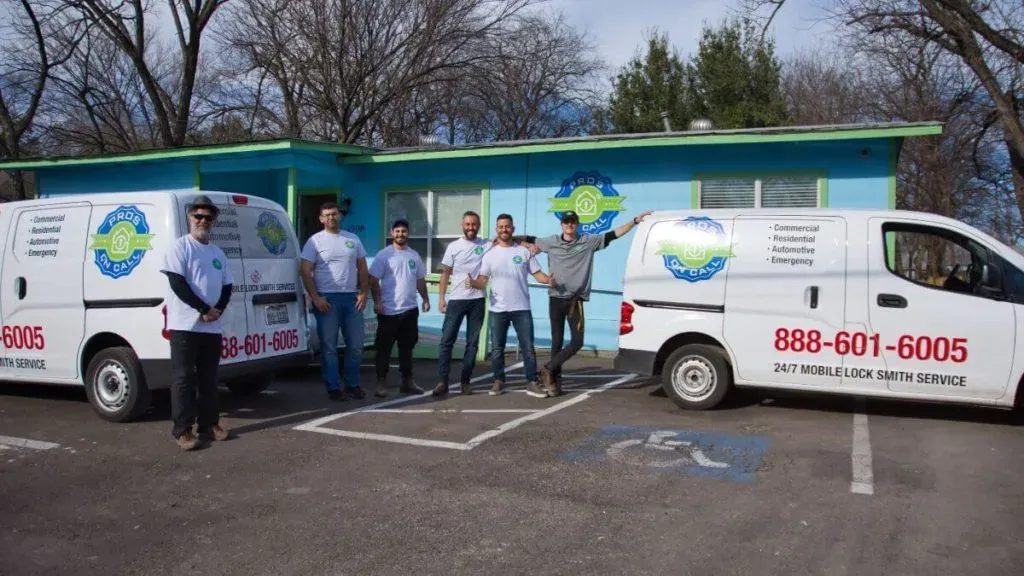
Pros On Call provides licensed locksmith services (License #B19847) across all major Texas metros with upfront pricing and no hidden fees. We serve Austin, Houston, Dallas, San Antonio, Fort Worth, El Paso, Arlington, Corpus Christi, Plano, Lubbock, Irving, McAllen, Laredo, and more. 24 hours a day, every day.
Call (888) 601-6005 for a free all-in price quote, same-day and emergency service, and a warranty on all parts and labor. You'll get an exact total before we dispatch, so there are no surprises when the invoice arrives.
Content strategy and SEO by Optymizer