You're standing in a parking lot, staring at your keys sitting on the driver's seat with all the doors locked. Sound familiar? Car lockouts happen to everyone, and they always seem to occur at the worst possible time. Whether it's 2 AM in a grocery store parking lot or midday at work, knowing how to find a reliable 24 hour car locksmith can save you hours of frustration and a whole lot of panic.
Why Car Lockouts Happen
It's tempting to blame yourself when you get locked out, but the truth is that modern vehicles are engineered in ways that make lockouts surprisingly easy to trigger. The lock mechanisms, automatic features, and key fob technology that make cars convenient are the same things that can leave you stranded. Understanding the common causes helps you recognize the risk points in your own routine.
Keys left in the ignition or on the seat account for a large share of lockouts, but automatic door locks are a close second. Many cars lock themselves the moment you reach a certain speed or when the door closes with the fob detected nearby. Key fob batteries also die without much warning, and a fob that worked fine this morning may leave you standing in a San Antonio parking garage by afternoon. Children pressing lock buttons, a trunk that closes on a full set of keys during loading, frozen lock cylinders after a rare Texas cold snap, and broken or stuck keys in the cylinder round out the most common causes.
Modern vehicles with push-button start and proximity keys add their own wrinkle. If the fob ends up inside the car, some models lock automatically when the door closes, because the car senses the fob is present and assumes you are inside. It's a safety feature that backfires in a specific, infuriating way.
Whether it's 2 AM in a grocery store parking lot or midday at work, knowing how to find a reliable 24 hour car locksmith can save you hours of frustration and a whole lot of panic.
Immediate Steps When Locked Out of Your Car
Step 1: Stay Calm and Assess
The first few minutes after a lockout are when people make decisions they regret, whether that's trying to force a window or calling the first number they find without vetting it. Take sixty seconds before you do anything else.
Work through the car systematically. Try every door, because sometimes only the driver's door locks while a rear door stays open. Check the trunk: on some sedans, a fold-down rear seat or a trunk release lever gives you access to the interior. Look for any window left slightly open, and confirm the key is actually inside the car rather than lost somewhere in your bag or pocket. Then assess your surroundings: where you are, whether the location feels safe, what time it is, whether you have your phone charged, and most importantly whether anyone, a child or a pet, is inside the vehicle.
Step 2: Check for Immediate Solutions
Before calling a locksmith, it takes only a minute to rule out faster options. A family member or trusted friend who has a spare key is the cleanest solution if they can reach you in a reasonable amount of time. Some people keep a magnetic key holder under the car, though this carries a security risk if it's discoverable. A spare stored at home is ideal when someone can bring it to you.
Roadside assistance is worth checking next. AAA memberships, insurance company roadside packages, and manufacturer programs like OnStar cover car lockouts for many policyholders. A number of credit cards, including many Visa, Mastercard, and Amex products, also include roadside dispatch as a cardholder benefit. It takes two minutes to call and find out, and if you're covered, the cost is already paid.
Finding a 24 Hour Car Locksmith Fast
When you need a professional and you need them now, the way you search matters. A panicked Google tap and a call to the first result is exactly how people end up with scam operators who quote one price on the phone and triple it at the car. A sixty-second vetting process saves you from that.
Quick Search Methods
Searching with your city name attached to "24 hour car locksmith" or "emergency car lockout service" gives you geographically relevant results. Google Maps results are useful because they show distance, business age, and reviews in one place. Look for businesses with a meaningful number of reviews spanning multiple years, not just a handful of recent five-stars that could be manufactured. A physical address listed on the website, not just a PO box or a service area claim, is a sign of a legitimate operation. If you've used a locksmith for your home before and had a good experience, that company is a natural first call, since established local businesses like those that handle residential locks almost always do automotive work too.
If you're in Austin, McAllen, San Antonio, or anywhere else in Texas, asking a nearby business owner or posting quickly in a neighborhood Facebook group can get you a real referral in minutes. People who've been through this know who showed up and who didn't.
A panicked Google tap and a call to the first result is exactly how people end up with scam operators who quote one price on the phone and triple it at the car.
Red Flags to Avoid
Locksmith scams are genuinely common, and a car lockout is one of the situations where you're most vulnerable to them. You're stressed, possibly in an unfamiliar area, and you just want someone to show up. Knowing the warning signs before you make the call puts you in control.
A price that sounds too low is the most reliable signal. A lockout quoted at $15 or even $35 is almost never real: the scammer arrives, invents reasons the job is harder than expected, and presents a bill that's three or four times the original quote. A company that can't give you a business name or a license number when you ask is another hard stop. In Texas, locksmiths are regulated by the Texas Department of Public Safety (DPS) Private Security Bureau, so any legitimate service can give you their DPS license number immediately. Watch also for the bait-and-switch price game, unmarked vehicles, demands for cash before any work starts, and any pressure to replace your locks for what should be a simple unlock job.
Verify Before They Arrive
Spending two minutes asking the right questions on the phone protects you from the problems above. Ask for the full business name and license number first, and write it down. A legitimate company gives this without hesitation. Ask for a total price for the car lockout including the service call, labor, and any mileage, and confirm that number is firm. For a standard lockout in Texas, $50 to $100 during business hours and $75 to $150 after hours is the realistic range. Ask how long until they'll arrive, because an honest estimate tells you something about how seriously they're taking your call. Ask what method they'll use to open the car: a professional never leads with window-breaking. And ask whether they carry insurance, because mistakes do happen and you want your car covered if one does.
What to Expect from Professional Car Locksmith Service
Tools and Methods
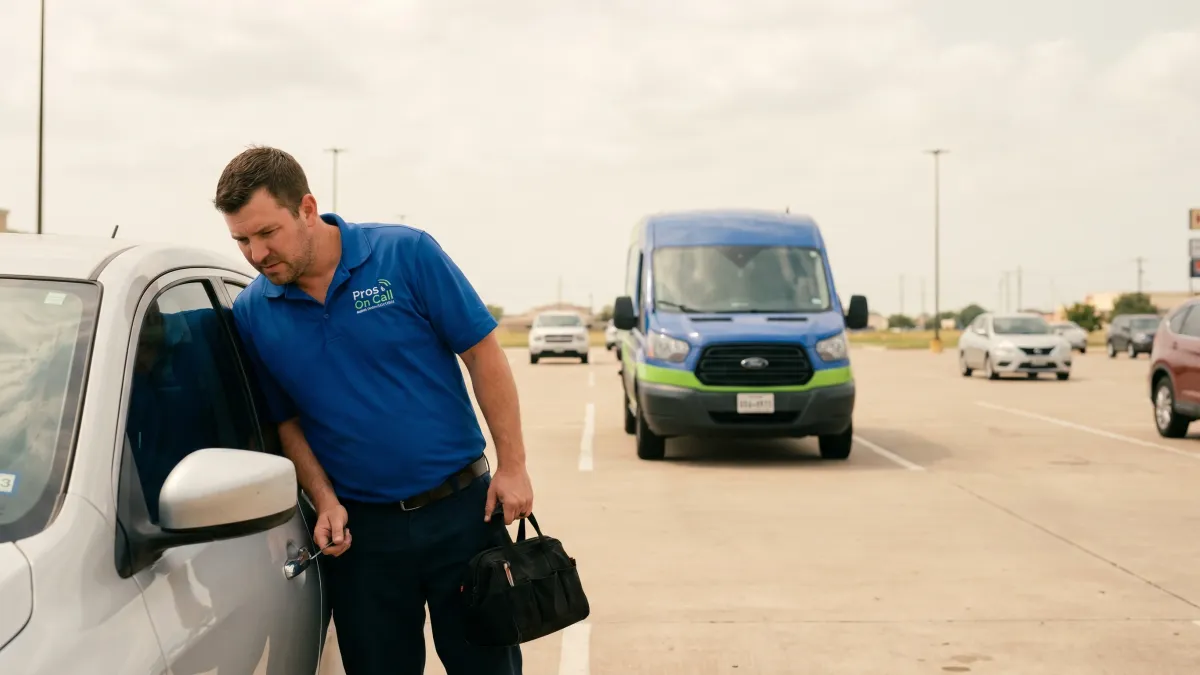
A trained automotive locksmith carries a set of purpose-built tools that open cars without leaving a mark. Understanding what these are helps you have a real conversation with the technician and know whether what they're doing makes sense.
The air wedge and long-reach tool is the standard for modern vehicles. The technician inserts an inflatable wedge at the top corner of the door, creating a small gap without bending the frame, then uses a long rod through that gap to press the unlock button inside the car. It's fast, leaves no damage, and works on the vast majority of cars built in the last two decades. The slim jim, a flat metal tool slid between the window glass and the weather stripping to manipulate the lock rod directly, is more common on older vehicles with accessible locking mechanisms. Lock picking applies to traditional keyed door cylinders and requires genuine skill, not a YouTube tutorial. For cases where the lockout is compounded by a lost or broken key, a mobile locksmith can cut a new key on-site from the VIN number. Transponder key and key fob programming is also done roadside for modern vehicles, though it requires more specialized equipment and adds to the cost.
Service Timeline
Knowing what each phase of the job looks like helps set realistic expectations and keeps you from worrying that something has gone wrong when the technician is simply driving to your location.
TYPICAL SERVICE PROCESS
Initial call
5-10 minutes (getting details, quote)
Travel time
15-60 minutes (depends on location)
Unlocking
5-15 minutes (experienced locksmith)
Payment and paperwork
5 minutes
From the moment you call to the moment you're back in your car, plan on 30 to 90 minutes total. The actual unlock is often the shortest part of the whole process, typically 5 to 15 minutes for an experienced technician. Most of the wait time is travel, which is why knowing your exact location and any useful landmarks before you call speeds things up.
Cost of 24 Hour Car Locksmith Service
What You'll Pay in Texas
Locksmith pricing varies by time of day, vehicle type, and how far the technician has to travel. For a standard car lockout, the realistic range in Texas is $50 to $100 during regular business hours (roughly 8 AM to 6 PM), and $75 to $150 for after-hours calls. Weekends run $75 to $125, and holiday rates typically reach $100 to $200. These are real numbers that reflect actual labor and overhead, not artificially inflated emergency rates.
Several factors push costs higher. Luxury vehicles and newer cars with advanced electronics take more time and specialized tools. Smart locks and keyless entry systems are harder to access without the right equipment. Remote locations add mileage to the bill, and calls in the late-night or early-morning window carry a surcharge that reflects the cost of keeping someone available at those hours. If you need more than just an unlock, expect $50 to $200 for a new key cut depending on type, $150 to $400 for key fob programming, and $200 to $500 for ignition repair or replacement.
Get Pricing Upfront
The single most important thing you can do on the phone is ask for a firm, all-in total before the technician leaves. Reputable companies will give you that number and put it in writing, or at minimum confirm it clearly before starting. The total should cover the service call or trip charge, labor for the unlock, any mileage or distance fee, and any after-hours surcharge. If the technician arrives and quotes something significantly higher without a genuine reason related to the car, that's your cue to pause the job and get clarity before anything proceeds.
Don't waste time with risky DIY methods or unreliable services. Get professional help from licensed automotive locksmiths who can get you back in your car quickly and safely.
DIY Methods (Try at Your Own Risk)
If you've ruled out every other option and help is more than an hour away, there are a few things people attempt. Most of them don't work on modern cars, and some cause damage that ends up costing more than a locksmith call. Read the warning below before trying anything.
String or Shoelace Method (Older Cars Only)
This technique works only on older vehicles with manual, post-style door locks, the kind that have a physical button or post that you pull up to unlock. It does not work on electronic systems, and it doesn't work on most cars built in the last fifteen or so years. Even on the right car, it's genuinely difficult to execute without practice.
- Create a small loop in the middle of a length of string or shoelace
- Work the string into the top corner of the door frame near the lock post
- Maneuver the loop down and around the lock post
- Pull both ends firmly to tighten the loop and lift the post
Success rates are low, and the weather stripping around the door frame is easy to damage in the process. Factor that into your decision.
SPARE KEY STRATEGIES
Give a copy to someone you trust
One call and your problem is solved, assuming they can reach you in a reasonable time.
Slim wallet-style emergency key
Fits in most wallets without adding bulk.
Magnetic key holder
Carries a real security risk if someone discovers them, so use them thoughtfully if at all.
Phone-controlled lockbox
A physical lockbox mounted to the vehicle that releases via app.
Coat Hanger Method (Not Recommended)
The coat hanger approach scratches paint, tears weather stripping, and can damage internal door components. It rarely works on any vehicle made after 2000, because the internal locking mechanisms are no longer accessible from the door edge the way older cars were. The repair bill from a bent door frame or stripped weather stripping will almost certainly exceed what a licensed locksmith would have charged.
Tennis Ball Method (Myth)
This doesn't work. The internet claim that air pressure from a tennis ball pressed against the keyhole can force a car door open is false. There is no physical mechanism by which this could function. Save the tennis ball.
| Method | Works On | Verdict |
|---|---|---|
| String or shoelace | Older vehicles with manual, post-style door locks | Success rates are low |
| Coat hanger | Rarely works on any vehicle made after 2000 | Repair bill will almost certainly exceed a locksmith charge |
| Tennis ball | No vehicles | Doesn't work, this is a myth |
Preventing Future Car Lockouts
Spare Key Strategies
The most reliable defense against a lockout is a spare key that lives somewhere other than in your car. Giving a copy to a trusted family member or close friend is the cleanest option: one call and your problem is solved, assuming they can reach you in a reasonable time. A slim wallet-style emergency key fits in most wallets without adding bulk. Magnetic key holders that attach to the underside of the car work but carry a real security risk if someone discovers them, so use them thoughtfully if at all. Some newer cars support phone-controlled lockboxes, a physical lockbox mounted to the vehicle that releases via app.
Modern technology offers other options worth knowing. Many vehicles manufactured in the last several years have manufacturer apps that can unlock the car remotely. Some models support the phone itself as a digital key. If your vehicle supports any of these, setting them up before a lockout is obviously better than discovering you could have during one.
SPECIAL LOCKOUT SITUATIONS
Engine running
The vehicle is a theft target, and fuel is being wasted. Call a locksmith immediately and stay with the car if the location is safe.
Extreme weather
If there is any person or animal inside the vehicle and you have any concern about their wellbeing, call 911 first, not a locksmith.
On the highway
Pull to the safest possible position on the shoulder, turn on your hazard lights, and stay as far from traffic as you can manage.
Better Daily Habits
The "phone, wallet, keys" check before every door close is a simple habit that prevents most lockouts outright. Making it a physical action, touching each item before closing the door, works better than a mental note. A quick visual confirmation through the window before walking away catches the cases where the key was in your hand and made it onto the seat during loading. For families, keeping children away from interior lock buttons and using child safety locks on rear doors eliminates a common cause. Spare fobs should stay in a bag or pocket, never inside the car.
STRING OR SHOELACE METHOD: STEP BY STEP
Create a loop
Create a small loop in the middle of a length of string or shoelace.
Work it into the door frame
Work the string into the top corner of the door frame near the lock post.
Maneuver around the post
Maneuver the loop down and around the lock post.
Pull to lift
Pull both ends firmly to tighten the loop and lift the post.
Special Situations
Locked Out with Engine Running
A running engine adds urgency for two reasons: the vehicle is a theft target, and fuel is being wasted. Call a locksmith immediately and stay with the car if the location is safe. Do not attempt to break a window while the engine is running: exhaust fumes concentrate quickly in enclosed or partially enclosed spaces, and the risk isn't worth it when a professional with the right tools is minutes away.
Locked Out in Extreme Weather
Texas heat is genuinely dangerous when a child or pet is trapped inside a car. Even on a mild day, interior temperatures rise fast once the car is stationary. If there is any person or animal inside the vehicle and you have any concern about their wellbeing, call 911 first, not a locksmith. Law enforcement and emergency responders are equipped and authorized to break windows immediately. If the situation is life-threatening, do not wait.
For cold weather, which does hit Texas occasionally, seek shelter in a nearby building or business while you wait for the technician. Mention the temperature when you call: many companies will prioritize calls when extreme weather is a factor, and frozen lock cylinders require specific tools that a technician will want to bring prepared.
Locked Out on the Highway
A highway lockout is primarily a safety situation before it's a locksmith situation. Pull to the safest possible position on the shoulder, turn on your hazard lights, and stay as far from traffic as you can manage. Call the police non-emergency line to let them know your location, especially if you're on a high-speed stretch of highway or a poorly lit area. Once you're in contact with dispatch and your position is noted, call a locksmith or roadside assistance. Do not stand behind your vehicle while you wait.
WHY CHOOSE PROS ON CALL
Licensed and insured
B19847
Response time
30-Minute Average Response
Vehicle coverage
All Vehicle Makes and Models
Entry method
Non-Destructive Entry Methods
On-site capability
Key Cutting and Programming On-Site
Pricing
Upfront Pricing - No Hidden Fees
Why Choose Pros On Call for Car Lockouts
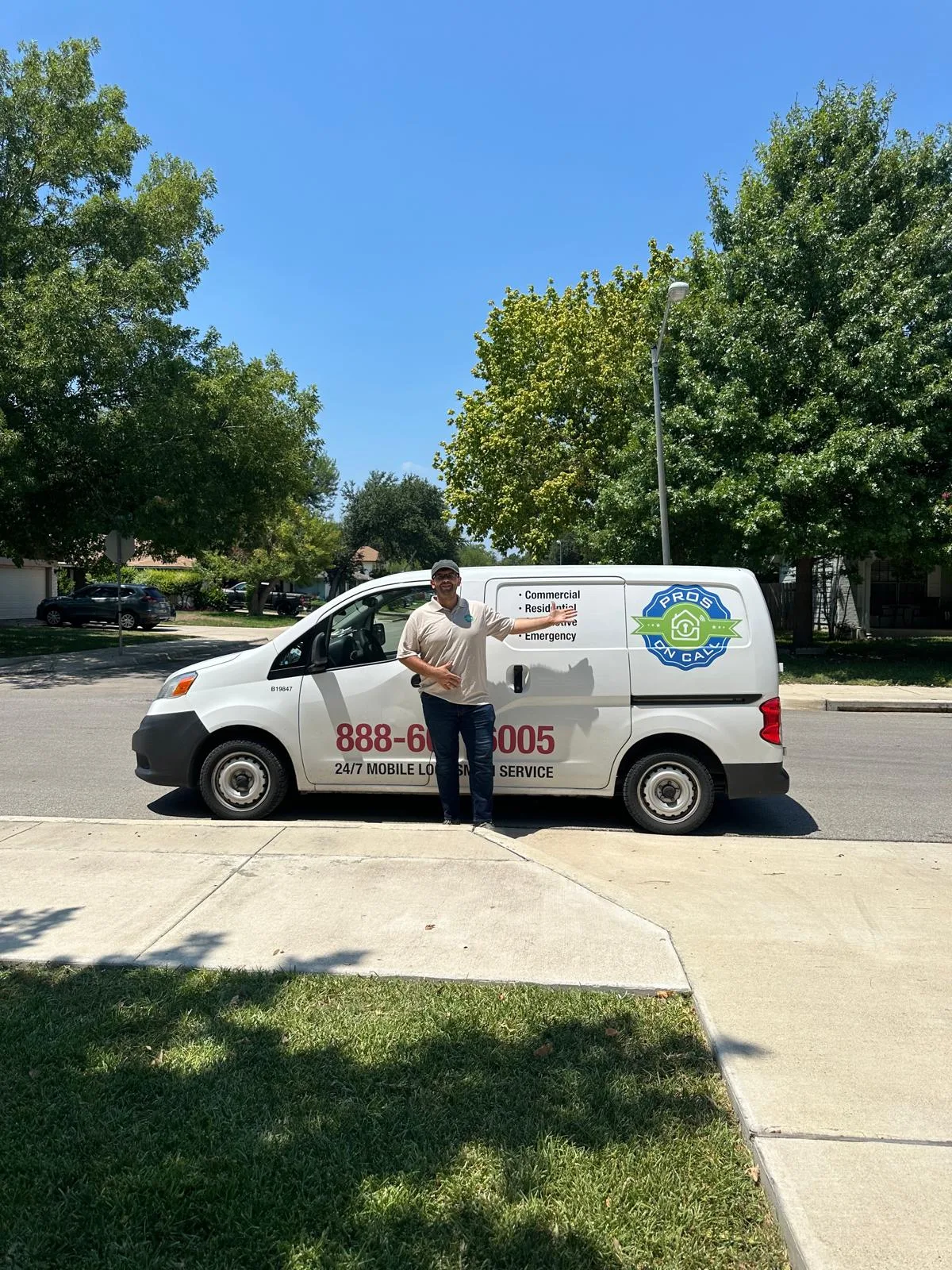
When you call Pros On Call, you're reaching a licensed Texas locksmith operation that has been handling automotive lockouts across the state since 2010. Texas License B19847 is not a detail we mention as an afterthought: it means our technicians are trained, background-checked, and working under a regulated framework that protects you. We carry full insurance on every job, so if something unusual happens during a service call, you're covered.
Our mobile fleet is positioned across Texas, including Austin, San Antonio, McAllen, Houston, Dallas, and Fort Worth, so that our travel times are realistic rather than aspirational. When we quote 30 minutes in an urban area, that's based on where our technicians actually are, not an optimistic projection from a dispatch center three cities away. Our trucks carry current non-destructive entry tools, on-site key cutting equipment for most vehicle makes, and transponder key programming hardware. We price the job upfront, confirm it before we start, and don't add fees on arrival.
WEATHER-SPECIFIC LOCKOUT GUIDANCE
Extreme heat
Law enforcement and emergency responders are equipped and authorized to break windows immediately. If the situation is life-threatening, do not wait.
Cold weather
Seek shelter in a nearby building or business while you wait for the technician. Mention the temperature when you call.
Locked Out of Your Car Right Now?
Don't waste time with risky DIY methods or unreliable services. Get professional help from licensed automotive locksmiths who can get you back in your car quickly and safely.
Emergency Car Lockout Service:
Call Now: (888) 601-6005
Licensed and Insured (B19847) 30-Minute Average Response All Vehicle Makes and Models Non-Destructive Entry Methods Key Cutting and Programming On-Site Upfront Pricing - No Hidden Fees
Serving all major Texas cities: Austin, Houston, Dallas, San Antonio, Fort Worth, El Paso, and more.
Available 24/7/365 - We're Ready When You Need Us
Content strategy and SEO by Optymizer
Pros On Call (24 Service LLC DBA Pros On Call) - Professional automotive locksmith service across Texas since 2010.