
Texas requires every locksmith company to hold a Class B license from the Department of Public Safety, and that license is public record. A business can look up any locksmith company's license number, status, and expiration on the state's free TOPS portal in about 30 seconds, before signing a contract or letting a technician into the building. Most businesses never do this.
I run dispatch at Pros On Call, which means the calls that go wrong before we're ever involved land on my desk after the fact. A general manager finds out three days late that the tech who fixed a rekey job at their warehouse wasn't the name on the invoice. A property manager gets a call from her own insurance carrier asking why a locksmith who wasn't on any vendor agreement had a master key to her building. Every one of those calls traces back to the same root cause: nobody checked anything before signing. This guide is the checklist I'd want any business to run before hiring a commercial locksmith, ours included.
When a Business Actually Needs to Vet a Commercial Locksmith
A business should vet a commercial locksmith vendor before an emergency forces the decision, not during one. The clearest triggers are signing a new lease, absorbing employee turnover, losing a master key, failing a compliance inspection, or opening a second location. Waiting until a lockout call is the single most common reason businesses end up with a vendor they never actually checked.
THE CLEAREST TRIGGERS
New lease or new location
Most leases require rekeying at move-in, and a landlord's handyman or a leftover set of keys from the previous tenant is not a security plan.
Employee turnover or a lost master key
A master key that walks out the door with a departing employee is a security event, not paperwork to file later.
A failed inspection or a planned expansion
A fire marshal or an ADA compliance reviewer flags hardware that doesn't meet code, and now there's a deadline to fix it.
New Lease or New Location
Signing a new commercial lease is the best moment to line up a vetted locksmith before you need one. Most leases require rekeying at move-in, and a landlord's handyman or a leftover set of keys from the previous tenant is not a security plan. If you're weighing whether you actually need a commercial locksmith for a given job in the first place, our overview of when each type of locksmith applies covers the basic service triggers. This guide is about the vendor selection itself, not the service list.
Employee Turnover or a Lost Master Key
A master key that walks out the door with a departing employee is a security event, not paperwork to file later. Businesses that handle this well already have a vetted locksmith on file, so the rekey happens that same week, not whenever someone gets around to finding a name in an old email thread. High turnover industries, retail, restaurants, multi-tenant offices, should treat locksmith vetting as onboarding infrastructure, the same way a payroll vendor gets set up before the first employee starts.
A Failed Inspection or a Planned Expansion
A fire marshal or an ADA compliance reviewer flags hardware that doesn't meet code, and now there's a deadline to fix it with a vendor who can prove they know what they're doing. A planned second or third location creates the same urgency in reverse: there's time to vet properly now instead of scrambling later. Both situations reward a business that already has answers to the questions in this guide, rather than one asking them for the first time under a deadline.
Waiting until a lockout call is the single most common reason businesses end up with a vendor they never actually checked.
The License Number Is Checkable in 30 Seconds
Every locksmith company operating in Texas must hold a Class B Private Security license from the Department of Public Safety, and DPS publishes that license status for free on its TOPS portal. Search by business name or license number, and the result page shows license class, active or suspended status, and the expiration date, without creating an account or calling anyone.
What the TOPS Portal Actually Shows You
Go to the TOPS public search and enter the business name or license number. A live result shows the license class (Class B, for a security contractor company covering locksmith services), the current status (Active, Suspended, or Expired), the expiration date, and the insurance policy expiration DPS has on file. No login, no fee, no waiting for a callback.
What the License Number Format Tells You
Individual technician registrations use an L prefix, formatted like L0123456. Company licenses use a B prefix, formatted like B0123456. If someone gives you a license number that doesn't match either format, that's worth a second question before it's worth a service call.
Verify Us the Same Way You'd Verify Anyone Else
Pros On Call's own Class B license, #B19847, is searchable on TOPS right now. Search it yourself before taking anything else in this guide on faith. It's exactly the process we're asking you to run on every vendor you consider, ours included. Always verify current requirements directly against Texas Occupations Code Chapter 1702, since the statute is the authority and this guide is only a summary of it. The chapter's section numbering was last updated January 1, 2025 in a nonsubstantive recodification; the licensing requirements themselves didn't change.
The license number is checkable in 30 seconds. Most businesses never check.
What a Company License Does and Does Not Tell You
A Class B company license confirms the business itself is authorized to operate, but Texas law separately requires every individual doing locksmith work to hold their own DPS Locksmith registration, cleared through a fingerprint-based criminal history check. A company license alone doesn't confirm the specific technician standing at your door has been individually vetted.
The Individual Locksmith Registration
Texas Occupations Code Section 1702.2227 defines a locksmith as anyone who sells, installs, services, or maintains mechanical security devices, or represents themselves to the public as a locksmith, and requires that person to hold an individual DPS registration tied to a licensed company. A technician can work for a fully licensed Class B company and still not personally hold this registration if something slipped through onboarding. Asking the company to confirm it is a fair, specific question, not an accusation.
The Fingerprint-Based Background Check
DPS runs a fingerprint-based Texas and FBI criminal history check on individual registrants before issuing the Locksmith registration, submitted electronically through the department's approved vendor. That background check, not just the company's overall reputation, is what actually stands behind the person working inside your building. A business is entitled to ask whether the technician arriving on-site is individually registered, not only employed by a licensed company.
ALOA Certifications: What to Ask a Commercial Tech
ALOA Security Professionals Association, the trade's main certifying body, ranks general locksmith credentials in three tiers: CRL for entry level, CPL for the professional tier built on top of CRL, and CML, Certified Master Locksmith, ALOA's highest general credential. A commercial job, especially one touching master keying, access control, or panic hardware, is where the CPL or CML tier starts to matter.
The Three-Tier Ladder: CRL, CPL, CML
CRL, Certified Registered Locksmith, is the entry credential built on core coursework. CPL, Certified Professional Locksmith, adds electives and a higher exam bar on top of CRL. CML, Certified Master Locksmith, is ALOA's top general tier, built on CPL with additional electives and a 70 percent or higher passing score on every exam. ALOA also maintains specialty tracks, institutional facility credentials, an electronic locksmith track, and a fire door inspector credential, that sit alongside these three rather than replacing them.
Why the Tier Matters More on a Commercial Job
A CRL credential is a reasonable baseline for a straightforward residential call. A commercial job, a master key hierarchy, access control integration, panic hardware on a fire-rated door, rewards the deeper training behind a CPL or CML. Ask which certification the assigned technician holds, and don't accept "we're licensed" as a substitute answer, since the DPS license and the ALOA certification measure two entirely different things.
Insurance and Bonding: What to Demand in Writing
Texas sets a minimum general liability requirement for a licensed locksmith company, but that state floor isn't a serviceable commercial standard on its own. A business should ask for a certificate of insurance in writing, confirm the coverage limits and dates directly with the carrier, and request additional insured status when its own vendor policy requires it, rather than accept a verbal assurance.
The Certificate of Insurance, Verified, Not Just Viewed
Ask for the certificate of insurance before work begins, not after. A COI is a document, and documents can be outdated or altered, so confirm it directly with the insurance producer or carrier listed on it rather than relying on a photo or a PDF someone emailed you. Texas's own statutory minimum for a licensed company is $100,000 per occurrence and $200,000 aggregate, which is the regulatory floor, not what most commercial and institutional vendor contracts actually require.
Additional Insured Status
Commercial and institutional vendor contracts commonly ask for $1,000,000 per occurrence and $2,000,000 aggregate as a baseline, with the hiring business named as an additional insured on the policy. If your own company already requires that language from every vendor, ask your locksmith for it explicitly rather than assuming general liability coverage automatically includes it. It usually has to be requested and issued as its own endorsement.
Bonding: A Compliance Check, Not a Number to Quote
Texas requires a locksmith company to keep a surety bond on file with DPS at all times as a licensing condition, and a lapsed bond is one of the things that can trigger a suspended status on the TOPS lookup. Treat bonding as something you confirm indirectly, through an Active status on the license search, rather than a specific dollar figure to ask for by name, since the state doesn't publish one fixed bond amount for every locksmith license.
The Vetting Sequence, Start to Finish
Vetting a commercial locksmith vendor is a five-step sequence, not a single phone call. Look up the license, request a written certificate of insurance, call actual references, get a written scope of work, and settle key control terms before anyone signs anything. Skipping a step to save time is exactly how a business ends up with a vendor it never really checked.
Before You Call
Do the license lookup and the reference calls before you ever dial the vendor's number. A five-minute search on TOPS and two phone calls to businesses of a similar size tell you more than anything said during a sales pitch.
THE VETTING SEQUENCE
License lookup
Search the company's Class B license number on the TOPS portal before you ever call.
COI request
Ask for a certificate of insurance in writing, then verify it directly with the carrier or producer.
References
Call two commercial references from jobs similar in size and scope to yours.
Written scope
Get the exact list of doors, hardware, and work items in writing before anyone touches a lock.
Key control terms
Confirm who documents every key cut and what happens to those records if the contract ends.
Before You Sign
The certificate of insurance, the written scope, and the key control terms should all be in your hands before a technician sets foot on your property, not promised verbally and delivered later. If a vendor pushes back on providing any of these in writing before the first visit, that reluctance is itself useful information.
Key Control Belongs in the Contract
A key control agreement is a contract term, not a favor you're asking your locksmith for. It should name who is authorized to request duplicate keys, how the vendor documents every key cut for your building, and what happens to the keying records when the contract ends. None of that requires understanding how a master key system is actually built, only requiring it in writing.
What to Put in Writing
Name the people authorized to request a duplicate key or a rekey, in writing, and require the vendor to log every key cut against your address. If your building already uses a restricted keyway system, duplication should already require an authorization card on file with the vendor, and your contract should say so explicitly rather than assume it. If a full master key rollout is part of the project, our master key systems service covers scoping, and our master key system guide covers how the underlying hierarchy gets designed. This section is about the contract language that sits on top of both. Duplication authority is a contract term; the mechanics of copying a key you already hold are covered separately in our key duplication guide.
What Happens to Records When the Contract Ends
Ask, before you sign, who keeps the keying chart and the duplication log if you switch vendors later, and whether those records transfer to you or stay with the locksmith. A vendor that can't answer this clearly hasn't thought about it, which is worth knowing before a master key system covering your entire building is designed by a company you may not keep working with.
A key control agreement is a contract term, not a favor you're asking your locksmith for.
What Commercial Locksmith Work Actually Costs in Texas
Commercial locksmith pricing in Texas breaks into service lines rather than one flat number, and each line varies with scope, hardware, and time of day. A written quote should itemize the service call, any after-hours surcharge, per-opening rekey costs, and access control installation separately, using Texas 2026 market ranges as a starting point, not a promise.
Reading the Range, Not the Bottom Line
The table below reflects general Texas 2026 market ranges gathered from locksmith industry pricing data, not a government price survey, since no government body sets locksmith pricing. Use it to sanity check a quote's individual line items, not to predict your own final invoice, which depends on your building's specific hardware and scope.
| Service Line | Texas 2026 Range | What Drives the Range |
|---|---|---|
| Commercial service call | $50 to $120 | Base trip charge, before any labor |
| After-hours surcharge | $50 to $250 flat, or 1.25x to 2x daytime rate | Time of day and how the vendor structures its multiplier |
| Per-opening rekey (commercial) | $25 to $40 per cylinder | Added on top of the service call, per opening |
| Access control, per door | $500 to $8,000 | System type; most full single-door deployments land between $1,000 and $5,000 |
What Changes the Price on Any Given Line
Hardware grade, the number of openings involved, and whether the call happens during business hours or after them all move these numbers within their range. Master key system design and panic hardware installation have their own detailed cost breakdowns in our master key system guide and commercial door hardware guide, since those projects involve enough variables to deserve their own pricing discussion rather than a single line in a table. Access control is the same way: the per-door range above is a starting point, and our access control overview breaks scope down further. And if a lock itself is failing rather than simply needing a rekey, whether to repair or replace it is a separate decision, covered in our lock repair vs. replacement guide.
Getting a Quote That Holds Up
A quote that holds up in practice names the exact scope of work, includes a walkthrough before the number is finalized, and spells out how a change in scope gets priced and approved. A verbal number given over the phone without seeing the doors involved is an estimate, not a quote, and should be treated as one.
The Written Scope
A real scope of work names which doors or openings are involved, which hardware is being touched, whether the job is a rekey or a full replacement, and what the master keying impact is, if any. Ambiguity here is exactly what turns a $300 job into a $900 invoice with nobody able to point to what changed.
The Walkthrough
Any quote covering more than a single lock deserves an actual walkthrough of the space before the number is final. A vendor willing to quote a multi-door commercial job sight unseen over the phone is guessing, and a guess isn't a number you can hold anyone to later.
GETTING A QUOTE THAT HOLDS UP
The written scope
A real scope of work names which doors or openings are involved, which hardware is being touched, and whether the job is a rekey or a full replacement.
The walkthrough
A vendor willing to quote a multi-door commercial job sight unseen over the phone is guessing, and a guess isn't a number you can hold anyone to later.
Change orders in writing
Ask how change orders get approved before you sign the original scope, not after the first one appears.
Change Orders in Writing
Hidden lock conditions and unexpected hardware failures happen, and a serious vendor has a defined process for pricing and approving that change before the work continues, not after it shows up on the final invoice. Ask how change orders get approved before you sign the original scope, not after the first one appears.
Service Agreements and Response Commitments
A written service agreement should state what response commitment the vendor is making, in what timeframe, for what type of call, rather than leaving it as a verbal promise made during the sales conversation. A business should ask for this in writing and treat any number given only over the phone as unconfirmed until it appears in the contract.
What a Written Response Commitment Should Actually Say
A response commitment should specify the call type it applies to, the general timeframe the vendor is targeting, and what happens if that window is missed. It shouldn't promise an exact guaranteed arrival time for every possible situation, since traffic, weather, and call volume are real variables no vendor fully controls. What matters is that the commitment is written down and specific enough to hold the vendor to something.
Retainers for Multi-Site or Round-the-Clock Operations
A business running multiple locations or 24-hour operations benefits from a standing service agreement rather than restarting the vetting process at every location or every shift change. A retainer arrangement, negotiated once, in writing, saves the same due diligence work from repeating itself at every new site.
If you're locked out right now and need help immediately rather than vetting a vendor for next time, our business lockout guide covers what to do in the moment. This guide is about choosing who you call before it happens again, not what to do while you're standing outside the door today.
SERVICE AGREEMENTS AND RESPONSE COMMITMENTS
What the commitment should say
A response commitment should specify the call type it applies to, the general timeframe the vendor is targeting, and what happens if that window is missed.
Retainers for multi-site operations
A retainer arrangement, negotiated once, in writing, saves the same due diligence work from repeating itself at every new site.
Vetting a Vendor Across Multiple Texas Locations
A business with locations in more than one Texas city faces a choice between vetting one vendor capable of covering every site or building a short list of vetted vendors by metro. Either way, the underlying paperwork, license verification, insurance certificate, written scope, and key control terms, should stay identical across every location rather than getting renegotiated site by site.
One Vendor or a Vetted Short List
Pros On Call dispatches technicians across Austin, Houston, Dallas, San Antonio, El Paso, Midland, and Odessa, which is one reason multi-site businesses in Texas often standardize on a single vendor rather than managing a different locksmith relationship in every city. The trade-off is coverage versus a smaller local relationship in any one market. Either approach works as long as the vetting standard in this guide applies at every location, not just headquarters.
Keeping the Paperwork Consistent Across Sites
A certificate of insurance verified for your Austin location should be the same document your Houston site manager can reference, not a separate negotiation. Multi-location businesses that keep this paperwork centralized catch a lapsed COI or an expired license faster than ones where every location manager handles vendor relationships independently.
Compliance Your Inspector Will Check
Egress hardware, ADA accessible hardware, and fire-rated door assemblies are compliance areas your inspector checks independently of anything your locksmith tells you, and the business, not the vendor, owns responsibility for the building passing. Each area has its own detailed code requirements, covered fully in a dedicated guide. This section names what to expect, not the code itself.
Egress Hardware
Your inspector will check that every door in the path of egress opens from the inside with a single motion, no key, no tool, no tight grasping or twisting required, and that nothing about the hardware can trap someone during an evacuation. This is enforced through the locally adopted fire and building code, and it's worth confirming your vendor understands it rather than assuming any lock that closes properly also satisfies egress rules. Full detail lives in our commercial door hardware guide.
ADA Accessible Hardware
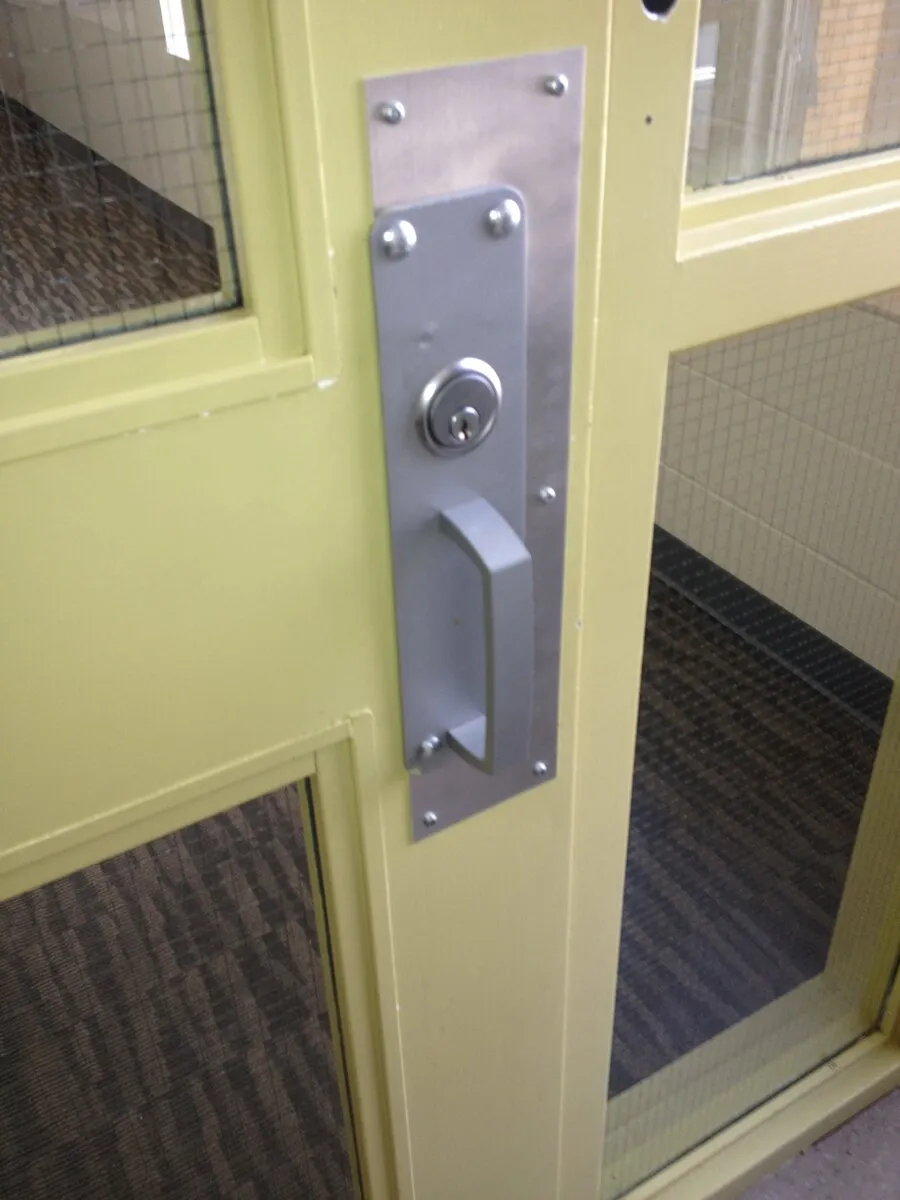
Your inspector or an accessibility reviewer will check that hardware on an accessible door operates with one hand, without tight grasping or twisting, requires no more than five pounds of force, and sits within the required mounting height range, with lever-style hardware rather than a round knob. Texas layers its own Architectural Barriers Act review on top of the federal ADA for many commercial projects. That same guide covers the specific measurements and thresholds in full.
Fire-Rated Door Assemblies
Your inspector will check that a fire-rated opening still closes and latches on its own, that its listed hardware hasn't been swapped for something non-rated, and that it's been inspected within the required annual window. Unauthorized hardware substitution on a rated door is one of the most common fire inspection failures, and it's a good, specific question to ask any vendor working on a rated opening.
Ten Questions to Ask Before You Sign
Before signing a commercial locksmith contract, ask ten specific questions covering licensing, insurance, and contract terms, distinct from the general residential vetting questions most locksmith guides publish. A residential emergency call and a commercial vendor relationship carry different risks, and a procurement-minded business asks accordingly, in writing, before any technician arrives.
If you're calling someone for a same-day residential job instead, our guide to avoiding locksmith scams covers the phone-call questions that matter most there. The ten questions below are built for a business signing a standing vendor relationship, not a one-time emergency call.
On Licensing and Credentials
- What is your Class B company license number, and can I verify it myself on TOPS before you arrive?
- Is the technician assigned to my job individually registered with DPS as a locksmith, separate from the company license?
- Which ALOA certification does that technician hold, CRL, CPL, or CML?
THE TEN QUESTIONS, BY CATEGORY
On licensing and credentials
What is your Class B company license number, and can I verify it myself on TOPS before you arrive?
On insurance and risk
Can you send a certificate of insurance in writing before the first visit, not just tell me you carry coverage?
On contract and scope
Will the scope of work be written down before any work begins, naming the specific doors or openings involved?
On Insurance and Risk
- Can you send a certificate of insurance in writing before the first visit, not just tell me you carry coverage?
- Will you name my business as an additional insured if my own vendor policy requires it?
- What is your current license status on TOPS right now, and through what expiration date?
On Contract and Scope
- Will the scope of work be written down before any work begins, naming the specific doors or openings involved?
- How do you price and approve a change order if the job scope changes once work is underway?
- Who documents every key cut for my building, and what happens to those records if I switch vendors later?
- What does the written service agreement say about response commitments, and is that language in the contract itself, not just something said on the phone?
Frequently Asked Questions
The questions below cover the details businesses ask most often once they've started the vetting process: license verification specifics, what a lapsed credential means, and how vetting differs across a multi-location footprint. Each answer stands on its own and doesn't require reading the rest of this guide first.
How do I check if a Texas locksmith company is actually licensed?
Search the company's name or license number on the TOPS portal, run directly by the Texas Department of Public Safety. The result shows the license class, current status, and expiration date at no cost and with no login required.
- Works for any Class B locksmith company license in Texas, not only ours.
- Search by business name or license number.
- Shows Active, Suspended, or Expired status, plus the expiration date.
- Takes about 30 seconds and requires no phone call.
What is the difference between a company license and an individual locksmith registration?
A Class B license authorizes the business itself to operate as a locksmith company in Texas. An individual DPS Locksmith registration, required separately under Occupations Code Section 1702.2227, authorizes the specific technician doing the work and requires a fingerprint-based background check.
- A company can be fully licensed while an individual technician issue still exists.
- Individual registrations use an L prefix; company licenses use a B prefix.
- Both are checkable, though confirming the individual registration typically means asking the company directly.
- Texas requires both to be current for the work to be fully compliant.
TWO SEPARATE CREDENTIALS
Company license
A Class B license authorizes the business itself to operate as a locksmith company in Texas.
Individual registration
An individual DPS Locksmith registration, required separately under Occupations Code Section 1702.2227, authorizes the specific technician doing the work and requires a fingerprint-based background check.
Should I ask for a certificate of insurance before or after signing a contract?
Ask for the certificate of insurance before signing, and verify it directly with the insurance carrier or producer listed on the document rather than accepting a photo or a PDF at face value. A vendor unwilling to provide this before work begins is a real signal worth weighing.
- Confirm the named insured matches the company you're hiring.
- Confirm the policy dates cover the full length of your engagement.
- Request additional insured status in writing if your own policy requires it.
- Call the carrier or producer directly rather than trusting the document alone.
Does a locksmith's DPS license cover every technician who works for the company?
No. The Class B license covers the company itself. Texas separately requires each individual doing locksmith work, selling, installing, servicing, or maintaining mechanical security devices, to hold their own DPS Locksmith registration tied to that licensed company.
- A company license doesn't automatically mean every technician is individually registered.
- Ask directly whether the specific technician assigned to your job holds this registration.
- Individual registration requires a fingerprint-based criminal history check.
- This is a fair, specific question, not an unusual demand.
How is vetting different for a business with locations in more than one Texas city?
The vetting steps stay the same, license lookup, insurance verification, written scope, key control terms, but a multi-location business should keep that paperwork centralized rather than letting each site manager negotiate separately. A single vendor covering multiple metros, or a short vetted list, both work as long as the standard applies everywhere.
- Centralize the certificate of insurance so every location references the same verified document.
- Standardize the written scope and key control language across sites.
- Confirm coverage areas match your actual locations before assuming one vendor serves all of them.
- Re-verify license status periodically, not only at initial vendor selection.
Vetting a commercial locksmith vendor takes less time than most businesses assume, and the paperwork it produces protects you long after the job is done. Ready to start with a commercial locksmith whose license you can verify yourself? Call Pros On Call at (888) 601-6005, or check our Class B license, #B19847, on TOPS before you ever pick up the phone.
Content strategy and SEO by Optymizer