
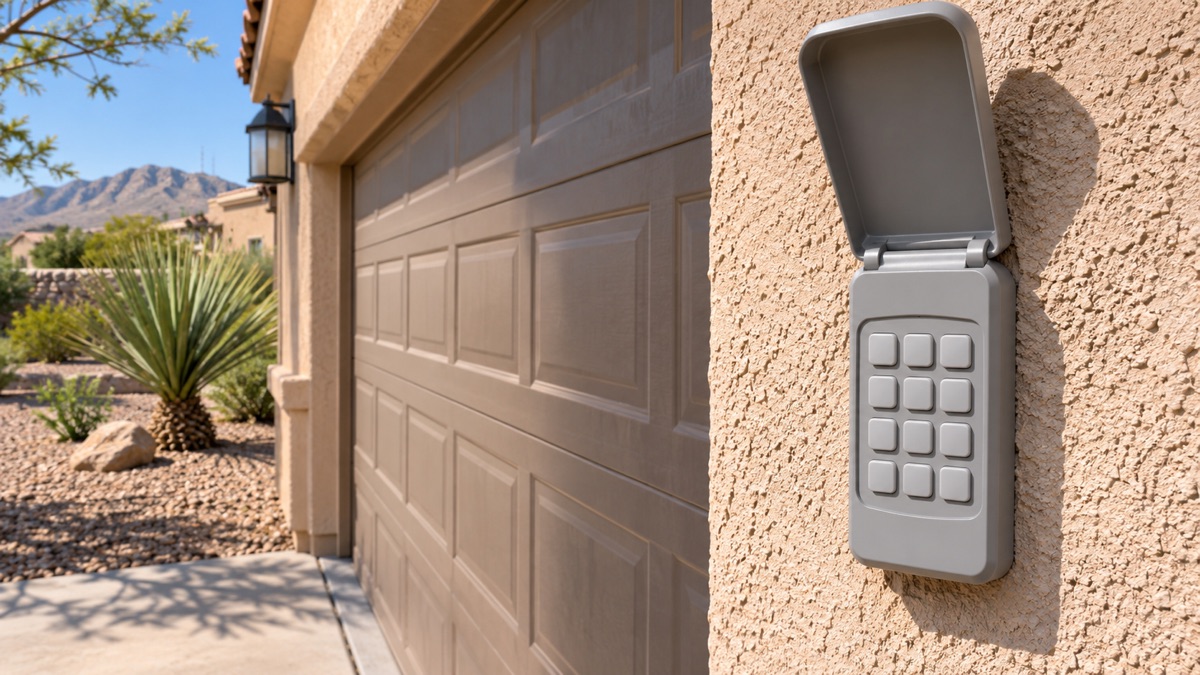
A wireless keypad that is placed, powered and paired well keeps an El Paso household out of a dark driveway, and a high-cycle torsion spring is the longer-rated option worth asking about when the door opens and closes many times a day. The two jobs are linked because both wear with use and with the desert climate, and a trained technician fixes both. The spring is never a place for guesswork.
I'm AK, a garage door partner and manager with Pros On Call, and our El Paso crew gets asked about both. To book or get a quote, our El Paso garage door and lock service page is where to go. This guide is how to judge the keypad and spring questions first.
How a Keypad Fits an El Paso Household's Routine
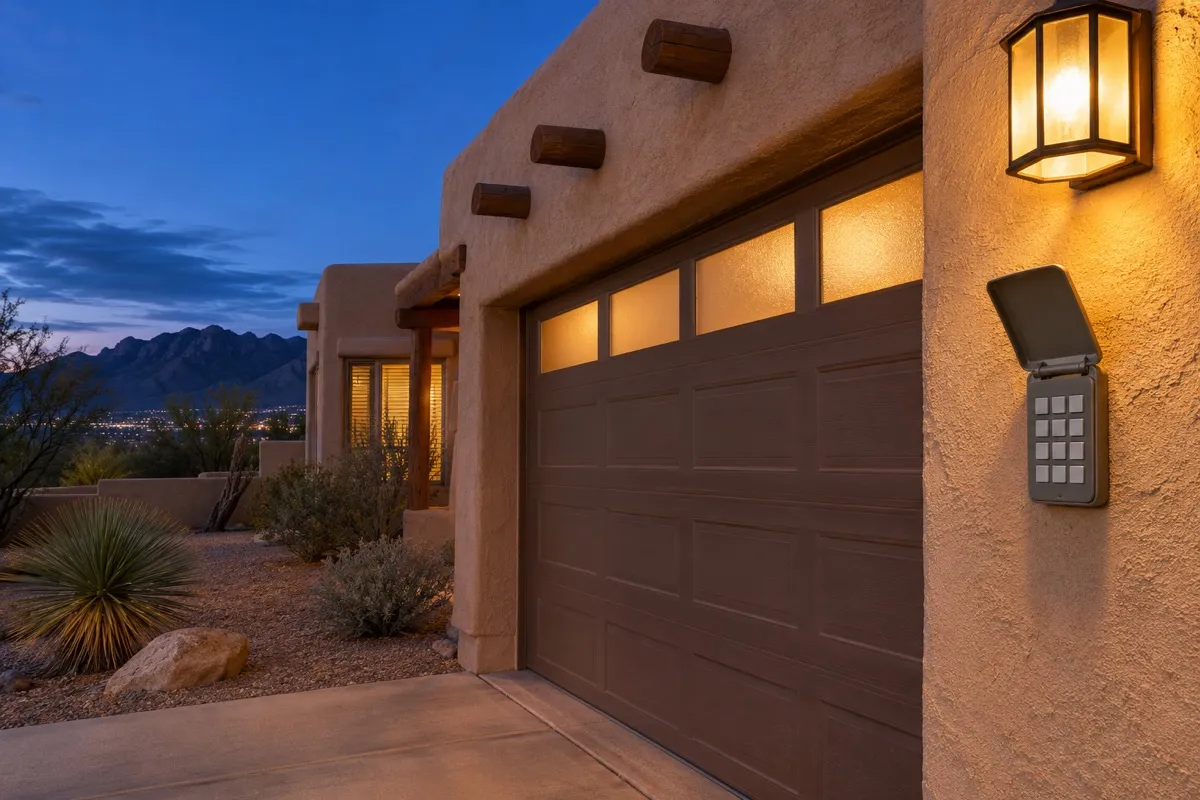
A wireless keypad lets anyone with the PIN open the garage without a remote, so kids, guests, a dog walker or a package hand-off do not depend on one clicker in one car. It matters more right now. Daylight saving time ended on November 1, so the garage gets entered in the dark earlier, and holiday deliveries and Thanksgiving travel lean on garage access.
Think about who actually needs in. A teenager home before anyone else. A neighbor watering plants over the holiday. A driver you have agreed to let leave a box inside the door. One remote in one car covers none of them. A PIN covers all of them, and unlike a spare remote, you can take it back.
That last part is the catch. Every new person who learns the code is a reason to change it later. This is our view, and it borrows from how locksmiths think about rekeying when a tenant moves out: when who has access changes, the code should change too. It is a habit, not a rule from any standards body. If you want a hand with the opener or the door itself, start with our residential garage door service.
A keypad only helps if it opens the door every time, in the dark, on the first try. The rest of this guide is about making that true.
A keypad only helps if it opens the door every time, in the dark, on the first try.
El Paso Sun, Dust and Swings: What Your Exterior Keypad Faces
El Paso is known as the Sun City, averaging roughly 84 percent of possible sunshine a year, according to a National Weather Service El Paso research paper. The same paper says March, April and May carry a 42 percent chance of encountering blowing dust on any single day in that window. Those are the conditions an exterior keypad lives in.
That is the paper's phrasing, so read it as a chance over the spring window, not as a count of days. It also says dust storms are most frequent in March and April and comparatively rare in the summer monsoon season.
Here is our field view, and I want to label it as that: sun, dust and big day-to-night swings are hard on an exterior keypad's face, its buttons and its battery. I have never seen a published failure rate for keypads, and I will not invent one. What I can give you is what to look at.
Start with the battery type, because it is not the same on every keypad. Many keypads use a 9 volt battery, and LiftMaster's keypad battery page is where to check if yours is one of theirs. Other keypads differ, and one opener maker's keypad runs on two AAA batteries. Read the label in your unit or its manual rather than guessing. I have not found a maker's change interval I would stand behind, so the next section gives you a schedule that does not depend on one.
Where to Mount a Wireless Keypad
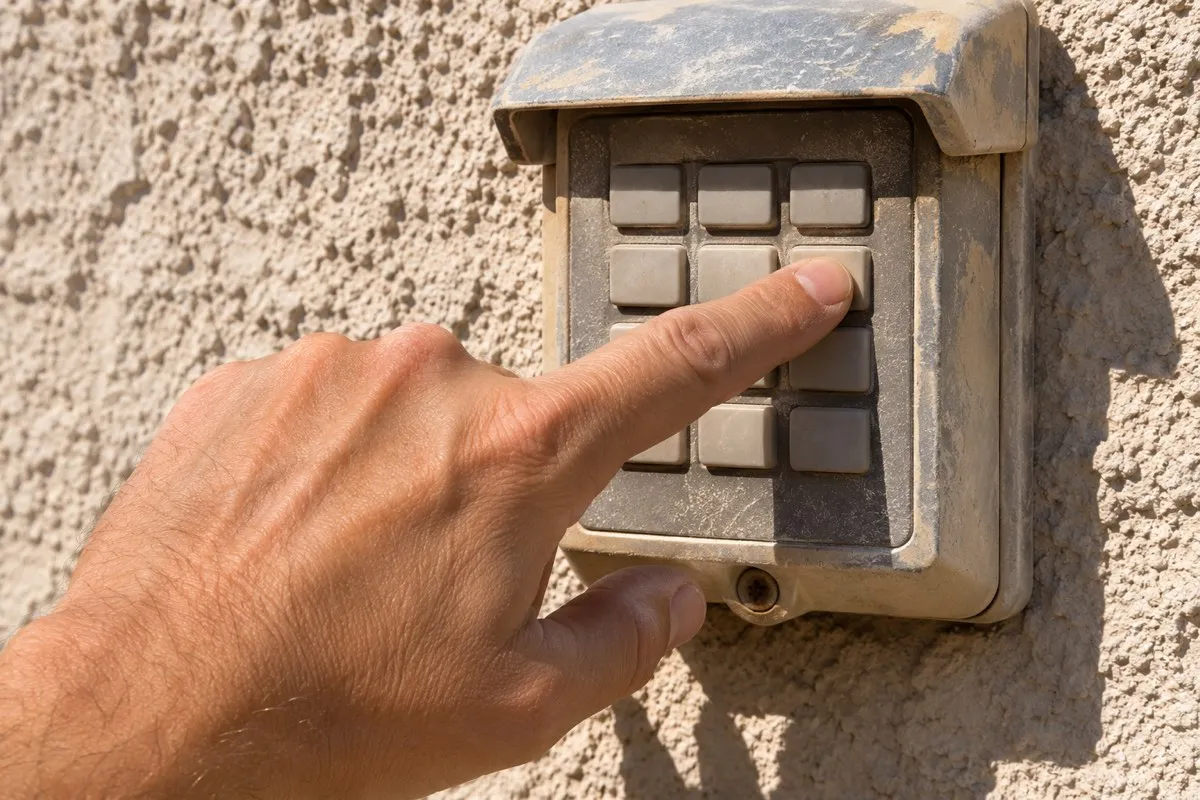
Mount the keypad where you can reach it from the driveway without leaving your path to the door, at a height adults and teenagers can reach, and out of the hardest afternoon sun if the wall allows. This is field advice, not a code requirement. Here are the three spots we see most often, each with its tradeoff.
- Shaded wall by the door frame. Best against sun and dust. The tradeoff is that a deep porch or a post can make it awkward to reach from a car window.
- Open front wall. Easiest to reach and easiest to find in the dark. The tradeoff is full sun on the face for more of the day, and more dust.
- Side entry near the walk-through door. Keeps the keypad out of sight from the street. The tradeoff is that guests and drivers have to know to walk to it.
Pick a code that is not your street number or a birthday, and change it when a guest, tenant or contractor no longer needs it. If your garage connects to the house, the keypad is part of your door security, and our guide to the best garage door locks covers the rest of that picture.
One habit saves the most trouble. Wipe the dust off the keypad face and check the battery when you change the clocks, and again before the spring dust season, because March through May is the blowing dust window in the NWS paper.
How a Keypad Pairs With Your Opener
Pairing teaches the opener to recognize the keypad. You put the opener in learn mode, enter a PIN on the keypad, and the opener light confirms it. Rolling code means each press sends a different code, so a captured signal cannot be replayed. The keypad also has to match the opener's radio generation, or it will not pair at all.
On openers that use a colored learn button, the color tells you the radio generation. Chamberlain's page on learn button colors shows how to read yours. Colors fade, so a purple button can look brown. I am pointing there instead of copying a chart.
A new keypad that will not pair is often a generation mismatch, not a bad keypad. Check the generation before you decide the new unit is faulty. For the full reset and reprogram steps, use our garage door keypad reset and reprogram guide.
Reset or Replace: When an El Paso Keypad Is Done
Reset when the keypad shows signs of life and the code simply stopped working. Replace when the face is cracked or faded, the buttons stick or are worn through, water or dust is inside, or a fresh battery and a re-pair both fail. If the remote also fails, the problem may be the opener, not the keypad.
A faded face and dust inside are the El Paso signs I would weigh first, because in our experience that is what bright sun and a dusty spring do to a plastic keypad over time.
Here is what our technicians typically check, in order: the battery, the pairing, then the opener. The simple causes come first. If the keypad passes all three and the door still ignores it, the opener is the next suspect. A good keypad often gets blamed for an opener that has gone bad.
If the remote and the keypad both fail, look at the opener before you blame either one. Start with our garage door remote troubleshooting guide. If the opener turns out to be the culprit, garage door opener repair is the next step.
If the remote and the keypad both fail, look at the opener before you blame either one.
What Is a Garage Door Spring Cycle?
One cycle is the door opening once and closing once, which is the definition our technicians use. The industry baseline for a door is 10,000 cycles, and a residential door is one expected to run under 1,500 cycles a year. Both numbers come from the 2004 edition of ANSI/DASMA 102, which says a door system should be designed for at least 10,000 cycles when it is properly selected, installed, operated and maintained.
One caveat, said once: that baseline describes the door system, not the spring alone. DASMA's technical data sheet on spring cycle life, TDS 190, notes that spring cycle life may not necessarily match door cycle life. So treat 10,000 as a baseline, not a promise.
If you want the mechanics, how a torsion spring stores tension has its own guide. Here I only need you to hold one idea: a cycle is a count of use, and wear follows the count.
How Many Cycles Does a Busy El Paso Household Add?
Arithmetic only, and for illustration: one open-and-close is one cycle, so 4 cycles a day is 1,460 a year, just under the 1,500 residential assumption. At 6 a day it is 2,190, at 10 a day it is 3,650, and at 15 a day it is 5,475. Multiply cycles per day by 365.
Ten cycles a day adds up to about 3,650 cycles a year, which is an illustration, not a lifespan. That is about two and a half times the 1,500 a year a residential door is expected to see. I am not converting any of it into years, because no primary source supports a year figure for a given household, and a made-up number would only mislead you.
For illustration, not a measured El Paso average: each time someone leaves, the door goes up and comes back down, and each time they return it does it again. Four people each leaving and returning once is 8 cycles a day, before a delivery or a second car. Count your own week. The chart below shows how the daily count scales.
What High-Cycle Means and Who Benefits
A high-cycle spring is a torsion spring rated above the 10,000 cycle door baseline, with options such as 25,000 cycles, which one manufacturer markets as roughly double the life of a standard spring. Treat that as a rating, not a guarantee. The figure is the maker's own claim, and the spring still has to be matched to your door.
Who benefits? Households above the roughly 4 cycles a day line from the last section, doors that serve as the main entry, home businesses, and anyone who has had a spring break early.
Rated cycle life depends on the spring's design, and your technician matches the spring to your door's weight and height. That matching matters. DASMA TDS 190 says a spring on the wrong door, or on a door heavier than the manufacturer's weight spec, shortens spring life and creates a safety issue. Paint or added items can push a door over its spec.
On climate, TDS 190 says doors in extreme heat or cold climates should be kept closed where possible, and that regular lubrication as the manufacturer directs helps spring life. It does not tie El Paso to a failure rate, and neither can I. To tell whether yours is wearing out, read our guide to the signs a spring is near the end of its life. Replacing before it fails is a planned garage door spring replacement, and it is calmer than the emergency version.
Here is how the two options line up, pair by pair:
- Cycle rating. A standard spring fits a door baseline of 10,000 cycles. A high-cycle spring comes in options such as 25,000 cycles.
- Fits. A standard spring fits a residential door under about 1,500 cycles a year. A high-cycle spring suits busier doors above that.
- What is not broken out. Spring replacement is an estimate range on our pricing page. The range does not break out high-cycle springs.
- Who installs. A trained technician installs either one.
| Question | Standard torsion spring | High-cycle torsion spring |
|---|---|---|
| Cycle rating | Door baseline of 10,000 cycles | Options such as 25,000 cycles |
| Fits | A residential door under about 1,500 cycles a year | Busier doors above that |
| What is not broken out | Spring replacement is an estimate range on our pricing page | The range does not break out high-cycle springs |
| Who installs | A trained technician | A trained technician |
The decision flow below sorts it by how often your door moves, and it ends every path in the same place: a technician, never a DIY job.
Why Torsion Springs Are Never a DIY Job
Torsion spring work belongs to a trained door systems technician, never a DIY repair. As DASMA notes, the door runs on a high degree of spring tension, and DASMA urges everyone to consult a trained technician for spring repairs. Its page adds that CPSC and the National Safety Council recognize the hazard.
DASMA TDS 190 repeats the trained technician language and says applying an incorrect number of turns is a safety issue for the installer. I will not teach winding steps, turn counts or a tools list here, and that is deliberate. A guide that walks you through it is a guide I would not want my name on. I still get under doors myself, and I treat every spring like it is loaded, because it is.
If a spring has already snapped, do not lift the door by hand. A door with no spring working for it is heavy, and it can drop. Keep people and cars out from under it and call. Our emergency garage door spring replacement page is where to start, or call (888) 601-6005. For cost, safety and the DIY warning in more depth, our garage door spring replacement guide covers it.
What a Technician Checks, and the Monthly Check You Can Do
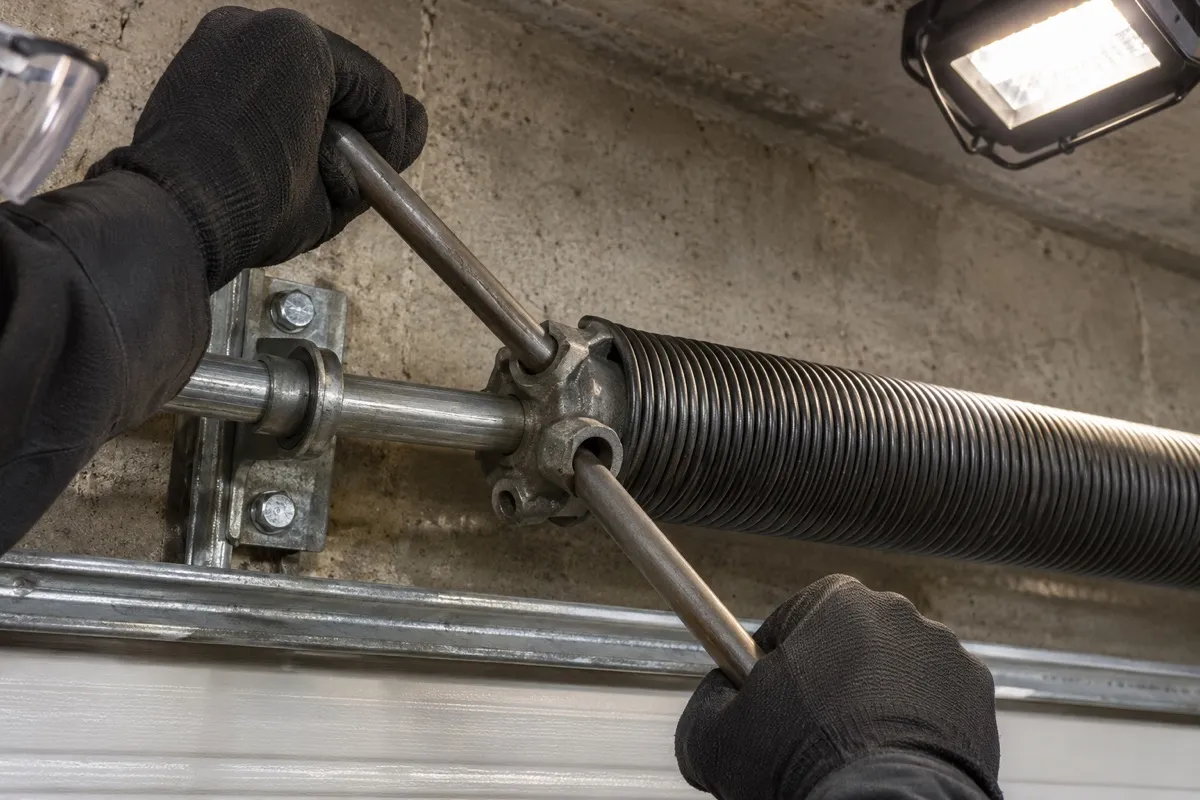
Our technicians typically look at the spring against the door's weight and height, rust on the spring wire, lubrication as the manufacturer directs, and whether the door balances and the opener reverses. Between visits you can test the safety reversal yourself once a month. It takes a 2x4 and no tools. The spring is never part of your check.
Rust matters because TDS 190 says rust reduces the effective area of the spring wire. Lubrication matters because the same sheet says regular greasing, as the manufacturer's instructions require, helps spring cycle life. That is the kind of thing we look at during a garage door tune-up.
Here is the monthly check. DASMA says the reversal system must be tested with a 2x4 laid flat on the ground, and that it should be tested monthly or after any adjustments or repairs, and Chamberlain's safety reversal test page says the same thing in its own steps.
- Open the door all the way.
- Lay a 2x4 flat on the ground under the door.
- Run the door down onto the board.
- It must reverse. If it does not, call a trained technician.
MONTHLY SAFETY REVERSAL CHECK
Open the door fully
Open the door all the way.
Lay a 2x4 flat under the door
Lay a 2x4 flat on the ground under the door.
Run the door down onto the board
Run the door down onto the board.
It must reverse, or call a technician
If it does not reverse, call a trained technician.
Why does the opener reverse at all? Under the CPSC rule described in the Federal Register, residential openers sold in the US must have an inherent reversing mechanism that can reverse a moving door within 2 seconds, plus a connection for an external entrapment sensor, and most openers on the market use an electric eye, the photo eye sensor, for that job. The requirement has applied to openers manufactured or imported after January 1, 1993. If the door fails the 2x4 test, leave the spring alone and call us. Fixing the reversal is the technician's job too.
El Paso Areas and Seasons: Tying Both Halves Together
Our El Paso crew serves homeowners across the Westside, Northeast and East El Paso, the Upper Valley and the Lower Valley, and out to Horizon City, which is a separate city in El Paso County. Spring brings the blowing dust season and summer brings triple-digit heat, so keypad faces and batteries meet the sun and dust, while springs carry the door through every hot and cold cycle.
Far East and Eastlake are informal local terms, and I use them the way homeowners do, without drawing boundaries. The City's own planning document, Plan El Paso, uses Eastside for what residents often call East and Far East. Our El Paso garage door service page lists the areas we cover.
Now the seasons. Spring is the blowing dust season, the same March to May window with that 42 percent chance in the NWS paper. In summer, the National Weather Service says El Paso averaged 26 days of triple digits per year from 1991 to 2020, with an average start date of June 12. Winter nights are cold enough that metal and batteries notice the swing.
Tie both halves together and the habit is simple. The keypad shows wear on its face, so wipe it and check the battery when the clocks change. The spring shows wear when it lets go, which is why we would rather talk about it before then.
What Spring Replacement Costs and What the Pricing Page Does Not Say
Spring replacement is an estimate range of $200 to $400 on our pricing page, and the final cost is confirmed on site. The range does not break out high-cycle springs, and the page has no keypad price, so we do not quote either one here. Ask the technician to quote the spring you are being offered and to explain its rating.
Two questions are worth asking. What is the rating on this spring? And is it a standard or a high-cycle spring for my door's weight and height? A straight answer to both is a good sign.
Next Steps With Our El Paso Crew
You have two decisions. For the keypad: reset it or replace it. For the spring: standard or high-cycle. You do not have to settle them alone. Our El Paso crew can look at both, and spring work is done by a trained technician. If we are already out for the keypad or the opener, that visit is the time to ask about the spring.
To get started, visit our El Paso page, read up on garage door spring replacement, or call (888) 601-6005 to talk through El Paso garage door service.
Questions El Paso Homeowners Ask About Keypads and Springs
Do I need to reprogram a keypad after changing the battery?
Often not. One opener maker says its keypad's programming survives a battery change, but check your own keypad's manual, because brands differ. Use the battery type your keypad states, 9 volt or AAA. If a fresh battery does not get the door moving, re-pair the keypad or call us.
Why will my new garage keypad not pair with my opener?
The keypad has to match your opener's radio generation, so a mismatch is more likely than a bad keypad. On openers with a colored learn button, the color on the motor unit tells you the generation, though colors fade, so purple can look brown. Check it against the maker's chart before you blame the keypad.
What is a high-cycle garage door spring?
A high-cycle spring is a torsion spring rated for more cycles than the 10,000 cycle door baseline, with options such as 25,000 cycles that a manufacturer markets as roughly double the life of a standard spring. It is a rating, not a guarantee, and a trained technician matches it to your door.
Can I replace a torsion spring myself?
No. DASMA urges everyone to consult a trained door systems technician for spring repairs because the door runs on a high degree of spring tension. DASMA TDS 190 adds that an incorrect number of turns is a safety issue for the installer. If a spring has snapped, leave the door alone and call.
How much does garage door spring replacement cost?
Our pricing page shows an estimate range of $200 to $400 for garage door spring replacement, and the final cost is confirmed on site. The range does not break out high-cycle springs, so ask your technician to quote the spring you are offered and to explain its rating.
Do El Paso heat and dust shorten spring life?
No source we can cite ties El Paso heat or dust to a spring failure rate. DASMA TDS 190 says doors in extreme heat or cold climates should be kept closed where possible, and that regular lubrication as the manufacturer directs helps. Ask a technician to look at rust and lubrication.