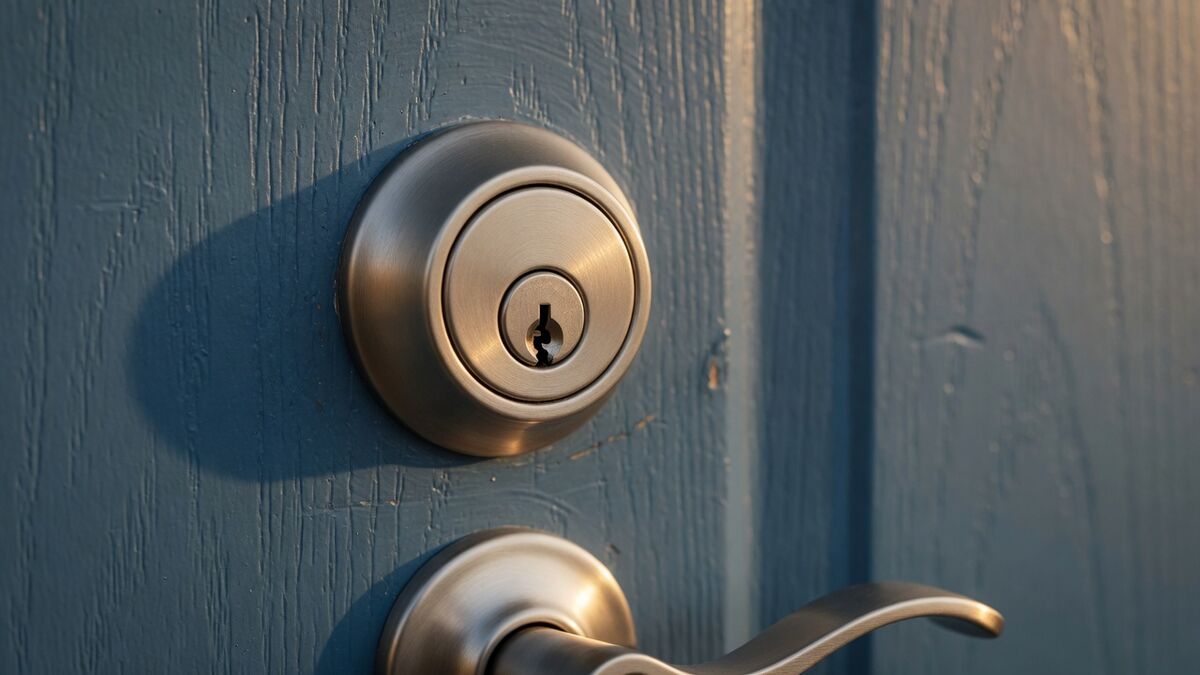
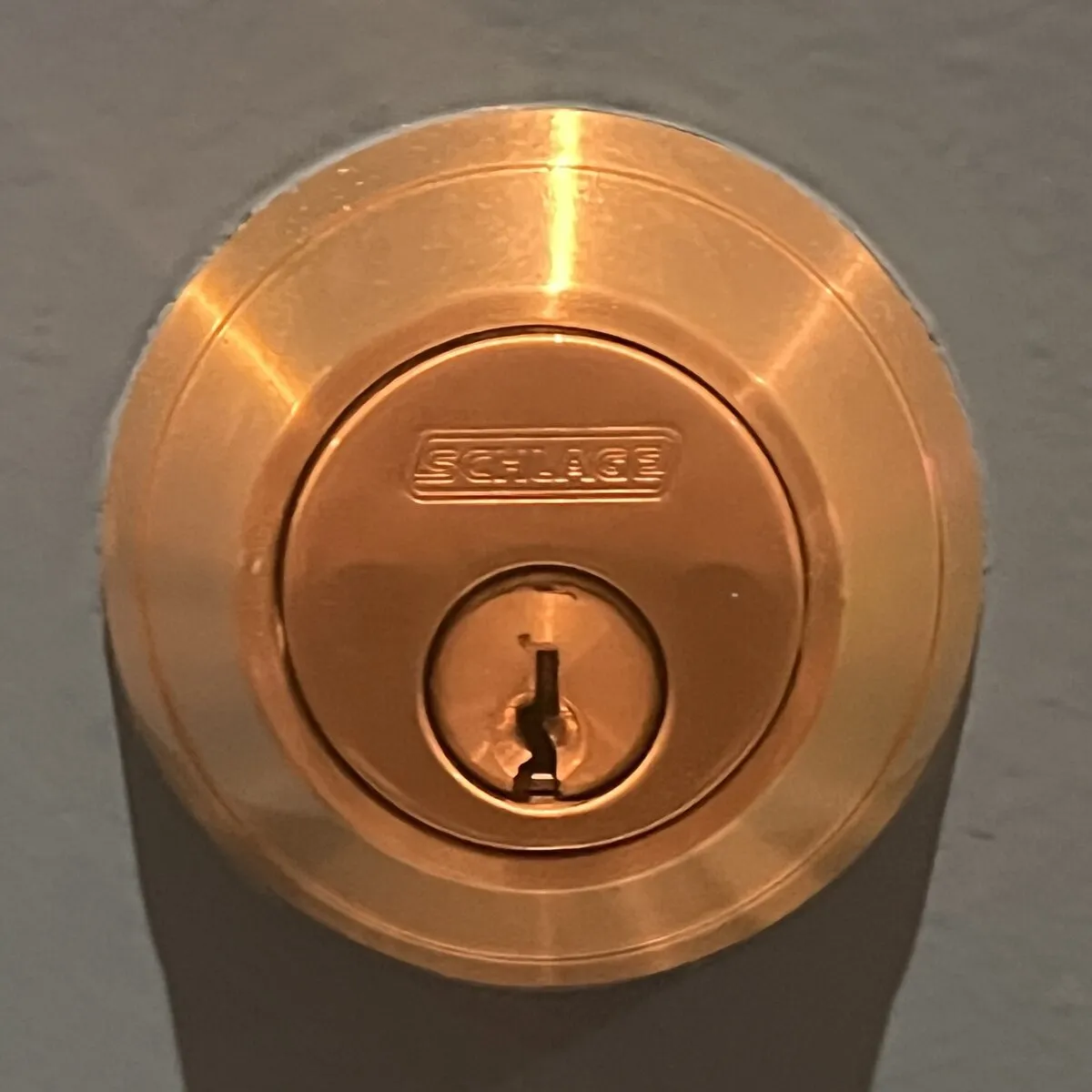
A Schlage B60N deadbolt carries an ANSI/BHMA A156.36 Grade 1 certification and an A156.40 Grade AAA rating, but neither test measures resistance to lock picking or bump keys. Grade 1 covers five classifications: operational, cycle, strength, security, and finish, and the security portion breaks into impact, tension, torque, pulling, and sawing. Picking and bumping never appear in that list, and the standard that does test them, UL 437, is a separate listing the base B60N does not carry.
That gap between what a Grade 1 badge says and what it actually tests is the whole reason this comparison exists. Fifteen years of pulling cylinders apart teaches you to read the standard instead of the box copy, and the standard tells a narrower story than "Grade 1 means secure." This guide walks through what A156.36 actually puts a deadbolt through, where the B60N's own anti-pick pins fit into that picture, and how the B60N stacks up against a Kwikset SmartKey deadbolt and a Yale YRD216 keypad lock once you separate certification from marketing.
THE FIVE SECURITY SUB-TESTS
Impact and tension
test the bolt and cylinder under sudden force and steady pulling pressure, the kind of stress a kick or a pry bar applies.
Torque
testing measures resistance to twisting the cylinder itself.
Pulling
tests whether the bolt can be yanked out of engagement.
Sawing
tests whether an exposed, extended bolt can be cut through with a blade.
What Is the Schlage B60N, and What Grade Does It Actually Carry?
The Schlage B60N is a single-cylinder residential deadbolt certified to two separate standards on Schlage's own product page: ANSI/BHMA A156.36-2010 Grade 1, the numeric commercial-style grade, and ANSI/BHMA A156.40-2015 Grade AAA in Security, Durability, and Finish, the newer residential letter-grade system. Both ratings come from the manufacturer's own spec sheet, not a locksmith's assumption or a marketing line on the box.
The ANSI/BHMA A156.36 Grade 1 rating, straight from Schlage's own spec page
Grade 1 is the top tier in the older, numeric ANSI/BHMA grading system, the one most homeowners already recognize from shopping for a deadbolt. It is not a self-appointed marketing tier. ANSI/BHMA A156.36 is the standard that governs deadbolts specifically, distinct from A156.2, which covers bored knob and lever locksets, the hardware often installed alongside a deadbolt rather than the deadbolt itself. Our own lock grades guide walks through the full three-tier system in detail if you want the complete methodology behind Grade 1, 2, and 3.
The newer A156.40 Grade AAA letter system, and what AAA actually means
Alongside the numeric grade, the industry now runs a consumer-facing "BHMA Certified" letter system that scores three categories independently: Security, Durability, and Finish, each rated C for good, B for better, or A for best. A product's overall rating is the three-letter combination, so AAA means top tier in all three categories at once, not an average or a marketing rounding-up. The B60N carries a Grade AAA rating under A156.40-2015, meaning it scored the highest tier across all three residential categories, according to Schlage's own current product page.
What Does ANSI/BHMA A156.36 Actually Test? Five Classifications, Not Two
ANSI/BHMA A156.36 tests five classifications: operational, cycle, strength, security, and finish. The security classification is not one test but five sub-tests: impact, tension, torque, pulling, and sawing, each measuring resistance to a specific forced entry attack. None of the five classifications, and none of the five security sub-tests, evaluates picking or bumping.
Operational, cycle, strength, and finish: the four nobody argues about
These four classifications are the parts of Grade 1 that nobody disputes, because they are straightforward mechanical checks. Operational testing confirms the lock actually functions as designed under normal use. Cycle testing runs the bolt through repeated lock and unlock operations to confirm the mechanism survives ordinary wear over years of daily use. Strength and finish round this out, covering material integrity and the hardware's ability to hold up cosmetically and structurally over time. None of these four classifications touches a burglar's forced entry attempt directly. That is the job of the fifth classification.
Security breaks into five sub-tests: impact, tension, torque, pulling, sawing
The security classification is where Grade 1's forced entry resistance actually gets measured, and it splits into five distinct sub-tests rather than one blanket check. Impact and tension test the bolt and cylinder under sudden force and steady pulling pressure, the kind of stress a kick or a pry bar applies. Torque testing measures resistance to twisting the cylinder itself. Pulling tests whether the bolt can be yanked out of engagement. Sawing tests whether an exposed, extended bolt can be cut through with a blade. That is the complete list. A Grade 1 badge is a real certification. It just certifies something narrower than most buyers assume.
A Grade 1 badge is a real certification. It just certifies something narrower than most buyers assume.
The Reveal: Picking and Bumping Are Absent From This Test Suite
Picking and bumping do not appear anywhere in ANSI/BHMA A156.36's five classifications or its five security sub-tests. The standard that tests surreptitious entry with picks and bump keys is UL 437, a separate listing entirely, and Schlage's base B60N deadbolt is not UL 437 listed. A Grade 1 badge certifies mechanical strength and durability, not resistance to stealth attacks on the cylinder.
UL 437 is the standard that actually tests picking and bumping
UL 437 exists precisely because A156.36 does not cover this ground. It is the Underwriters Laboratories standard for high-security cylinders, and it specifically evaluates a cylinder's resistance to picking, decoding, and impressioning, the surreptitious attacks that rely on skill and patience rather than force. A lock can be a genuinely excellent Grade 1 performer against kicks, pries, and saw blades while carrying no UL 437 certification at all, because those are two different questions answered by two different standards.
Why the base B60N carries no UL 437 listing
This is not a knock on the B60N specifically. Most mainstream residential deadbolts, across every major brand, are not UL 437 listed, because that level of independent certification is built for a different price point and a different threat model, typically high-security commercial cylinders. What matters here is precision in how you talk about the B60N's security: its resistance to picking and bumping rests on its internal pin design and Schlage's own engineering claim, not on an independently verified UL 437 test result.
How a Bump Key Actually Defeats a Cylinder, and What the B60N Does About It
A bump key is cut to the maximum depth at every position, then struck sharply while light turning pressure is applied, which briefly bounces every driver pin clear of the shear line at once. A standard pin stack separates cleanly under that impact, letting the plug rotate for an instant. The B60N's own anti-pick pins, which Schlage's product page states are designed to resist picking and bumping, are built to catch instead of separate.
The mechanics: five pins, one strike, one instant
A pin tumbler cylinder normally holds a key pin and a driver pin in each chamber, with a spring pushing the driver pin down across the shear line, the boundary between the fixed housing and the rotating plug. With no key inserted, the driver pins straddle that line and block rotation. A bump key inserted and struck transfers the impact up through the key pins into the driver pins, which jump clear of the shear line for a fraction of a second. If the attacker's turning pressure is timed to that instant, the plug rotates before the pins settle back down. The diagram below shows all five chambers at the moment of impact.
Anti-pick pins, spool-shaped security pins, and the line between a claim and a certification
Schlage's product page describes the B60N as containing anti-pick pins in its 5-pin C-keyway cylinder, with a 6-pin upgrade available, and states the lock is designed to resist picking and bumping. That is a real, current manufacturer spec claim, not marketing fluff invented for this comparison. Third-party locksmith and technical sources, not Schlage itself, describe the B60N's pins as spool-shaped security pins, a geometry that catches at the shear line during a bump attempt instead of separating cleanly. Schlage's own literature does not name the pin geometry directly. A locksmith's honest read: very likely effective in practice, resting on real internal pin design, but not the same thing as an independently certified UL 437 test result.
Drilling a Deadbolt: Where the Attack Aims and What Stands in Its Way
A drill attack aims just below the shear line, straight into the keyway, trying to destroy the pin stack or the surrounding cylinder material so a flat tool can turn the plug once the pins no longer block it. The B60N's cylinder area includes anti-drill plates built into the lock face, per Schlage's own spec page, and, per multiple retailer listings that reproduce Schlage's catalog copy, a free-spinning cylinder guard around the keyway.
Why the drill aims just below the shear line
An attacker drilling a cylinder is not attacking at random. The target is precise: just below the shear line, where the driver pins sit, because destroying that material removes the obstruction blocking rotation without needing a key at all. Once enough of the pin stack is gone, a flat tool like a screwdriver can turn what is left of the plug. This is a fundamentally different attack from picking or bumping. It is brute destruction of the mechanism rather than a surreptitious manipulation of it, and it leaves obvious physical damage behind.
The B60N's anti-drill plate and free-spinning guard collar
The B60N answers the drill attack with two separate features rather than one. The anti-drill plate sits directly in the bit's path, hardened material built into the lock face before the pin stack, per Schlage's own spec page. Separately, a free-spinning cylinder guard collar surrounds the keyway opening, a detail consistently described across multiple retailer and catalog listings reproducing Schlage's product copy, and it is meant to spin freely when gripped with pliers or a wrench, defeating an attacker's attempt to twist the cylinder out entirely rather than drill through it.
Sawing Through an Extended Bolt: the One Security Test With Real Numbers
A saw attack targets an extended bolt where a gap between door and frame exposes enough of it to reach with a blade. ANSI/BHMA A156.36 Section 12.11 is the one security sub-test with a fully published numeric standard: a band saw at a sustained 5 lbf load, using a 0.25 inch, 0.025 inch thick, 14 tooth per inch blade at 100 feet per minute, and a required minimum resistance time.
The mechanics of a saw attack on an exposed bolt
Sawing depends on access, which is why it usually shows up on doors with a wider gap or a loose, older installation. An attacker feeds a hacksaw or band saw blade against the extended bolt where it crosses that gap and cuts through it under sustained pressure. It is slow, loud, and visible, none of which stops a determined attacker with enough time and privacy, which is exactly why the standard bothers to test it with real numbers instead of leaving it to assumption.
TWO WAYS THE B60N ANSWERS A DRILL ATTACK
Anti-drill plate
sits directly in the bit's path, hardened material built into the lock face before the pin stack.
Free-spinning cylinder guard collar
surrounds the keyway opening, meant to spin freely when gripped with pliers or a wrench, defeating an attacker's attempt to twist the cylinder out entirely.
Section 12.11's real lab numbers, and what the B60N ships with to meet them
The Dead Bolt Sawing Test specifies a band saw fed into the fully extended bolt under a sustained 5 lbf load, using a 0.25 inch, 0.025 inch thick, 14 tooth per inch commercial blade running at 100 feet per minute. A Grade 1 narrow-stile deadbolt must resist for 30 minutes minimum, and all other Grade 1 and Grade 2 deadbolts must resist for 5 minutes minimum. The B60N ships with a 1 inch throw and a hardened steel roller or insert built into the bolt that spins under a saw blade to resist cutting, the physical feature that lets a Grade 1 deadbolt clear this specific numeric test. It is a real, citable lab test, not the same thing as a kicked door in the field.
Kick-Ins: Why the Frame Usually Fails Before the Bolt Does
ANSI/BHMA A156.36's own Appendix A states that the standard evaluates the lock as a component and does not account for the door, frame, or wall system it is installed in, some of which are vulnerable under the same attacks. That is the standard-setting body's own acknowledgment that a Grade 1 badge certifies the lock, not the frame holding it, and the frame can be the weaker link regardless of grade.
What the standard's own appendix says about doors and frames
Section A-4 of the standard's Appendix A reads, in the standard's own language, that the provisions evaluate locks as a component and do not take into account the variety of doors, frames, and other surrounding systems available, some of which are vulnerable under the kinds of attacks described, and it directs installers to select doors and frames compatible with the level of lock security chosen. That is a direct, sourced statement from the body that writes the grading standard itself, not a locksmith's guess about where kicks tend to succeed. The lock stopped the attack the badge promised. The frame said nothing about the wood holding the strike plate.
The lock stopped the attack the badge promised. The frame said nothing about the wood holding the strike plate.
Why stock strike-plate screws often miss the stud entirely
Section A-5 of the same appendix addresses fasteners directly: where a strike is applied to a wood frame under 1 inch thick, the screws normally furnished are sometimes inadequate, and the standard recommends screws of sufficient length to engage the structural stud behind the frame. In plain terms, the stock screws that ship with a basic strike plate often bite only into the thin door jamb trim and never reach the framing stud behind it. Longer screws, commonly 3 inches, which is what the B60N ships with as an integrated strike reinforcer, pass through that trim and anchor into the stud, transferring force into the house framing instead of relying on thin trim alone to hold. A security door upgrade or added frame reinforcement addresses the other half of this equation, since a Grade 1 bolt in a weak frame is only half the job done, and our security door repair guide walks through which multi-point lock and hinge failures call for that upgrade instead of a straight lock swap.
Schlage B60N vs Kwikset SmartKey: a Different Mechanism Entirely
Kwikset SmartKey does not use a pin-tumbler cylinder like the B60N. It uses five wafers that shift horizontally against a sidebar, and the sidebar must align with all five wafers before the plug turns, a mechanically different system that needs its own security conversation rather than a like-for-like pin comparison. SmartKey has been Kwikset's core cylinder technology since 2008 and remains current, not a discontinued line.
How the wafer and sidebar mechanism works
Instead of key pins and driver pins riding across a shear line, SmartKey uses wafers that shift horizontally when the correct key is inserted, and a sidebar that must sit flush against all five wafers simultaneously before the plug can rotate. Kwikset's own current product page describes SmartKey Security as pick resistant and bump proof, its own marketing terms rather than the wording of an independent standard. A separate Kwikset claim, tied specifically to its UL-branded Key Control Deadbolt line, states that SmartKey passes UL 437 paragraph 11.6 on that specific SKU. That UL 437 citation should not be extended as a blanket claim to every SmartKey-equipped Kwikset product, including the base 980, without the same qualifier, since no independent certificate confirming that broader scope turned up in the sourcing for this comparison.
What changed since 2016, and what stayed a documented characteristic
The original, circa 2007 SmartKey used a V-shaped sidebar and locking-cutout geometry that locksmith-community researchers found could, in some cases, be forced inward with a hardened tool to rotate the plug, a documented forced-entry bypass rather than a picking or bumping technique. Kwikset redesigned the sidebar and locking cutout to a rectangular shape to close that specific gap, and trade press confirms that deadbolts shipping from the factory as of a 2016 article already carried the new geometry, meaning that specific bypass should not be attributed to current-generation SmartKey product. Separately, and not tied to that sidebar fix, locksport researcher Shane Lawson published a SmartKey decoding technique at Shmoocon 2009 that exploits manufacturing tolerances in the wafer-and-sidebar system itself. Lockwiki's technical writeup describes documented attack categories against SmartKey as lockpicking, tryout keys, impressioning, decoding, bypass, and destructive entry, a set of characteristics tied to the mechanism's inherent tolerances rather than a single fixable manufacturing defect.
A Grade 1 deadbolt like the B60N is enough for the overwhelming majority of Texas front doors.
Yale YRD216: a Grade 2 Keypad Deadbolt, Not a Grade 1 Peer
The Yale Assure Lock Push Button Keypad Deadbolt, model YRD216, is tested to ANSI/BHMA Grade 2 per Yale's own specification sheet, not Grade 1 like the B60N. It is also an electronic keypad deadbolt first, with a standard 5-pin KW-1 cylinder kept only as a battery-dead backup, not a purpose-built mechanical security deadbolt in the same category as the B60N or Kwikset 980.
Grade Tested to ANSI/BHMA Grade 2, per Yale's own spec sheet
Yale's official Assure Lock Collection Specifications sheet states the door specifications directly: a KW-1 5-pin keyway and Grade Tested to ANSI/BHMA Grade 2, in Yale's own printed document, not a locksmith's interpretation of a lesser-known SKU. That is a meaningful step down from the B60N's Grade 1 rating, and it should not be softened or left out of a fair comparison just because the YRD216 is a newer, more feature-rich product on the shelf next to it.
Why comparing all three as equals misses the point
Yale's current mainstream residential lineup, the Assure Lock family that includes the YRD216, is electronic-keypad-first, not a simple mechanical deadbolt in the same mold as the B60N or Kwikset 980. The YRD216 retains a standard 5-pin KW-1 keyed cylinder as a battery-dead backup override, so it is exposed to the same physical attack classes, bump, pick, drill, through that backup cylinder, but Yale's own spec sheet does not claim any special anti-pick or anti-bump pin technology for it the way Schlage and Kwikset do for their primary cylinders. Two of these three products are purpose-built mechanical security deadbolts rated Grade 1. The third is a Grade 2 electronic keypad deadbolt with an ordinary pin-tumbler backup. That distinction matters more than any single feature comparison.
Schlage B60N vs Kwikset SmartKey vs Yale YRD216, Side by Side
The table below lines up the Schlage B60N, a Kwikset SmartKey deadbolt like the 980, and the Yale YRD216 across the attack types and certifications this guide covers: bump, drill, saw, pry, rekey method, and certified grade. Reading it by row rather than by column shows where the products genuinely differ and where the difference is really about frame and installation quality rather than the lock itself.
| Feature | Schlage B60N | Kwikset SmartKey | Yale YRD216 |
|---|---|---|---|
| Bump | Anti-pick pins Schlage says resist picking and bumping; not UL 437 certified for it | Wafer and sidebar mechanism, no traditional pin stack to bump; Kwikset markets it as Bump Proof | Standard 5-pin KW-1 backup cylinder; no stated anti-pick or anti-bump pin technology in Yale's spec sheet |
| Drill | Anti-drill plate and free-spinning cylinder guard, per Schlage's spec page | No drill-specific hardening stated in Kwikset's current spec for the SmartKey mechanism | Ordinary 5-pin backup cylinder; no drill-resistance claim in Yale's spec sheet |
| Saw | Hardened steel roller in the bolt; A156.36 Section 12.11 requires 5 minutes minimum under lab conditions | Bolt hardware on the 980 is Grade 1 per this site's lock grades guide; same A156.36 sawing minimum applies | Grade 2 tested; A156.36's Grade 2 sawing minimum also applies to the bolt itself |
| Pry | 1 inch throw bolt; ships with an integrated strike reinforcer and 3 inch screws | Frame-dependent, like any deadbolt; reinforcement is about the strike and frame, not the cylinder | Frame and strike quality matter here too; Yale's spec sheet adds no pry-specific hardware beyond the standard bolt |
| Rekey method | Standard pin-tumbler rekey; a locksmith swaps the pin stack | Kwikset markets SmartKey around easy self-rekeying, per its own product page title | Keypad code changes instantly; the physical backup cylinder still needs a locksmith pin-tumbler rekey |
| Certified grade | ANSI/BHMA A156.36 Grade 1, A156.40 Grade AAA, per Schlage's own product page | Grade 1 (per this site's lock grades guide); not independently re-verified for this comparison | ANSI/BHMA Grade 2, per Yale's own specification sheet |
Schlage, Kwikset and Yale are trademarks of their respective owners. Pros On Call is an independent locksmith service and is not affiliated with or endorsed by any manufacturer named here.
Reading the table by attack type
Read across any single row and the pattern holds: the B60N and the SmartKey-equipped Kwikset are both purpose-built mechanical deadbolts answering the same attack classes with different mechanisms, pin geometry against wafers and a sidebar, while the YRD216's answer to bump, drill, and pry all comes down to the same ordinary backup cylinder rather than a dedicated security feature. That is not a knock on the YRD216. It is simply not competing in the same category.
Reading the table by rekey method
The rekey row is where the products diverge most in daily use rather than in a burglary scenario. SmartKey's whole selling point is a fast, tool-based self-rekey a homeowner or landlord can do without a locksmith visit. The B60N's pin-tumbler rekey needs a locksmith with a pinning kit. The YRD216 splits the difference: the electronic code changes instantly from the keypad, but the mechanical backup cylinder still needs a standard locksmith rekey like any pin-tumbler lock. If rekeying between tenants or after a move is the deciding factor for you, that is a genuinely different comparison than picking the most attack-resistant hardware.
THE FOUR CLASSIFICATIONS NOBODY ARGUES ABOUT
Operational testing
confirms the lock actually functions as designed under normal use.
Cycle testing
runs the bolt through repeated lock and unlock operations to confirm the mechanism survives ordinary wear over years of daily use.
Strength and finish
round this out, covering material integrity and the hardware's ability to hold up cosmetically and structurally over time.
When a Grade 1 Deadbolt Is Enough, and When to Ask for UL 437
A Grade 1 deadbolt like the B60N is enough for the overwhelming majority of Texas front doors, where the realistic attack profile is a kick, a pry, or an opportunistic saw at an exposed bolt, exactly what A156.36 tests. A UL 437 listed lock or cylinder becomes worth asking for when the threat model specifically includes a patient, tool-carrying attacker working the keyway itself rather than the door and frame.
The signs a Grade 1 deadbolt is the right call
Most residential situations point straight to Grade 1: a single-family home in a typical neighborhood, a rental property between tenants, a back or garage service door, or any front door where the realistic risk is a smash-and-grab attempt rather than a targeted, prepared burglar. Our why deadbolts matter guide covers the broader installation quality checklist, strike plate, door material, hinge protection, that determines whether a Grade 1 badge actually delivers on its rating once it is hung on your specific door.
The signs you should ask for a UL 437 listed cylinder instead
A handful of situations genuinely call for going further than Grade 1: a business handling cash or sensitive records, a property with a documented pattern of targeted break-in attempts rather than opportunistic ones, or any application where you specifically need certified resistance to picking, not just a manufacturer's claim about it. Our high security locks page covers UL 437 listed options and where they make sense for both residential and commercial Texas properties.
WHAT WE CHECK ON A TEXAS DEADBOLT INSTALL
Frame wood condition
a check of frame wood condition behind the strike plate.
Strike screw length
confirmation that strike screws actually reach the structural stud rather than stopping in trim.
Texas Notes: Heat, Frame Wood, and What a Licensed Tech Actually Checks
Central Texas heat cycles metal cylinders and door frames through expansion and contraction that a lock's ANSI grade never accounts for, since A156.36 tests run under lab conditions, not a summer in Austin. A licensed technician checks frame wood condition, strike screw length, and cylinder binding as part of any deadbolt installation or upgrade, because a Grade 1 badge on a rotted jamb is not the security a homeowner thinks they bought.
Why heat cycling matters more here than the badge on the lock
A156.36's lab tests measure a controlled, one-time event: a fixed number of kicks, a fixed sawing load, a fixed cycle count. They do not measure what happens to a cylinder and a wood frame after years of 100 plus degree Texas summers followed by winter cold snaps, expansion and contraction that can bind a plug, loosen screws, and dry out the wood behind a strike plate long before the lock's rated cycle count is ever reached. Our Austin heat wave lockout guide walks through exactly how that seasonal movement pushes a deadbolt's bolt out of alignment with its strike hole. A Grade 1 deadbolt installed once and never revisited is not the same thing as a Grade 1 deadbolt maintained on a schedule that matches Texas conditions.
What we check on a Texas deadbolt installation call
Every deadbolt installation call we run includes a check of frame wood condition behind the strike plate, confirmation that strike screws actually reach the structural stud rather than stopping in trim, and a test of cylinder rotation for binding before we call the job finished. If the deadbolt itself is fine but the internal pin stack has worn or the door has changed hands, our lock repair vs replacement guide walks through how to tell whether a repair, a rekey, or a full replacement is the right call. Once a new deadbolt is installed, our key duplication guide covers how to get spare keys cut without introducing the tolerance drift that weakens a copy over successive generations.
WHEN GRADE 1 IS ENOUGH VS. WHEN TO ASK FOR UL 437
Most residential situations
a single-family home in a typical neighborhood, a rental property between tenants, a back or garage service door.
When to ask for UL 437 instead
a business handling cash or sensitive records, a property with a documented pattern of targeted break-in attempts.
Frequently Asked Questions
Does the Schlage B60N stop bump keys?
Very likely, in practice, due to its internal anti-pick pins, but that resistance is a manufacturer engineering claim, not an independently certified test result. The B60N's Grade 1 and Grade AAA certifications never test bumping at all. UL 437 is the standard that does, and the base B60N is not UL 437 listed.
Can burglars saw through a Schlage B60N deadbolt?
Not easily, and the resistance is a measured, published number rather than a guess. ANSI/BHMA A156.36 Section 12.11 requires a Grade 1 deadbolt to resist a band saw at a sustained 5 lbf load for at least 5 minutes, longer for narrow-stile units, and the B60N ships with a hardened steel roller in the bolt built to meet that standard.
Schlage B60N vs Kwikset SmartKey: which resists forced entry better?
Both are rated Grade 1 hardware answering the same forced entry attacks, kicks, pries, sawing, through different cylinder mechanisms, pin tumbler against wafer and sidebar. Neither has an independent edge on forced entry resistance from the fact pack behind this comparison. The real difference between them shows up in rekey method and daily convenience, not in Grade 1 security testing.
What does an ANSI/BHMA Grade 1 badge actually certify?
It certifies five classifications: operational, cycle, strength, security, and finish, with security further split into impact, tension, torque, pulling, and sawing sub-tests. It certifies mechanical strength and durability against forced physical attacks. It does not test or certify resistance to lock picking or bump keys, which fall under the separate UL 437 standard instead.
Is the Kwikset SmartKey UL 437 listed?
Only for one specific SKU. Kwikset's Key Control Deadbolt, a UL-branded SmartKey product, is stated to pass UL 437 paragraph 11.6. That citation does not extend to every SmartKey-equipped Kwikset product, including the base 980, since no independent certificate confirming that broader scope was found for this comparison.
Is a Yale YRD216 as secure as a Schlage B60N?
Not in the same certification category. The YRD216 is tested to ANSI/BHMA Grade 2, one tier below the B60N's Grade 1, and its physical backup cylinder carries no stated anti-pick or anti-bump pin technology in Yale's own spec sheet. The YRD216's strength is electronic keypad convenience, not mechanical forced-entry resistance at the B60N's level.
REKEY METHOD BY LOCK
Kwikset SmartKey
a fast, tool-based self-rekey a homeowner or landlord can do without a locksmith visit.
Schlage B60N
pin-tumbler rekey needs a locksmith with a pinning kit.
Yale YRD216
the electronic code changes instantly from the keypad, but the mechanical backup cylinder still needs a standard locksmith rekey.
Getting the certification right matters, but so does the install underneath it. A Grade 1 deadbolt in a weak frame is a Grade 1 badge attached to a Grade 3 outcome. If you want a straight answer on which lock fits your door, your budget, and your actual threat model, rather than whichever one had the loudest box copy, our licensed Texas technicians will walk the door with you before recommending anything. Call (888) 601-6005 or reach out through our deadbolt installation page. Licensed under Texas DPS License #B19847.
Call (888) 601-6005 for a straight answer on Grade 1 versus UL 437 for your door, no upsell required.
Content strategy and SEO by Optymizer