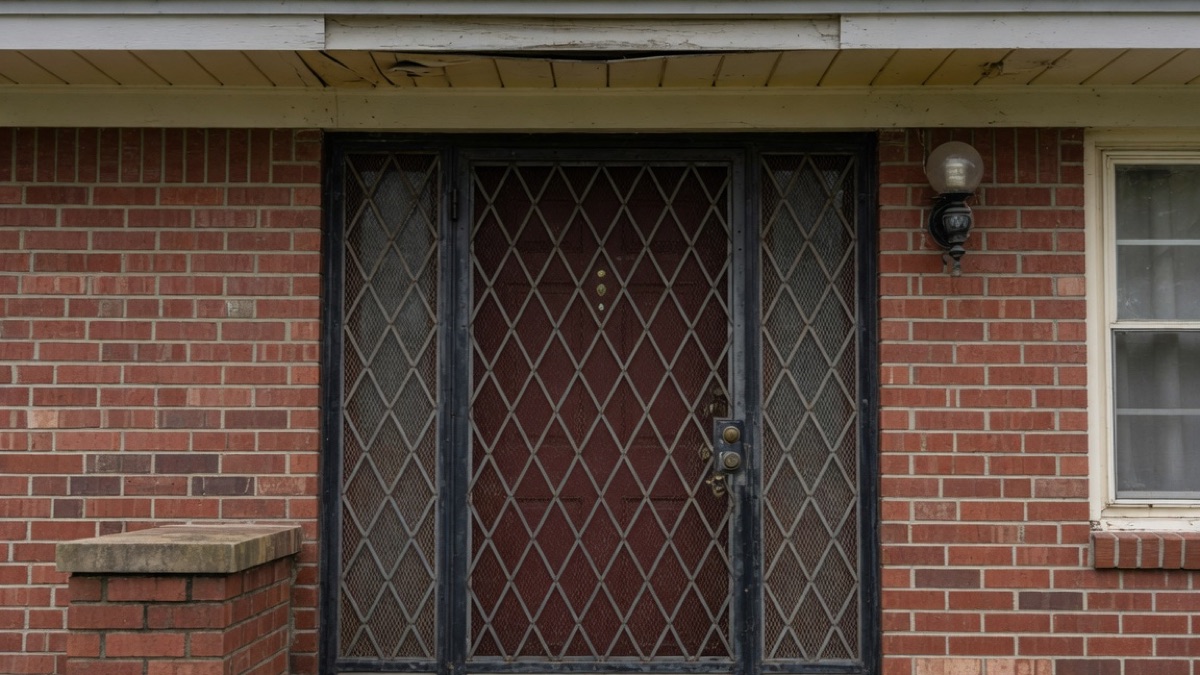
Security door repair covers three separate failure points on a steel-clad or storm security door: the multi-point lock mechanism, the hinges and frame carrying the door's weight, and any mesh, grille, or screen exposed to Texas storms, and each one calls for a different fix. After twenty-one years working these doors, the pattern holds every time. People point at the handle, and the handle is almost never where the problem actually started.
What Counts as a "Security Door," and Why the Definition Changes the Repair
A security door is a hinged steel-clad entry door, a security storm or screen door, or a wrought iron grille door, and Texas homes use all three types. A standard steel-clad entry door typically weighs 60 to 100 pounds, built from a thin steel skin wrapped around a foam core rather than solid steel, and its real security depends on the hinge, lock, strike, and jamb working together, not the door slab alone.
I bring that up first because it changes everything about how you diagnose a problem. A steel-clad hinged door sags at the hinges under its own weight. A storm or screen door tears at the mesh in a hailstorm. A wrought iron grille door has neither of those failure points, but it has its own hinge and lock hardware to worry about. Treat all three the same and you will misdiagnose the fix.
A door assembly's security depends on the hinge, lock, strike, and jamb working together, not the door slab alone.
That assembly-level idea isn't new. Forced-entry test methods for swinging door assemblies have historically tested the hinge, lock, strike, and jamb as a complete system rather than testing the door slab by itself, which is the same logic ANSI/BHMA uses today when it standardizes how hardware gets prepped into a steel door and frame. I am not citing a specific grade number here. The concept, that the weakest link in the assembly decides the real security level, is the part worth remembering.
If you want the broader home-hardware picture before you get into door-specific failures, our deadbolt security guide covers why the deadbolt itself matters on any exterior door, security door included. And if this is a general residential door, not a security-specific one, our residential door services cover the rest of what we handle beyond locks and hinges.
How a Multi-Point Lock Actually Works
A multi-point lock uses a central gearbox, engaged by the door handle or a cylinder, to drive several locking points, typically hook bolts, extra deadbolts, or shootbolts, into keeps set into the frame at the top, middle, and bottom of the door at the same time. That single mechanism is why a multi-point door locks more securely than a door with one latch and one deadbolt.
Lift the handle and you're not throwing one bolt. You're throwing three or more, all from the same motion, all landing in keeps set into the frame at different heights. That's the entire point of the design: a would-be intruder working on the middle of the door still has to beat locking points at the top and bottom too. It's a good design, and it's also a design with more moving parts than a standard latch and deadbolt, which means more parts that can wear, bind, or go out of alignment.
The Three Multi-Point Lock Failure Modes We See Most in Texas
The three multi-point lock failures we see most are gearbox wear, keeper or strike misalignment, and bent tie rods or shootbolts. Gearbox wear shows up as the handle spinning loose, feeling disconnected, or only some of the locking points engaging. Misalignment shows up as the handle being hard to lift only when the door is closed. Bent rods usually trace back to a door forced or slammed while partially locked.
Here's the pattern that trips people up: they hear the handle grinding or feel it go loose and they assume the lock itself failed. Sometimes it did. More often, the door has shifted in the frame just enough that the keepers no longer line up with the bolts, and the gearbox is straining against a misalignment problem it was never built to fix. Your lock is not the problem. Your door is.
Fixing a Misaligned Multi-Point Lock: Frame First, Then Hinges, Then Gearbox
Misaligned multi-point locks are often field repairable in a specific order: adjust the keepers on the frame first, then the hinges on the door, then fine-tune the gearbox itself, because adjusting the lock alone without fixing door sag usually produces only a temporary fix. A worn or broken gearbox is typically replaced as a single part rather than repaired.
MULTI-POINT LOCK REPAIR ORDER
Adjust the keepers on the frame
Start at the frame, not the lock, since a keeper that has shifted out of position is often the real source of a binding handle.
Adjust the hinges on the door
Fix any door sag next, because a lock adjustment made before the door is sitting correctly in the frame usually only holds temporarily.
Fine-tune the gearbox
Only after the frame and hinges are corrected does adjusting the gearbox itself make sense, and a worn or broken gearbox gets replaced as a single part rather than repaired.
Skip that order and you'll chase the same complaint back to the same door in a few months. I've seen plenty of gearboxes replaced that didn't need it, because nobody checked whether the door itself was sagging first.
Why a Heavy Steel Door Sags: Hinge Pull-Out and the Weak-Screw Problem
A heavy steel security door sags or drags most often because the top hinge, which carries most of the door's static weight, has pulled loose from the jamb, especially where the original screws are short and only bite into thin jamb trim instead of the structural wall stud behind it. That single failure point is the leading cause of sagging-door complaints on steel doors.
Think about what that top hinge is actually doing. It's not just holding the door open and closed, it's carrying the full weight of a 60 to 100 pound slab every time someone swings it. A short screw biting only the jamb trim was never built for that load held up for years on end. Give it enough open-close cycles and it works itself loose, and the door starts dragging on the threshold or binding against the frame before anyone touches the lock.
The Fix for Hinge Pull-Out, and When It Calls for Reinforced Hinges
The commonly recommended fix for hinge pull-out is replacing at least the center screw in the top hinge with a 3-inch screw long enough to reach through the jamb into the wall stud, restoring holding strength a short screw never had. On unusually heavy or wide doors, some installers add heavy-duty or ball-bearing hinges because the mounting plate itself can bend under sustained weight.
That's usually the whole fix. A 3-inch screw reaching into real framing lumber instead of only the jamb trim gives the hinge something solid to hold onto, and a lot of sagging complaints resolve right there. On a wider or heavier door, or one that's already sagged more than once, I'll look at swapping in a reinforced hinge instead of just re-anchoring the same one, since the mounting plate on a standard hinge can flex under sustained weight even with a better screw behind it.
Our door repair services cover hinge, frame, and hardware fixes like this one directly, on security doors and standard entry doors alike.
Texas Hail and Storm Damage: Why Security Doors Take the Hit
Texas recorded more major hail events than any other state in 2025, 902 recorded incidents against 375 in second-place Kansas, and severe storms account for roughly two-thirds of the state's billion-dollar weather disasters recorded since 1980, a pace that has more than tripled since 2020. That storm exposure is a direct driver of the mesh, grille, and frame damage security doors take across Texas.
That's not a seasonal talking point. It's a straight numbers problem. A mesh or grille panel mounted on the outside of a home is exposed to whatever the sky throws at it, and Texas throws more hail at its homes than anywhere else in the country. According to the Insurance Information Institute, Texas's 902 recorded hail incidents in 2025 outpaced Oklahoma (369), Nebraska (315), and Missouri (253) along with Kansas. NOAA's own billion-dollar disaster data shows severe storm events made up 126 of the state's 190 confirmed billion-dollar weather disasters between 1980 and 2024, and the pace has accelerated: 13.6 such events a year from 2020 through 2024, against a 4.2 per year average across the full 45-year period. A security screen door sitting on the front of a Texas home is standing in the way of that trend every storm season.
Repairing Torn Mesh and Bent Grilles After a Storm
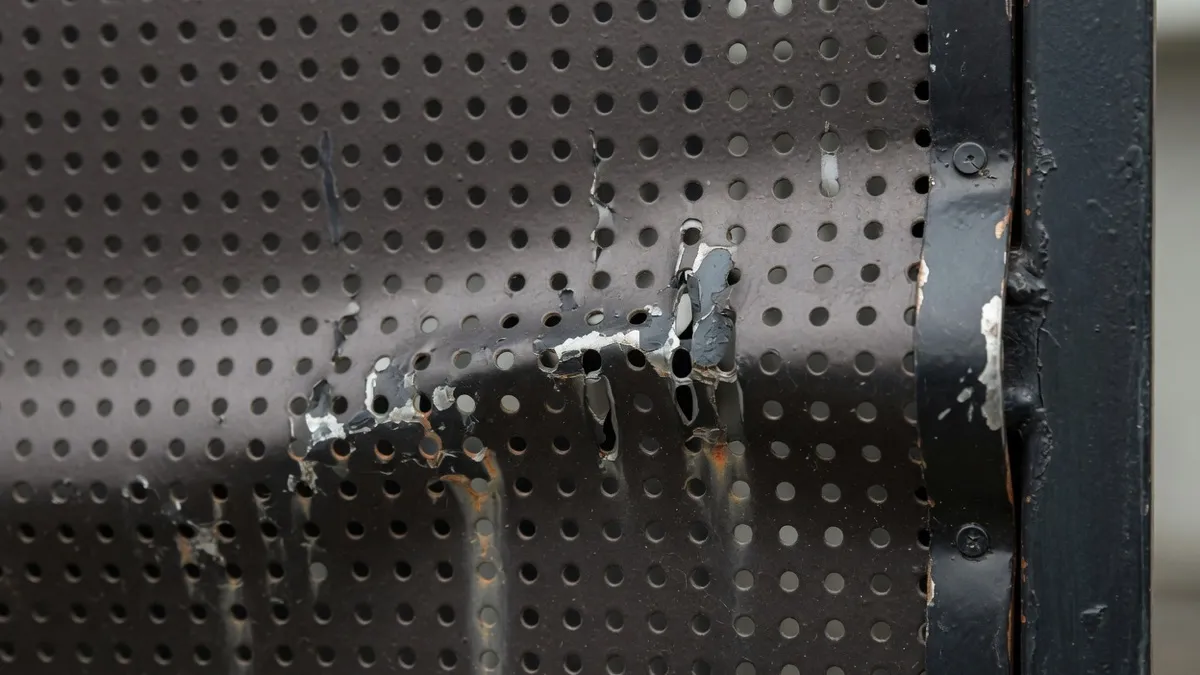
A security screen or storm door's mesh or grille is a common casualty of hail impact and wind-driven debris. A small, isolated tear smaller than a quarter can often be patched with an adhesive mesh patch or a cut section of replacement roll screen, but a bent frame or loose, sagging mesh usually calls for full screen replacement, since a patched screen no longer seats evenly in the frame channel.
I get a lot of these calls right after a hailstorm rolls through, and the first question is always whether it's a patch job or a full replacement. Small holes from wind-blown debris, sure, patch it. A frame that took a direct hit and bent, or mesh that's come loose all the way across, that's a different job, and trying to patch it just means doing the replacement anyway a few weeks later once the patch fails.
Corrosion on Steel Security Doors: Coastal Texas Versus West Texas
Moisture, not heat, drives steel corrosion, which is why hardware on Gulf Coast doors in Galveston, Corpus Christi, and the Houston ship channel corrodes faster than the same hardware in dry West Texas cities like El Paso, Midland, and Lubbock, where standard finishes and galvanized coatings hold up for years longer because there is far less moisture to react with.
I can't give you an exact multiplier on how much faster that corrosion happens. Nobody I trust has published one. What's well established is the direction: wet, salty air eats hardware faster than dry air does, full stop, and a coastal Texas door needs a different maintenance conversation than a West Texas door does. We walk through that West Texas side of the conversation, including what blowing dust does to door hardware, in our guide to locksmith and hardware needs across Odessa and the Permian Basin.
Corrosion-Resistant Hardware Worth Asking About on the Gulf Coast
In direct coastal exposure, the kind hardware gets in Galveston or along the Corpus Christi shoreline, hot-dip galvanized steel can show surface rust in as little as 5 to 7 years, while the same coating a few blocks inland can commonly last 15 to 25 years longer before comparable rusting appears. Lock manufacturers sell dedicated corrosion-resistant finishes for humid, salt-air climates, and it is worth asking for one on coastal Texas hardware replacements.
That 5 to 7 year figure is illustrative, not a guarantee for any specific door. It comes from one industry source on galvanized coatings in coastal exposure, and it's meant to show how much the microclimate matters, direct salt spray versus a few blocks inland, not to predict exactly how your hardware will hold up.
ANSI/BHMA Grades and What They Mean for Multi-Point Security Hardware
ANSI/BHMA hardware grading runs from Grade 1, the highest tier, down to Grade 3, and most residential hardware ships at Grade 2 or Grade 3, with Grade 1 generally reserved for commercial and higher-security applications. A Grade 1 lock must survive one million open-close cycles and resist 1,200 inch-pounds of locked-lever torque plus impact from two directions, a materially different bar than a Grade 3 unit clears.
A Grade 2 rating is not a slightly smaller Grade 1. One of them was tested for a break-in scenario and the other was not, and that gap does not close because the hardware looks newer. The cycle testing alone tells the story: a million open-close cycles under load is a different engineering bar than what a Grade 3 unit is built to survive, and the forced-entry testing behind Grade 1, resisting 1,200 inch-pounds of locked-lever torque and impact from two directions, is testing for a scenario most Grade 3 hardware was never designed to handle. That grading system comes straight from BHMA's own published grade summary for locks and latches, not a manufacturer's marketing claim. For the mechanics of what a grade rating actually tests on a standard deadbolt, our Schlage B60 versus Kwikset comparison walks through that in more detail.
| Requirement | Grade 1 Threshold | What It Tests |
|---|---|---|
| Cycle rating | 1,000,000 open-close cycles under a 10 lb load | Long-term mechanical durability |
| Forced-entry torque | 1,200 inch-pounds of locked-lever torque | Resistance to someone forcing the lever |
| Impact resistance | Impact from two directions | Resistance to physical force on the lock body |
| Operating torque cap | 28 inch-pounds maximum to work the lever | Life-safety limit so the lock is not too stiff to escape through |
The standard also caps the torque needed to operate a lever handle at 28 inch-pounds, which is as much a life-safety requirement as a security one: a lock cannot be so stiff that it becomes hard to escape through in an emergency. That's worth knowing before you assume "higher grade" only means "harder to break into."
Repair or Replace? The Decision Factors That Actually Matter
Whether to repair or replace a security door comes down to four factors: how extensive and localized the damage is, the door's age and material condition, whether the problem is a one-time event or a repeat failure, and whether the existing hardware still meets the security grade the household wants. Isolated hardware or frame damage favors repair; structural panel damage across the whole assembly favors replacement.
The lock only has to survive normal use. The door has to survive the house settling around it for years.
That's the real tension behind every repair-or-replace call I make. Hardware wears in predictable, fixable ways. A door and frame absorb years of weather, settling, and use in ways that eventually go past what any hardware adjustment can compensate for. If this is a burglary-damage situation rather than ordinary wear, that's a different conversation entirely, and our burglary damage repair service is built specifically for a door or frame that took a forced-entry hit rather than years of normal use.
What Lock Hardware Repair or Replacement Typically Costs
Industry cost guides put general lock hardware replacement in the range of roughly 50 to 600-plus dollars installed depending on lock type and grade, with many contractors budgeting 120 to 400 dollars per lock for standard jobs and 500-plus dollars for commercial or high-security setups. No source I have found breaks out a security-door-specific repair or replacement cost separately from that general lock-hardware range.
I'm not going to hand you a security-door-specific number, because I haven't seen a credible source that publishes one separately from general lock hardware pricing. What I can point you to is the broader picture. Our statewide locksmith pricing guide carries the full range across service types, and it's a better starting point for budgeting than a number I'd otherwise be guessing at here.
When a Security Door Problem Calls for a Licensed Technician
A security door problem calls for a licensed technician once the diagnosis moves past a simple hinge screw or a torn screen patch: a worn gearbox, a bent frame, hardware that no longer matches the door's original prep dimensions, or any doubt about whether the assembly still meets the security grade the household actually wants. A misdiagnosed multi-point lock is expensive to fix twice.
That last part is the one I'd underline. A multi-point lock has more moving parts than a standard deadbolt, and a wrong diagnosis on one of those parts, replacing a gearbox that didn't need it, or adjusting a lock without fixing the door sag underneath it, costs you the price of doing the job twice instead of once. If you're not sure which failure mode you're looking at, that uncertainty is itself the signal to call someone who sees these doors regularly.
If you're securing more than just the one door, our residential gate repair guide covers the same kind of diagnostic thinking applied to a driveway or side gate, and our broader home security guide is worth a look if the real question behind your security door problem is your whole home's security, not just one entry point. Our security door service page covers what a visit for a job like this actually looks like.
Frequently Asked Questions
How do I know if my security door lock needs repair instead of replacement?
A worn or misaligned multi-point lock is usually repairable. Adjusting the keepers, then the hinges, then the gearbox fixes a lot of cases, since a broken gearbox gets swapped as a single part. Bent tie rods, a cracked mounting plate, or hardware that no longer matches the door's prep dimensions usually mean replacement instead.
Can a bent security door frame be repaired, or does it need to be replaced?
It depends on how far the bend goes. A frame that has only pulled loose at the hinge screws is a repair, usually solved with a longer screw into the stud. A frame that is structurally bent or twisted, not just loose, is the kind of damage that favors full replacement of the frame or the door assembly.
What ANSI grade should I look for when replacing multi-point lock hardware?
ANSI/BHMA A156.2 grades hardware from Grade 1, the highest tier, down to Grade 3. Most residential hardware ships at Grade 2 or Grade 3, and Grade 1 is generally reserved for commercial and higher-security applications. Whether that upgrade is worth it depends on what security level you actually want, not a default answer.
How much faster does steel corrode on the Texas coast than inland?
I cannot give you a precise multiplier. The direction is well established. Moisture drives steel corrosion, and coastal Texas hardware exposed to persistent humidity and salt air corrodes on a meaningfully faster timeline than the same hardware in dry West Texas. No source I trust puts a hard number on exactly how much faster.
Is a security storm door the same thing as a security screen door?
In practice, people use both terms for the same product category. A security storm or screen door has a steel or aluminum frame with a mesh or grille panel, mounted outside a primary entry door. That is a different assembly than a solid steel-clad hinged entry door, which is why I separate the two before talking about repair.
Do I need a licensed technician for a torn security screen, or can I patch it myself?
A small, isolated tear smaller than a quarter is a reasonable DIY patch job with an adhesive mesh patch or a cut section of replacement roll screen. A bent frame, a sagging or loose mesh panel, or anything past a small patch usually calls for a technician, since a patched screen on a bent frame will not seat evenly in the channel.
Twenty-one years of these calls has taught me the same lesson over and over: the part that fails is rarely the part people blame first. Get the diagnosis right, in the right order, frame before hinges before gearbox, and most security doors get fixed once instead of twice. Pros On Call runs under Texas DPS Private Security Bureau license #B19847, and you can verify it yourself at tops.portal.texas.gov the same way you'd check anyone else's. Call (888) 601-6005 if you want a second set of eyes on a security door that's giving you trouble.
Content strategy and SEO by Optymizer