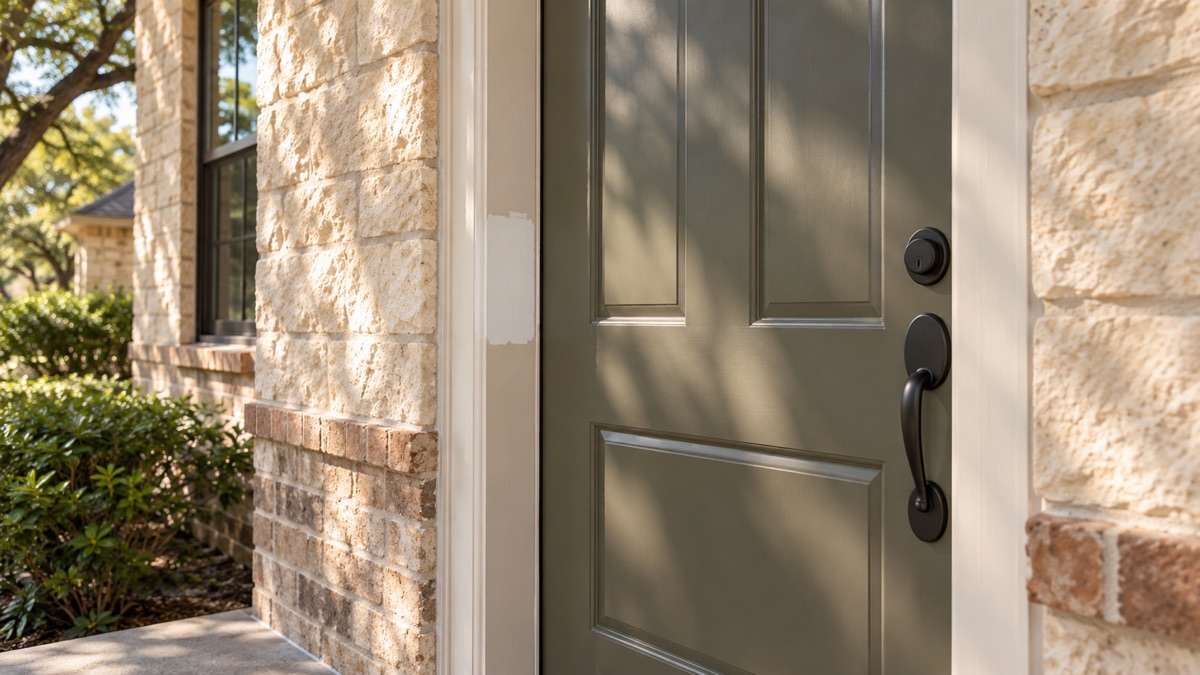
A split, kicked-in, rotted or out-of-square door frame can usually be repaired when the damage stays local to the jamb and the wall behind it is sound. It needs replacing when rot or splitting runs into the sill, or when the opening itself has moved. In Austin homes the lock is often innocent: the frame is the part that broke or shifted.
I'm Allex Mamine, a locksmith technician with Pros On Call, and I see this on calls that start as "my lock is broken." To book or get a quote, our door frame repair page and our Austin door repair page are where to go. This guide is how to judge the damage first.
Is It the Door Frame or the Lock? A Two-Minute Check
If the key turns freely with the door open but the bolt will not slide into the strike hole when the door is closed, the lock is fine and the frame or strike is off. Look for a gap that is uneven from top to bottom, a latch bolt that lands above or below the hole, scrape marks on the jamb, cracks near the strike, or a soft spot at the base.
Here is the check I run first. Turn the bolt by hand with the door open. If it moves freely, the lock is not your problem. Then work through four steps.
- With the door open, turn the key or thumb turn until the bolt is fully out, then pull it back in.
- Notice whether it moves freely, with no drag or grinding.
- Close the door slowly with the bolt pulled back, and hold it shut.
- Extend the bolt and watch where it meets the strike hole. If it hits above, below or the edge, the opening has moved.
Summer is a common culprit, because summer heat can swell a frame and bind a deadbolt. That cause has its own guide, so I will not repeat it here. If the bolt drags even with the door open, that is a hardware question, and our guide to lock repair versus replacement covers it.
Door Frame Anatomy: Jamb, Stop, Strike Side, Hinge Side, Header
A door frame is the jamb on each side and the header across the top, with the stop as the thin strip the door closes against. The strike side holds the latch and deadbolt receivers, and the hinge side carries the door's weight. Damage on each side behaves differently, which is why the repair differs.
On the strike side, the trouble is usually force: a kick, a shoulder, or a bolt that has pushed against a swollen opening for years. On the hinge side, the trouble is weight and time. Screws loosen, the door sags, and the latch stops meeting the strike. Low on the jamb, near the sill, the trouble is water.
The diagram below marks where each problem tends to show up, and where a long screw can reach the stud behind the jamb.
Kick-In Damage: How a Door Frame Splits Where the Bolt Sits
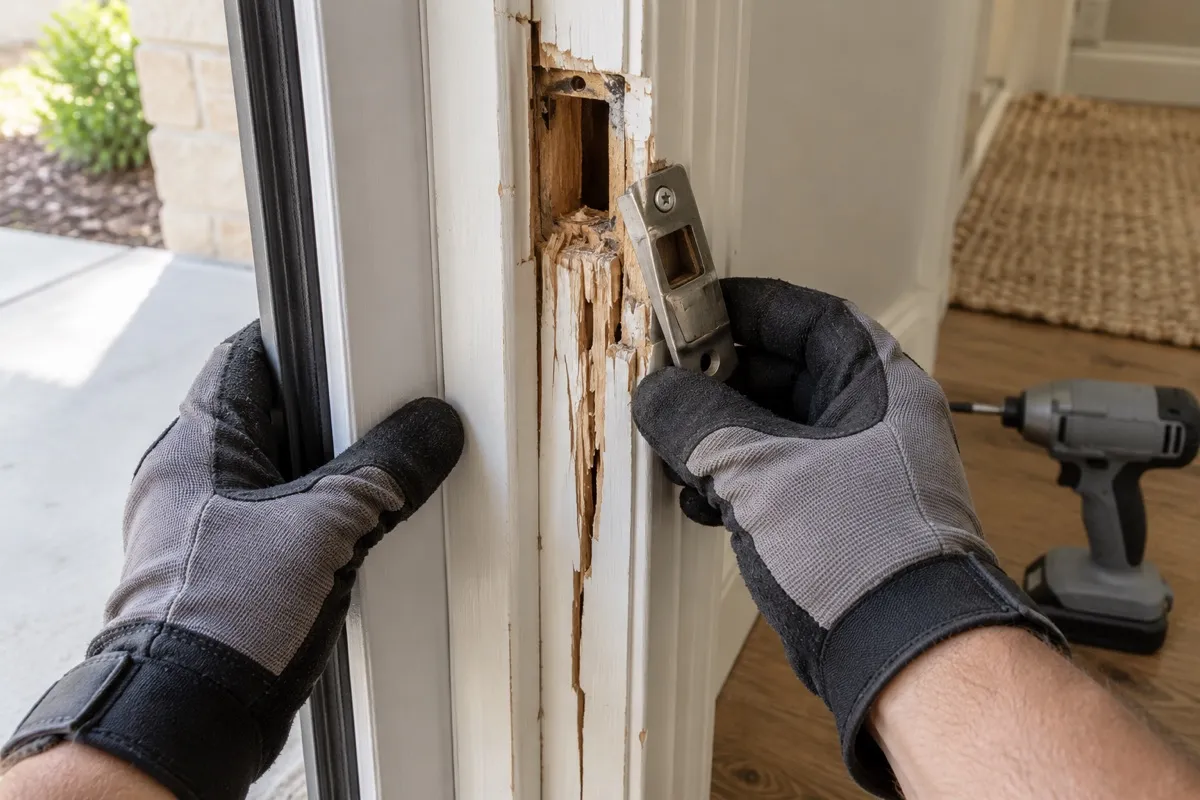
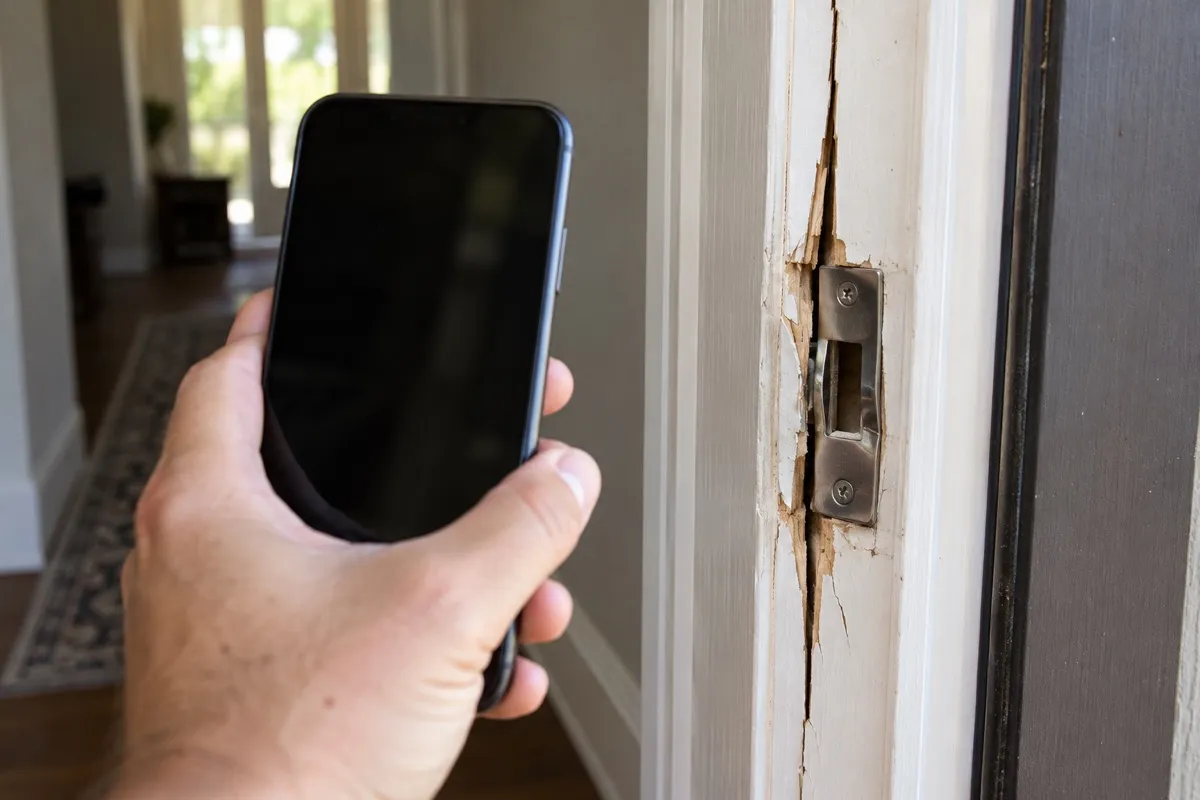
In a forced entry the bolt usually holds while the wood around the strike splits along the grain, so the lock looks intact and the jamb is the casualty. Typical signs include a long crack running from the strike hole, a strike plate bent or torn out, splinters on the inside edge, and a door that no longer closes flush.
That matches what I see on the job. A deadbolt is a steel bolt in a wood opening, and the wood is the weaker material. The frame usually fails before the bolt does, which is why a new lock on a split jamb does not fix the real problem. When a door is kicked in, the lock usually survives and the wood around it does not.
If you are standing in a hallway looking at a split jamb, do not trust the door to latch. Check the strike plate, check the hinge side for new gaps, and look at the wall on both sides of the frame for cracks. A frame can look repaired from the front while the wood behind the trim is still split. Our residential door repair work starts with that look behind the trim.
When a door is kicked in, the lock usually survives and the wood around it does not.
Rot and Termites: Water Is the Real Cause
Rot needs persistent moisture; wood that stays dry does not decay. That is why a rot repair that skips the water source fails. Termite damage is a separate cause, and Texas A&M AgriLife Extension has noted that termite activity is often hidden behind wallboards, siding or wood trim.
The research behind the first point is solid. A USDA Forest Service paper on decay of wood above ground in buildings says its authors found nothing in the literature to contradict the 20 percent moisture content rule, the idea that wood kept at or below 20 percent stays safe from decay. For termites, the AgriLife publication Subterranean Termites (a 2010 AgriLife Extension PDF) lists swarmer wings on window sills, mud tubes on outside walls, and damaged wood inside or around a structure as signs. It does not single out door frames, so I will not either.
The practical test is simple. Press a screwdriver tip into the wood at the base of the jamb; if it sinks in easily, the wood is soft and the cause is moisture. Then look for the water: a sprinkler that sprays the door, a missing drip edge, a threshold that holds a puddle. In our experience, older solid wood jambs often fail at the bottom first. Fix the source, or the new wood will go the same way.
Racked Frames and Central Texas Clay: Why the Door Stopped Closing Square
Much of the Austin area, especially east of I-35, sits on clay that swells when wet and shrinks when dry, and the Texas Department of Licensing and Regulation bulletin on expansive soils says that kind of movement is a very common cause of foundation problems. A frame that has racked out of square is often a symptom of that movement.
That bulletin comes from TDLR as a building regulator. Locksmiths are licensed by DPS, not TDLR. The bulletin explains the mechanism: high moisture makes the soil swell and lift a building, low moisture makes it shrink and settle, and both can cause extensive damage. A house does not move evenly, so a door opening can twist. The latch side rises or falls, the gap at the top becomes uneven, and the door starts to rub or miss the strike.
Racking is different from kick-in damage and from rot. The wood may be perfectly sound. The opening is the thing that moved. Repairing a racked frame does not stop soil movement, so if the foundation is still moving the repair can be temporary. Look at the cracks in the wall above and beside the door first. If they are growing, talk to a foundation professional before you spend money on the door.
A door assembly is only as strong as its weakest part, and the hinge side is where that shows up first on a door that has started to sag. The top hinge carries most of a door's static weight, so hinge screws pulling out of the jamb are a leading cause of sag. A sagging door rubs, the latch lands low, and the lock gets blamed. Before you pay for a new lockset, check whether the hinge screws are tight and the jamb behind them still holds a thread. Tightening frame screws and lubricating the hinges are routine upkeep steps in the National Park Service guide to maintaining building exteriors. If the screws spin freely in the wood, the jamb has lost its grip and needs repair.
Strike Plate and Jamb Reinforcement: What Spreads the Force
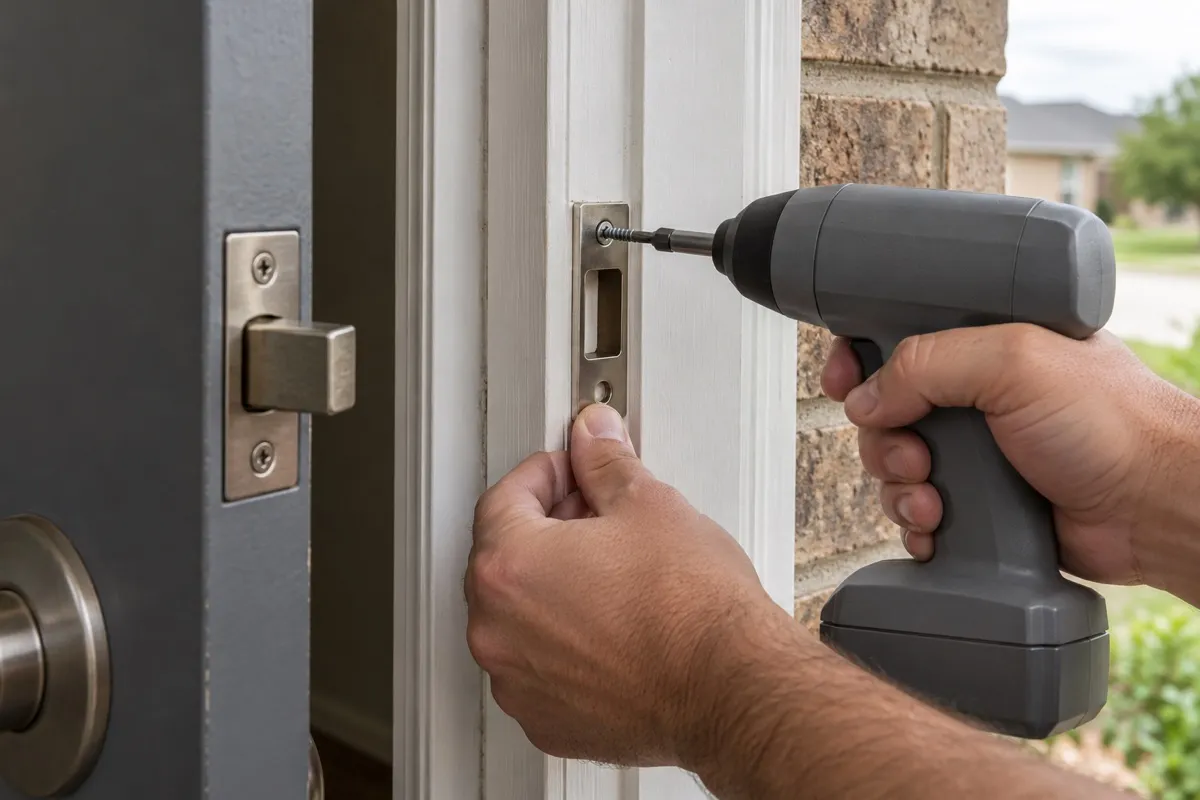
A strong deadbolt only helps if the strike plate and jamb behind it hold. Reinforcement spreads the force: a metal plate or wrap across the strike zone, and long screws that reach the wall stud instead of only the thin jamb. A good deadbolt is only as strong as the frame and strike behind it.
Think of a kick as a chain. Force goes from the door to the bolt, to the strike plate, to the screws, and into whatever the screws are holding. Short screws hold only the thin jamb. Long screws that reach the stud tie the strike into the wall framing. That is the whole idea.
I will not promise that any plate, wrap or kit stops a forced entry, because nobody can honestly promise that. What I can say is that reinforcement is part of a proper repair, not an afterthought. When a deadbolt goes in, as with our deadbolt installation work, the strike behind it should be treated as the same job.
Repair or Replace the Frame? A Decision Path
Repair when the damage is local: a split along the strike, a torn-out plate, a small soft patch above the sill, or a hinge side that needs reseating. Replace when rot reaches the sill or runs deep, the frame is split in several places, or the opening itself is out of square. That is our rule of thumb, not a code rule, and the water source gets fixed first.
Here is how that sorts in practice. A split along the strike is usually a repair. A torn-out strike plate is usually a repair. A soft patch low on the jamb is a repair if it stays above the sill. Rot into the sill usually means replacement. A racked, out-of-square frame usually points to replacement. Multiple splits usually point to replacement.
Replacement is a bigger job, covered on our door and frame replacement page. Steel and security doors are a different job, handled under security doors and in our security door repair guide. This post stays with wood and standard residential frames.
| Damage type | Usually | Why |
|---|---|---|
| Split along the strike | Repair | The damage is local to the jamb |
| Torn-out strike plate | Repair | The plate seat can be rebuilt and reinforced |
| Soft patch low on the jamb | Repair | Only if it stays above the sill |
| Rot into the sill | Replace | The damage runs deep and the water source has to be fixed first |
| Racked, out of square | Replace | The opening itself has moved |
| Multiple splits | Replace | The frame is split in several places |
What a Frame Repair Visit Involves, Step by Step
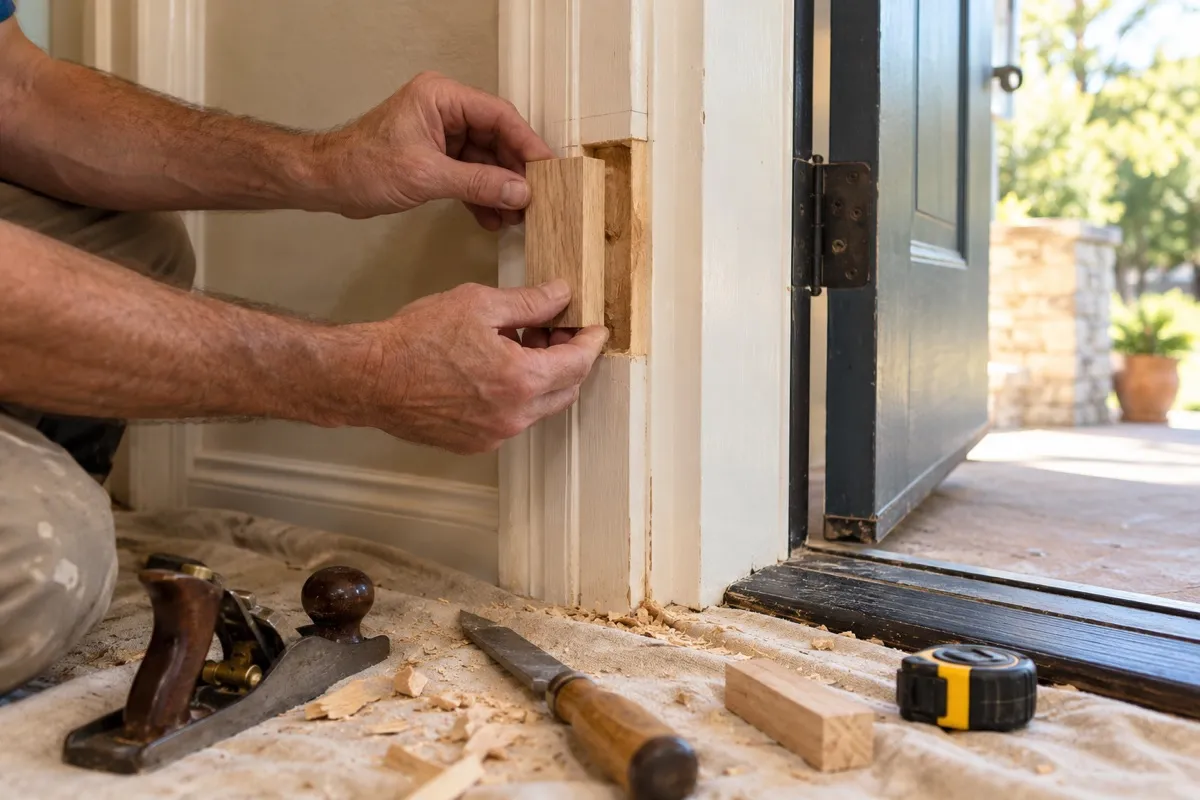
A typical visit starts by checking plumb, level and swing and finding the binding points. Next comes cutting out the damaged section and splicing in matching wood, or consolidating it. Then we reinforce the strike zone, fit hinges and weatherstripping, test the latch and deadbolt, and walk the result with you. That is how our technicians typically approach it.
Diagnosis comes first because the symptom is rarely the cause. A door that rubs at the top may have a loose hinge, a swollen jamb or a racked opening, and each one needs a different fix. Finding the binding points tells us which.
The repair itself depends on the wood. Sound wood with a split can be consolidated. Damaged wood gets cut out and replaced with a matching splice. Then the strike zone is reinforced, so the repair does not end with the old strike plate screwed back into new wood. Hinges and weatherstripping go back on last, and the latch and deadbolt are tested before anyone calls it finished.
Ask the technician what is covered and for how long. I would rather you ask than assume.
WHAT A FRAME REPAIR VISIT INVOLVES
Diagnose
Check plumb, level and swing and find the binding points.
Repair
Cut out the damaged section and splice in matching wood, or consolidate it.
Reinforce
Reinforce the strike zone, and fit hinges and weatherstripping.
Test and walk through
Test the latch and deadbolt, and walk the result with you.
What Door Frame Repair Costs in Austin
The typical range on our pricing page for door frame repair is $150 to $400, and we quote before work starts, so the final number is confirmed on site. Replacement usually costs more than a repair because it adds carpentry and finish work.
Four things move the number: how deep the rot goes, how many sides of the frame are involved, how closely the finish has to match, and whether the door needs rehanging. For a feel of how other jobs price out, see what locksmith work typically costs.
A quote should come before the first cut, and it should say what is and is not included. If someone cannot give you a range before they see the frame, ask why.
A quote should come before the first cut, and it should say what is and is not included.
Austin Permits, Historic Houses and the Exit Rule
Austin's exempt-work list includes replacing a door with one of the same size and operation. It says nothing about frames, so confirm with the city before a structural change or a resized opening. Landmarks and properties in a historic district are reviewed for exterior changes, while the city's historic review page describes routine in-kind repair as not needing review.
I am a locksmith, not a permit clerk, so I will not tell you a frame job needs no permit. Exempt work still has to follow the building and city codes. Call 3-1-1 before you change the opening. City staff say they can advise you on a project at any stage.
One more point about the opening. The residential code requires at least one exit door that opens from the inside without a key or special knowledge, so a replacement or rebuilt frame has to keep the opening usable as that exit. Do not narrow it. Austin enforces the residential code with local amendments, so a quick call settles anything you are unsure about.
Call 3-1-1 before you change the opening.
After a Break-In: Secure the Door, Document the Damage
Photograph the damage before anything is moved, secure the opening so the home is not left open, and call your insurer to learn what your policy covers. A temporary board-up and a temporary deadbolt are options when a frame cannot be fully fixed at once.
We handle burglary damage repair for split jambs, broken strike plates, splintered frames, bent deadbolts and damaged hinges, and we can document the damage with photographs. Check your policy for what it covers. I cannot tell you that.
If keys were taken or you do not know who has one, rekey as part of the repair. Our rekeying work changes who can use the locks you already own.
For an opening that will not close, start with our emergency locksmith help page, or call (888) 601-6005. Timing matters this time of year too. Fix a damaged frame before the house fills with guests or sits empty over the holidays.
Gaps, Drafts and Weatherstripping Around the Frame
Visible daylight or a loose-fitting exterior door is a common indicator of air leakage, and a U.S. Department of Energy job aid says to adjust loose hinges, knobs and strike plates before adding weatherstripping. So a frame fix and a seal go together.
When the first cold fronts arrive, drafts around a door are easy to feel. If you can see light at the edge of a closed door, check the hinges and strike first. Then look at door weather sealing. I will not quote energy savings, because I cannot back a number for your house.
Choosing a Licensed Team for Door Frame Work
Texas locksmiths are licensed by the DPS Private Security Bureau under Occupations Code Chapter 1702, not by TDLR. Search a company on the TOPS portal and check the status and class. Pros On Call holds Texas DPS Class B license B19847.
The search takes a minute. Open the portal, choose Search Licensees, enter the license number or company name, and read the status and class. Run your own lookup. Ask for a written quote and what the quote includes.
If you are in Austin and the damage looks local, our door frame repair page and Austin door repair page are where to book or ask for a quote, and Austin door and lock service lists everything else we do in the city. Or call (888) 601-6005.
Door Frame Repair Questions Austin Homeowners Ask
Can a split door frame be repaired, or does it have to be replaced?
A split door frame can usually be repaired when the damage is local to the jamb, such as a split along the strike or a torn-out strike plate. In our experience, rot that reaches the sill, several splits, or an opening that is out of square point to replacement. A technician can tell you which on the visit.
How much does door frame repair cost in Austin?
The typical range on our pricing page for door frame repair is $150 to $400. We quote before work starts and confirm the final cost on site. Replacement typically costs more than a repair, and what moves the price is how deep the rot goes, how many sides are involved, and how closely the finish has to match.
Why does my door stop closing right even though the lock works?
The frame or the strike has usually moved, not the lock. Kick-in damage, rot, or wet and dry clay movement that racks the opening can all cause it. Run the open-door test: if the bolt moves freely with the door open but will not enter the strike hole when closed, the problem is the opening.
Do I need a permit to repair or replace a door frame in Austin?
Austin's exempt-work list covers replacing a door with one of the same size and operation, but it does not mention frames. Call 3-1-1 before you change the opening or work on a landmark or historic-district property. The city describes routine in-kind repair as not needing historic review.
Will insurance pay for door frame damage after a break-in?
It depends on your policy, so check it and call your insurer. We cannot tell you what your policy covers. What we can do is document the damage with photographs, so you have a record of the split jamb, the strike plate and anything else that was broken before the repair starts.